Forget speed bumps and cycle lanes: Why Britain’s roads should be more like ice rinks

Over the festive period, many of you would have ventured to Somerset House or Winter Wonderland to ice-skate. Taking to the rink, you would have seen children skating for the first time while clasping their parent’s hand, as other adults whizzed round at high speed. Each individual, including you, moved at their own speed, judging their own abilities, making their own decisions about when to join or leave, anticipating the movement of others and exercising their independent judgement.
Yes, some accidents and contact collisions probably occurred. But, by and large, this unplanned spontaneous order of activity worked. Once a few social conventions had developed – such as that everyone moved in the same direction, left space for the rink’s entry and exit, and gave a wide berth to children – you had a good time and skated happily.
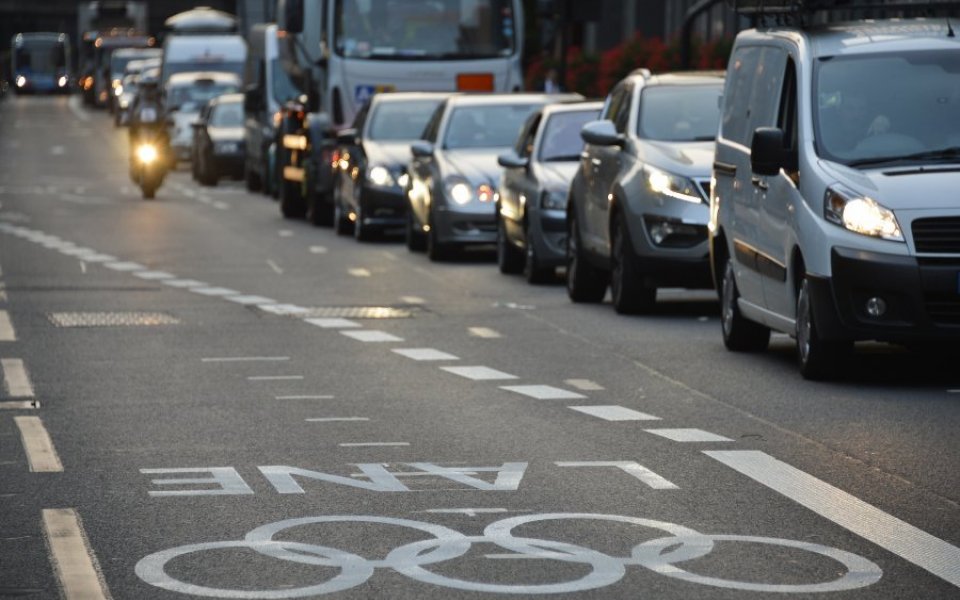
Such voluntary cooperation is the complete opposite of how our road traffic is managed. Instead, officials seek to “plan” the movement of traffic through a “command and control” approach of extensive traffic lights, speed bumps, signs, signals, bus and cycle lanes, speed cameras and speed limits. A new report by my colleague Richard Wellings and his co-author Martin Cassini shows there has been a 40 per cent rise in traffic light use in the past two decades, an increase much greater than the growth of traffic or drivable road space, which has somewhat flat-lined. Over roughly the same period, speed bump prevalence (proxied by the number of signs) is up 2,004 per cent, speed limits 96 per cent, and cycle routes 1,175 per cent.
For many Londoners, I suspect this will not come as much of a surprise. We can see some of the results. There have been two occasions recently where I’ve sat in gridlocked traffic around the Oval to Vauxhall area, where seemingly half the road has been assigned to cyclists, only to see the odd one or two riding a bike during those busy periods. Centrally planned traffic management systems are inflexible and eliminate the scope for discretion and common sense. Often, traffic lights and other road safety measures do not work as intended. Other times, they impose costs which vastly exceed the notional benefits.
TfL’s own modelling of the flagship East-West Cycle-Superhighway, for example, shows it will increase peak journey times for vehicles between the Limehouse Link tunnel in Docklands and Hyde Park Corner by around 20 minutes – a huge economic cost for a marginal shaving off the cycle time.
Here’s the crux: our whole approach to “managing” traffic often ignores sound economics. Many schemes are undertaken without sufficient analysis of costs and benefits. With traffic lights, for example, not enough focus is given to the environmental impact of drivers having to stop and start, the role of traffic lights themselves in causing accidents, the economic impact of slower journey times, and the costs to life of delays to accident and emergency vehicles. This is not to mention how, over time, a culture of dependence on management for safety erodes personal responsibility and courtesy to others on the road.
How can we escape from the culture of managerialism in this area? First, we can acknowledge that road safety was improving prior to this proliferation of regulation. Second, we can examine how both internationally and in the UK many schemes with far less use of traffic management techniques have been successful. So-called shared space schemes in Ashford, Portishead and Poynton, which have stripped out traffic management devices, seem to have resulted in lower accident rates and smoother traffic flow. Over the longer term, the whole need for traffic management might be usurped by driverless cars.
But in the shorter term and in London, perhaps we could just issue a plea: would it really be too much to ask for TfL and others to base decisions on sound economic thinking and to not always assume more management is the answer? After all, if we don’t need traffic lights, signs and bumps on the ice rink, why do we always assume we need them on the roads?