Global turmoil? Four things the Bank of England could still do if we were plunged back into a financial crisis

UK stocks have hit a three-year low, the economy has lost steam, and concerns are growing that, should things go pear-shaped, interest rates are so low the Bank of England has run out of ammunition.
Whatever your view on whether we're about to be plunged back into the misery of a full blown financial crisis, here's what the Bank can still do about it…
Read more: Bank shares fall – the dead cat bounce is over
1. Cut interest rates further
The Bank of England chose not to go below 0.5 per cent during the financial crisis and ensuing recession.
But cutting rates is now an option. In a recent letter to chancellor George Osborne, governor Mark Carney said rates could be cut further, should downside risks materialise. Negative rates are now possible because lenders are better capitalised, the Bank said last year. But the history of negative interest rates is not promising.
“Our European colleagues have found mixed evidence of the negative rate impact on lending conditions. Their findings suggest that banks may try to offset the negative deposit rate impact on their profitability by raising loan borrowing costs,” said Mark Cabana, an economist at Bank of America Merrill Lynch.
“Negative rates also hurt bank profitability given an increased pressure on net interest margins.”
Negative rates are not a guaranteed lending boost. The typical relationship between the Bank of England’s base rate and other interest rates in the economy may break down.
The countries with negative rates right now
| Japan |
-0.1 per cent on new bank reserves |
|
Eurozone |
-0.3 per cent on bank reserves |
|
Sweden |
lends cash to banks at -0.35 per cent |
|
Denmark |
-0.65 per cent on bank reserves |
| Switzerland |
-0.75 per cent on bank reserves |
2. Quantitative easing
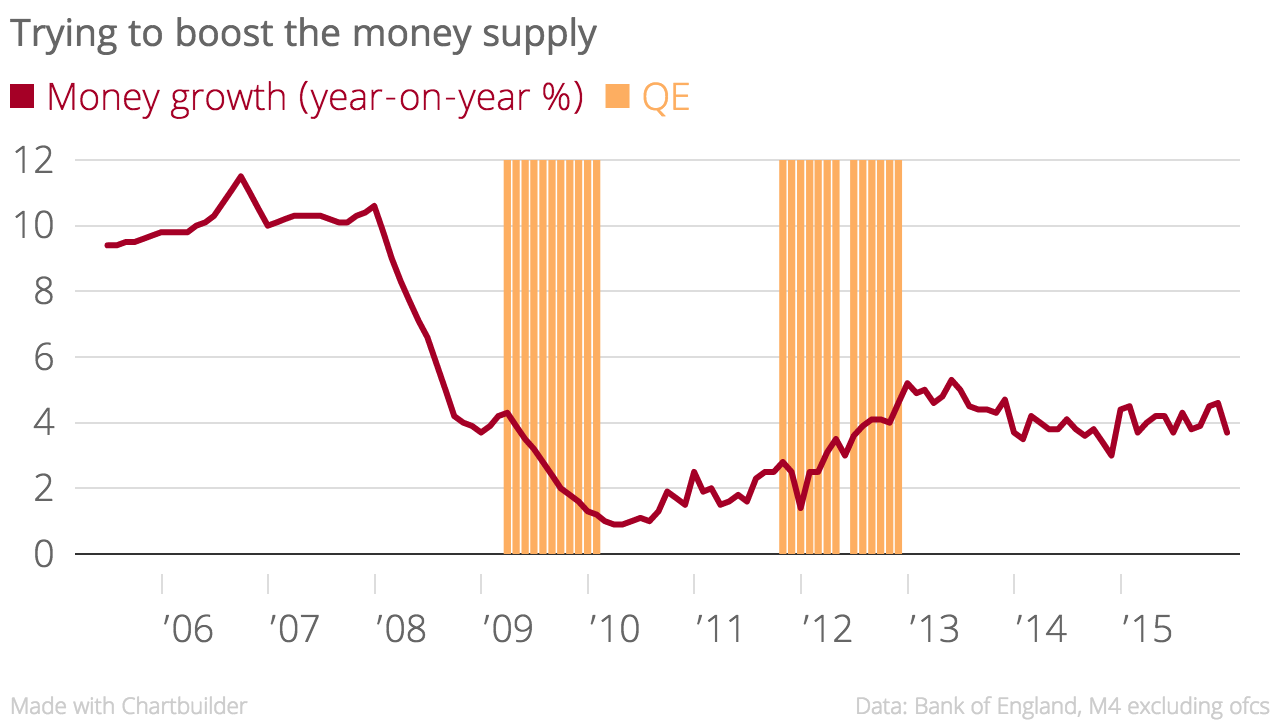
When the Bank does quantitative easing, it creates new cash out of thin air and uses it to buy assets, mostly government debt, from the financial sector. It initially did so with the goal of raising the growth rate of money in the economy – a different approach to the US Federal Reserve and the Bank of Japan.
In normal times, banks create electronic money when a customer takes out a loan. In recession the opposite happens, and money starts disappearing. Bank of England economists Michael McLeay, Amar Radia and Ryland Thomas spell out the basic mechanism behind QE in their paper “Money creation in a modern economy”:
QE is intended to boost the amount of money in the economy directly by purchasing assets, mainly from non-bank financial companies. QE initially increases the amount of bank deposits those companies hold (in place of the assets they sell). Those companies will then wish to rebalance their portfolios of assets by buying higher-yielding assets, raising the price of those assets and stimulating spending in the economy.
This chart gives an indication of how QE worked. It shows the notes and coins in circulation as well as electronic money people and businesses keep at banks:
3. Manage expectations
As former governor Mervyn King said in a 2005 speech at Cass Business School: “Expectations are of fundamental importance to monetary policy.”
Changing expectations of future policy allows the Bank of England to impact financial markets and the economy without actually having to change interest rates. Mark Carney did this when he succeeded King. He said the Bank would not consider an interest rate hike until unemployment fell below seven per cent – a policy called forward guidance.
The Bank also manages expectations using its speeches and inflation reports.
One quirky idea has been to adopt a higher inflation target, lifting it from two to around four per cent. This would be an indirect way of saying rates are staying lower for longer.
4. Lender of last resort
The Bank of England first acted as lender-of-last-resort during the Overend and Gurney panic of 1866. The basic rules for being lender-of-last-resort were laid out by Walter Bagehot, a 19th century economist.
"Very large loans at very high rates are the best remedy for the worst malady of the money market when a foreign drain is added to a domestic drain,” he said.
To mitigate the bad banks' mistake on the economy as a whole, he said the Bank of England should lend “most freely… to merchants, to minor bankers, to this and that man, whenever the security is good."
Mervyn King acted as LOLR to Northern Rock in 2007. However, the move was leaked by the press, leading to a bank run. When it had to do it again in 2008, it used code names for individual banks to protect against press leaks.