A carbon tax will allow capitalism to save the climate

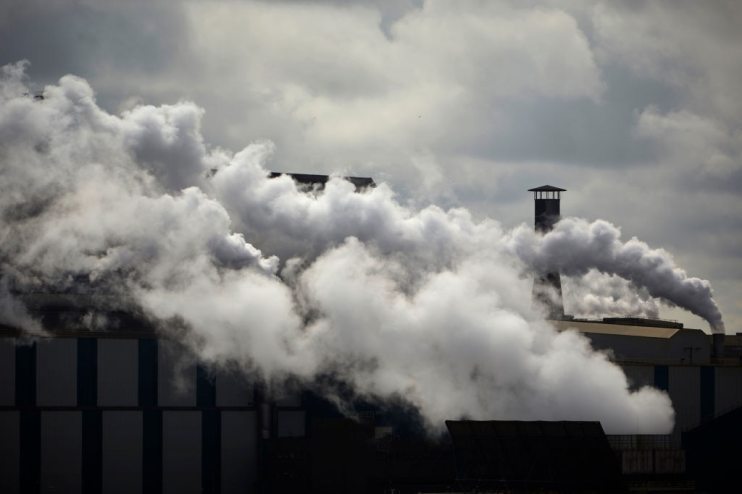
The Extinction Rebels are back at their barricades. This week, they smashed windows at JP Morgan’s offices and blockaded London Bridge. Speaking to LBC in the aftermath, Sadiq Khan worried they are alienating the public from their cause. They are certainly an uncompromising lot. Arla, the milk-maker, was a target of their ire. Even the World Wildlife Foundation was deemed a worthy victim.
The rebels’ concerns about our climate are certainly just. As the recent IPCC report illustrated, we are responding too slowly to climate change.
But Extinction Rebellion’s solutions are too simplistic. They demand immediate divestment from fossil fuels, whatever the cost of doing so. And they have a habit of making their case to the point of absurdity. The Arla invaders were a case in point: the masses, they commanded, must drink oat milk. It was latte-sipping moralism of the highest order.
Within Extinction Rebellion, there is an underlying assumption that is never far from the surface. “Systems change, not climate change,” their signs read. For crisis to be averted, capitalism must collapse.
It is certainly true that capitalism has been a handmaiden to our crisis. The free market fails to price pollution. It costs more to be clean, so the incentives are aligned against doing what is right.
One might reasonably argue that capitalism is worth saving. It has been the great engine of our progress, lifting countless numbers out of poverty for centuries.
But there are more prosaic reasons to stick with the system we have: we will not overcome this crisis without it. The ingenuity required to wean our economy off its fossil fuel addiction will require countless acts of creativity and invention. State-sponsored investment will play a part, of course, but companies must get creative too.
The question is how to point them at the problem. For a long time, economists have had an answer up their sleeves: a carbon tax.
The idea is simple, if deceptively so. A carbon tax puts a price on carbon, either as a flat tax or as a limited number of tradeable, pollution permits. In doing so, companies are incentivised to reduce carbon from their operations, and so their cost of production, as quickly as possible. The more they do so, the more they profit. With a helpful nudge, the invisible hand then takes its course.
Predictably, problems occur when the economists descend from their ivory towers.
One is that taxes are unpopular, and carbon taxes especially so, as they disproportionately affect those on low-incomes. As a result, while carbon taxes nominally cover 21.5 per cent of global emissions today, the rates are so low they serve little real purpose. Just 1 per cent of emissions are priced at more than $40 per tonne, the bottom-end of the World Bank’s recommended rate.
A second problem is that for a carbon tax to be effective anywhere, it must be enacted everywhere. Without a global price on carbon, companies in countries that have one will be out-competed by those that don’t. Introducing a unilateral carbon tax is, unfortunately, an act of national self-harm: importing emissions, while destroying businesses at home.
Both problems are, however, surmountable. A 2017 study by economists at Colorado State and Duke University shows that carbon taxed at $49 per tonne would leave 59 per cent of Americans worse off, including three quarters of the poorest half of the nation. If the tax revenues raised from a carbon tax were simply passed back to the populace however, in the form of a carbon dividend, the tables would be turned entirely: 9 in 10 of the country’s poorest would receive a net gain of $788. With that kind of money, they may turn to oat-milk of their own accord.
The international politics could prove more taxing than the national politics. But in a leaked paper, the European Union has suggested a neat solution, which proposes that companies importing into the area pay a top-up carbon tax on the difference between the EU’s carbon price and that of their own nation’s. By phasing the approach in gradually, giving companies time to adapt, and targeting only high-polluters, it could yet win backing.
All eyes should be on COP come November, when steps forward could be made. No doubt the protestors will be swarming, but have no doubt: the real action will be inside the room. This is a rare opportunity to put the might of the market to work at the greatest challenge of our age. Ignore the signs and slogans. Capitalism must not fall, because without it we will.