A green price to pay: Why offshore wind’s rising costs pose a challenge for renewables

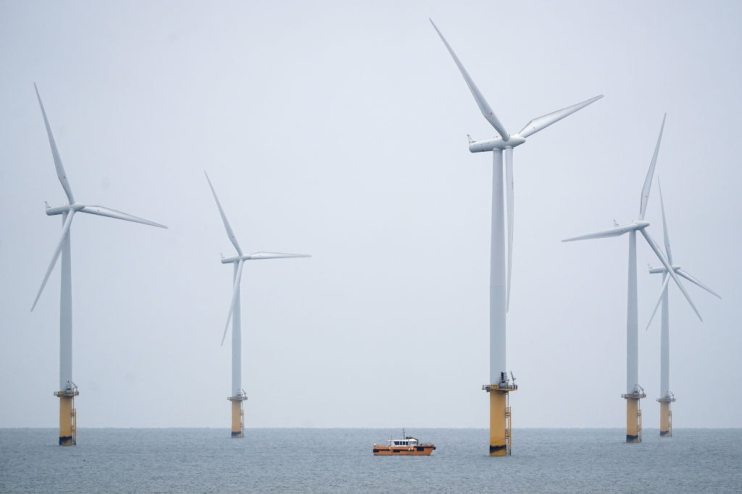
Soaring inflation, stagnant economic growth and intense pressure on mineral supply chains means the renewable industry expects the cost of wind power to rise for the first time in nearly a decade this year.
While media attention is focused on windfall taxes and slashed investment plans across fossil fuel operators, it is worth noting that the UK’s supposed long-term solution, offshore wind generation, is now facing real cost challenges for building new turbines.
Currently, energy firms are bidding against each other for potential projects in the North Sea, as part of the latest auction round for new developments overseen by the government.
This is where companies bid to offer the lowest fixed-rates – known as ‘strike prices’- to provide electricity, which is supported via the contracts for difference (CfD) scheme.
The CfD scheme is the government’s chief mechanism for delivering renewable energy at a low-cost to consumers.
Set up in 2015 and now undergoing its fifth allocation round, it means that when wholesale electricity prices are higher than the price agreed in the CfD scheme – generators pay back the difference.
So far, the government has awarded 27GW of low carbon energy through CfDs– enough to power 12m homes across the country.
It has also seen the strike price for renewable generation decline from £155 per megawatt in 2015 to £37 per MWh last year.
However lower prices, naturally, threaten the margins of generators – with inflationary pressures eating into company profits.
This has raised the growing possibility that the strike price could rise for the first time since the scheme was initiated eight years ago.
Experts disagree over funding support
Ana Musat, executive director of policy and engagement at Renewable UK, criticised the government’s £205m funding pledge for the latest CfD round– deeming it too low to ease pressure on energy firms.
She argued that if the cost of renewable energy generation kept rising, without government support this would make projects more expensive – jeopardising the UK’s push to reach its net zero and energy security goals.
There was also the prospect of fewer bids, with underwhelming auction rounds in Europe – including no winning bids in Spain’s allocation window last November.
With the government aiming to ramp up offshore wind from 14GW to 50GW by the end of the decade, it could not risk the prospect of projects being paused or put on hold.
Commenting on government support, Musat said: “I think there needs to be some recognition that we’re not in the era of easy money we used to be. That needs to be accounted for somehow. Again, we’re not talking about a huge uplift here. It’s just taking into account that obviously, it’s more expensive to build.”
The government has opened a consultation on offshore wind auctions – proposing that wider societal benefits of wind projects are factored in alongside strike prices for winning bids.
This would mean the role of wind turbines in boosting supply security and fostering green jobs in a domestic industry would be taken into account alongside delivery.
The idea was particularly topical in the context of vast subsidy pledges in the US Inflation Reduction Act and proposed EU policies – and was broadly supported by Renewable UK.
However, Andy Mayer, energy analyst at free market think tank, the Institute of Economic Affairs – argued the “best path for affordable decarbonisation is ruthless price competition.”
This would mean renewable costs rise in the short term, but would also allow fair competition with other industries like nuclear, hydrogen, batteries, and carbon mitigation technologies.
“The government needs to maintain steely indifference to special pleading from vested interests with fantasy British growth plans. The climate doesn’t care where or how carbon is saved, or who owns the company, nor should they. The only sustainable green growth comes from real businesses inventing things others want to buy, not subsidies,” Mayer said.
Wind power challenges go beyond inflation
Leading renewables player Octopus Energy remains bullish about the sector’s potential, attributing inflation to supply chain costs, which it considered to be a blip in the context of a long-term decline in prices.
Zoisa North-Bond, chief executive of Octopus Energy Generation, said: “Renewable energy prices have completely plummeted over the last decade – and consistently far below what was ever expected. It’s clear prices will only continue to come down even more in the long run as the technologies scale further. This will ultimately accelerate the drive to a low cost and more secure energy system for Britain, and lowering energy bills as a result.”
However, Kathryn Porter, energy consultant at Watt Logic was more sceptical.
She noted that turbine manufacturers are suffering large losses – having to swallow these cost increases.
Last week, the chief executives of Orsted and Siemens Gamesa have cautioned that the status quo is unsustainable, acknowledging that they cannot continue to support loss-making projects.
Porter argued this will “inevitably drive up prices in the CfD.”
She also warned that wind power suffered from a long-term challenge of high capital requirements but near-zero operating costs, meaning wind farms risked not recovering their capex costs due to intermittent generation.
The energy expert called for a more relative CfD where wind farms where support for wind farms was based on need rather than purely on generation potential.
Porter said: “Broadening the CfD would allow flexibility to be rewarded – ie generators would vary output based on need (where possible given weather conditions) instead of receiving curtailment fees. With the massive increases in balancing costs resulting from the increase in intermittent renewable generation, this could be a way of managing that variability more efficiently.”
The industry’s struggles with the challenges of rising costs reflect the reality that the push to net zero over the next three decades will not come without challenges.
The prospect of higher prices is a legitimate one, and whether it is an incidental blip or painful trend – it reminds us that continued ingenuity is essential for meeting our net zero goals.