A seismic election won’t deliver the change Germany needs

Friedrich Merz has emerged victorious in a general election which saw dramatic changes in German politics – but given that his party is responsible for many of the country’s problems, a radical about turn looks unlikely, says Rainer Zitelmann
Friedrich Merz’s center-right Christian Democratic Union (CDU/CSU) emerged victorious in Germany’s general election, securing 28.6 per cent of the vote. However, this is a weak result given the failings of the previous Green and Social Democrat-led government (in a three-way coalition with the free-market FDP, which failed to exert any influence). This marks the second worst election result in the history of the Christian Democrats, with only an eight percentage-point lead over the right-wing Alternative for Germany (AfD), which gained 20.8 per cent of the vote.
Friedrich Merz had promised to cut the AfD’s share of the vote in half. Instead, the party’s support doubled compared to 2021, increasing from 10.4 per cent to 20.8 per cent, while Merz’s party gained just 4.4 percentage points. Merz has paid the price for failing to distance himself sooner and more decisively from the legacy of Angela Merkel, Germany’s Chancellor from 2005 to 2021. In policy terms, Merz has gradually reshaped the Christian Democrats’ stance on a range of issues, particularly migration.
But every time the CDU/CSU criticised Germany’s migration policy, the AfD was able to reply: “But it was the CDU/CSU who started all this under Merkel in 2015”. The most interesting statistic from election night revealed that, when asked who was responsible for so many immigrants and asylum seekers coming to Germany, 54 per cent of voters blamed the CDU/CSU.
A similar picture emerged on other issues. Merz criticized the closure of nuclear power plants, and the AfD countered: “It was the CDU who decided to phase out nuclear power under Merkel’s leadership”. Similarly, when Merz voiced concerns about the ban on cars with combustion engines, the AfD simply responded: “But wasn’t it the CDU’s Ursula von der Leyen who spearheaded the ban on combustion engines in the EU?”
A new political beginning
In order to effectively signal a new political beginning, Merz should have distanced himself from Merkel’s policies much earlier and more resolutely, and proactively dealt with his party’s past. But Merz was afraid to do so because he knows that his party is divided between moderate conservatives like himself and party members, who are still aligned with the policies of the former chancellor Angela Merkel. Publicly renouncing Merkel’s legacy, while absolutely necessary, would have provoked division within his party. Merz only realised a few weeks before the election that he needed to acknowledge the CDU/CSU’s responsibility for many of the problems facing Germany (migration, energy policy and so on). But by then it was already too late.
Merz also struggled to convincingly explain how he planned to implement the radical changes in migration and economic policy he was promising. After all, he had ruled out a coalition with the AfD and committed himself to the Social Democratic Party (SPD) or the Greens as coalition partners, the very parties responsible for the disastrous migration and economic policies of the past three years.
In all likelihood, Merz will form a coalition with the SPD. The radical political about-turn that Germany so urgently needs after the Merkel era will not happen. What Germany really needs is a Chancellor who drastically cuts taxes, radically deregulates, puts a stop to the green energy transition, implements a migration policy similar to Denmark, the Netherlands, or Poland, and doubles defence spending. All of this is difficult to imagine in partnership with the Social Democrats. However, if the radical turnaround fails to materialise, there is a risk that more and more voters will switch to the AfD.
What Germany really needs is a Chancellor who drastically cuts taxes, radically deregulates, puts a stop to the green energy transition, implements a migration policy similar to Denmark, the Netherlands, or Poland, and doubles defence spending
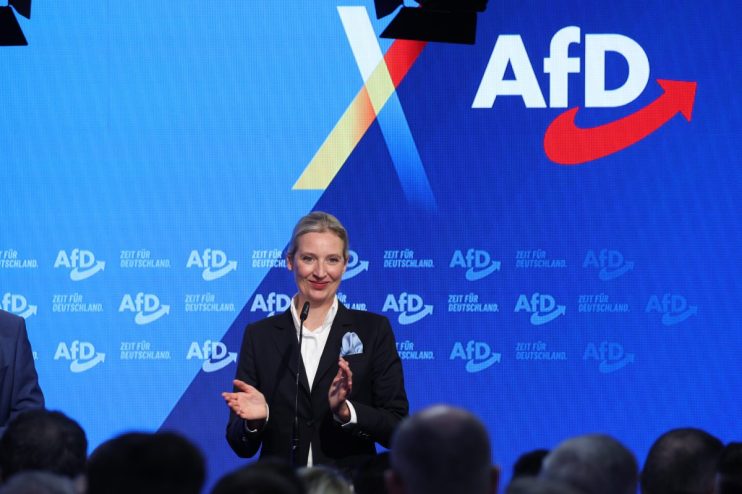
Should Merz look to form a coalition with the AfD? Firstly, he has promised thousands of times he will not do so. Secondly, it would tear his party apart. Thirdly, the AfD itself is doing a lot to prevent this from happening. Unlike right-wing parties in Italy and France, for example, which have become more moderate, the AfD has become so radicalised that even its former right-wing sister parties in other European countries no longer want to work with it in the European Parliament. Just recently, party chairwoman Alice Weidel said that she could imagine Björn Höcke, the far-right politician from Thuringia known for his national socialist views, as a government minister. This is a stark contrast to Weidel’s previous stance of advocating Höcke’s expulsion from the party. Today she praises him and apologises for her past “mistake”. Yet, in many respects, there remain huge ideological differences between Weidel’s free-market positions and the views held by Höcke and large parts of the party. The biggest problem with the AfD, however, is its close alignment with the Kremlin: co-chairman Tino Chrupalla’s speeches in the Bundestag sound as if they were written in the Kremlin.
The Social Democrats experienced their worst election result in 150 years, winning only 16.4 per cent of the vote. Past leaders, such as Willy Brandt, Helmut Schmidt, and Gerhard Schröder, achieved results well above 40 per cent, with Brandt gaining almost 46 per cent. That was a long time ago.
The far-left Die Linke (the former communist party SED, which ruled East Germany and has changed its name several times since the fall of the Berlin Wall), experienced a late and remarkable surge in support. Despite polling a mere three per cent in recent months, Die Linke managed to secure 8.8 per cent, and even came first in the capital Berlin on 19.9 per cent of the vote. With far-left slogans about class warfare, demands for open borders, and calls for a Germany without billionaires, Die Linke struck a chord with voters. Their message resonated with young voters aged 18-24, where they emerged as the leading party on 25 per cent, closely followed by the AfD on 21 per cent.
Left-wing parties in retreat
In the last general elections in 2021, the Greens and the free-market Free Democratic Party (FDP) were the top picks among young voters. Back then, 21 per cent of young voters supported the FDP, this time it was just five per cent, a loss of 16 percentage points. Nationally, the FDP won 4.3 per cent of the vote, falling short of the five per cent threshold to enter parliament, which means they are excluded from the next Bundestag. Voters who supported the FDP in 2021 would have liked a more right-wing FDP: the FDP lost 2.1m voters to the CDU/CSU and AfD. Voters punished the FDP for its role in a coalition that oversaw the ban on combustion engines, the nuclear power phase-out, and the introduction of a new ‘self-determination law’, which allows every German to change their gender once a year. Either the FDP reinvents itself as an unambiguously libertarian party that aligns itself with politicians like Javier Milei, or it will become irrelevant.
Despite so much bad news on election evening, one positive outcome was the narrow defeat of Sahra Wagenknecht’s BSW alliance, which won only 4.9 per cent of the vote. Sahra Wagenknecht, for many years an admirer of the socialist Hugo Chavez, a radical anti-American, and a Putin-apologist, had won big in European and state elections in Germany’s eastern states. This time, however, BSW lost because of their leader, a thoroughbred troublemaker who provokes controversy wherever she goes.
Dr Rainer Zitelmann is a German historian, sociologist and author. His latest book is “The Origins of Poverty and Wealth”