Ai Weiwei: Making Sense at the Design Museum is a triumph

There is a saying among locals in the Chinese city of Xi’an that the worst thing that could happen during a trip there would be to miss the world famous Terracotta Army. The second worst thing would be to see the Terracotta Army.
You see, despite this lifesize army of clay soldiers being a genuine marvel – it’s sometimes called the eighth wonder of the world – there’s something stultifying about the whole experience, from the aircraft hanger they are housed within to the gauntlet of gift shops you must pass through to reach them. It takes something magical and, through systematising and commodifying it, reduces it to the mundane.
Chinese dissident artist Ai Weiwei – infamously placed under house arrest for his outspoken stance on the Chinese state – does the opposite in his work, taking objects that seem mundane individually and creating something magical through sheer, bloody-minded repetition.
Perhaps the most famous example is his 2010 Tate Modern installation in which he filled the Turbine Hall with millions of hand-crafted porcelain sunflower seeds.
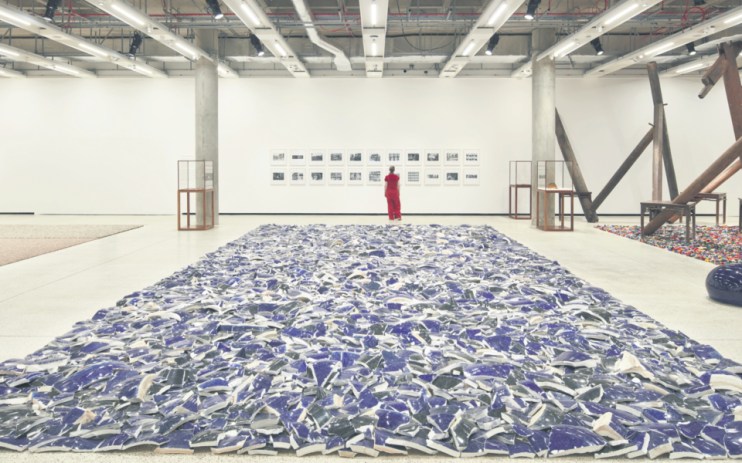
When you enter the Design Museum’s main exhibition space, you can see echoes of that installation: four vast rectangles cover the floor in the centre of the space like neatly ploughed fields.
One is filled with the sad remains of glazed pots made by Ai and his team, which were smashed by the Chinese authorities during one of their raids on his studio. Another is filled with more than 250,000 spouts from porcelain teapots dating from between 960-1279CE (any imperfect pot would have the spout snapped off and, presumably, thrown into a big spout pit), each one representing a mouth that has been silenced.
Then there’s a field of 200,000 hand-made stone cannon balls that have been meticulously arranged into a calming pattern that recalls a Japanese Zen garden, a far cry from their violent origins.
The final field is made up of neolithic tools – axe-heads, chisels, knives and the like – things that we have been trained to think of as rare but are clearly abundant enough for Ai to have amassed in their thousands, many from flea markets.
Through works like these, Ai has become perhaps the world’s leading collector and chronicler of Chinese historical artefacts, each one representing a past he says is being destroyed through reckless expansionism.
Circling the fields are bleak photographs of construction sites that have usurped local populations, while a triptych of videos show footage recorded at various points along Beijing’s three vast ringroads.
The spark of Ai’s work comes when meaning strikes material. A giant snake clinging to the rear wall becomes deeply moving when you realise it’s made up of school backpacks, representing the thousands of children who died in the 2008 Sichuan earthquake (he blames the deaths on poor quality construction).
Elsewhere there are riffs on another of the artist’s longstanding obsessions: the question of what makes a thing a thing, and the absurdity that arises when you make a copy of that thing in a different medium. There’s a glass loo roll, a marble lipstick, a set of jade anal beads. Outside the gallery there are a pair of comfy-looking sofas, copied from ones his father used to own, carved from marble.
As you work your way around the exhibition you end up faced with a 15m mural that spreads like a heat map across an entire wall: it’s Ai’s take on Monet’s Water Lilies, made using 650,000 Lego bricks. A dark “portal” to the right hand side represents the dugout where he and his father lived in forced exile in the 1960s. Like much of Ai’s work, it’s a captivating blend of beauty and horror.
With dozens of new works from one of the most exciting artists working today, Ai Weiwei: Making Sense represents one hell of a coup for the Design Museum.