Skip to content
Wednesday 2 September 2026London --:--Frankfurt --:--Zurich --:--
NewslettersSearchEN · DE · FR
MorningWire

European business, markets and politics

FTSE 100
10,764.15
-0.23%
DAX
25,848.33
-0.47%
CAC 40
8,292.95
-0.11%
STOXX 50
6,366.05
-0.05%
  • Europe
  • Markets
  • Business
  • Economy
  • Regulation
  • Politics
  • Opinion
More
GermanyFranceEU InstitutionsCompetitionPublic AffairsBankingTechnologyEnergy
  • Germany
  • France
  • Europe
  • Markets
  • Business
  • Economy
  • Regulation
  • Politics
  • Opinion
  • DE
Monday 16 March 2020 12:45 am  |  Updated:  Sunday 15 March 2020 5:25 pm

Andrew Bailey takes over with Bank of England battling coronavirus recession

By: Harry Robertson

Add as a preferred source on Google
Andrew Bailey takes over with Bank of England battling coronavirus recession
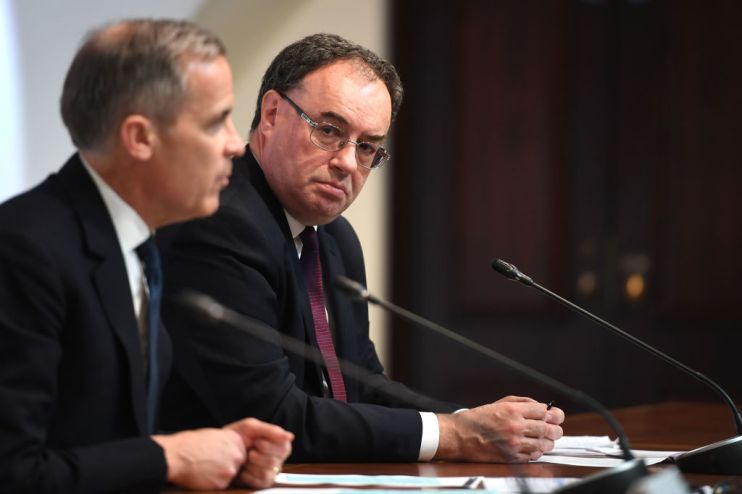
Andrew Bailey (right)

Andrew Bailey is no stranger to a tough job. But the incoming Bank of England governor, who takes up his new role as Mark Carney steps down tomorrow, could never have anticipated the size of the challenge that awaits him at Threadneedle Street.

Bailey’s time at the Financial Conduct Authority began in the wake of Brexit and coincided with a number of financial scandals, such as the disintegration of Neil Woodford’s investing empire and the collapse of mini-bond firm London Capital & Finance.

Those issues now look like small fry. As he takes the governor’s chair, he will have to deal with the fallout from the rapidly spreading coronavirus, which has rocked stock markets and could plunge the UK economy into recession.

Earlier this month, Bailey sought to reassure MPs that he can handle the pressure, invoking his work at the Bank during the financial crisis.

“I led many of the operations that the Bank did during the crisis – it was anything but slow-moving, so I think I can say that I have quite a strong history of doing things very quickly,” he told the Treasury Committee.

Sir Charlie Bean, a former deputy governor of the Bank of England, told Morning Wire earlier this year that Bailey has “oodles of relevant experience”. Bean said: “I think he is a really excellent appointment and will do a very good job.”

To cut or not to cut

Among the first decisions Bailey will have to make is whether the Bank should pursue another interest rate cut and perhaps relaunch its quantitative easing (QE) bond-buying programme. The BoE slashed its main rate from 0.75 per cent to 0.25 per cent in an emergency move last week.

Analysts at Canadian bank TD Securities said they think the Bank will wait for now. “Any cut to the effective lower bound of 0.1 per cent would be purely symbolic, and would likely accompany a broader QE package, which we do not expect at this time.”

Read more

Andrew Bailey warns markets are not ready for the rise (or fall) of AI

Andrew Bailey, Governor of the Bank of England, in a suit and tie, looking thoughtful during a press conference.

Yet Investec economist George Brown said he “would not rule out a cut in the Bank rate to its estimate of the effective lower bound”. He also said: “We do not discount the possibility that the Bank’s balance sheet could be expanded through the purchase of additional gilts and/or corporate bonds.”

Another possibility is expanding the loan scheme the Bank unveiled on Wednesday, which it said should support more than £100bn of lending to smaller firms. Yet as containment measures become more draconian, companies may need more than that.

Bailey will have to continue his predecessor’s close work with the government, which has won plaudits from many commentators. He has already met the chancellor Rishi Sunak to discuss the response to the virus and told MPs that the Treasury and Bank “must act in a coordinated fashion”.

Brexit and climate loom in background

All this will limit the extent to which Bailey can think about two other pressing issues, Brexit and climate change.

Britain has until the end of this year to strike a comprehensive free-trade agreement with the EU, or risk falling on to World Trade Organization trading terms with higher tariffs. As the deadline looms, uncertainty could cause the economy to slow again as it did towards the end of last year.

On top of all that is the threat climate change poses to the economy and financial stability in the UK. Carney led the way among central bankers in pushing the climate up the agenda, and set up a climate stress test that will take place next year.

Bailey has indicated he will continue this focus. In what could herald a major step for the Bank he told the Treasury Committee there is “a very strong argument” for excluding fossil fuel assets from future bond purchases.

Read more

How the Treasury got ‘fed up’ with the Bank of England’s payments plan

The Bank of England's Breeden argued the recent inflation bump was transitory (Photo by Chris Ratcliffe/Bloomberg via Getty Images)

Share this article

  • Facebook
  • X
  • LinkedIn
  • WhatsApp
  • Email

Similarly tagged content:

Sections

  • Markets & Economics
  • News

Categories

  • Banking
  • Economics

Trending Articles

  • Vodafone and Deliveroo look to patch up Reform ties after Yusuf prison threats

  • Trio of firms poised to quit London Stock Exchange as exodus gathers pace

  • Jaguar reveals the Type 01’s screen-free interior

  • Easyjet’s over-60s recruitment push is economically necessary

  • Jim O’Neill: Capital gains tax hike ‘looms’ as top option for Burnham

More from Morning Wire

  • Andrew Bailey warns markets are not ready for the rise (or fall) of AI

    Markets
    Andrew Bailey, Governor of the Bank of England, in a suit and tie, looking thoughtful during a press conference.
  • How the Treasury got ‘fed up’ with the Bank of England’s payments plan

    Fintech
    The Bank of England's Breeden argued the recent inflation bump was transitory (Photo by Chris Ratcliffe/Bloomberg via Getty Images)
  • Economists urge Bank of England to halt bond sales as borrowing costs climb

    Economics
    Bank of England headquarters with financial charts overlay, illustrating private credit stress test analysis
  • How patient can the Bank of England be?

    AD
    Historic Royal Exchange building in London with modern skyscrapers behind, clear blue sky.
  • Government pushes Bank of England to innovate on payments and digital currencies

    Regulation
    Bank of England building on Threadneedle Street, London, showcasing its historic architecture and financial significance
  • Reform’s Richard Tice under parliamentary investigation

    Politics
    Reform UK leader Nigel Farage and Deputy Leader Richard Tice are set to meet with Andrew Bailey to discuss interest rates and stablecoins.
  • UK government takes stake in miner after £71m injection

    Energy
    Tungsten West logo on a neon yellow high-visibility jacket with reflective stripes, suggesting mining or industrial work.
  • 22 months of cuts: Jobs crisis deepens despite growth boost 

    Economics
    London has defied national trends as job postings in the capital rose.
MorningWire

Independent European business, markets and political news for decision-makers.

Morning Briefing

Europe

  • Germany
  • France
  • EU Institutions
  • Europe

Business

  • Markets
  • Business
  • Economy
  • Regulation
  • Competition
  • Public Affairs

Editorial

  • Opinion
  • Editorial Policy
  • Corrections
  • Contact

Company

  • About Morning Wire
  • Privacy Policy
  • Terms of Use
  • Cookie Policy
© 2026 Morning Wire Ltd · Published by Morning Wire Media, Bahnhofstrasse 65, 8001 Zürich, Switzerland
Privacy · Terms · Cookies · Facebook