As global crises grow, Sunak should embrace the National Security Council

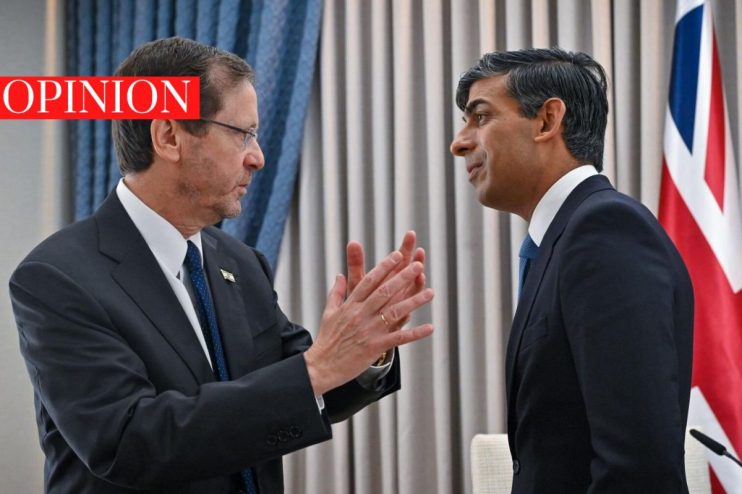
From Israel to China to Ukraine, to govern effectively in the midst of so many global crises, Rishi Sunak needs eyes in the back of his head, writes Eliot Wilson.
If you spend any length of time with politicians, one thing which can come as a surprise is how many of them have had at least casual daydreams of being prime minister. Some MPs will confess to these notions and leave you flabbergasted by their hubris: as an example, I point you to Rehman Chishti’s short campaign to be Conservative leader last summer.
My guess is that Rishi Sunak had been at home to the idea for longer, though its realisation may have come more quickly than he expected. But being PM is not like being president, and even a figure as dominant as Sir Tony Blair later complained that he had lacked the ability to make policy effective because he had no levers to pull. However, the reverse of that is that the whole of government is, directly or indirectly, the responsibility of the prime minister, in a way which can be suffocating.
Sunak is not an idle man. He wakes between early and subjects himself to a treadmill or his Peloton, and thereafter his pace is relentless. We are experiencing a cost of living crisis, property rental is rising, inflation is stubbornly high and economic growth remains sluggish. Public services consume any amount of money thrown at them and still crave more, and the NHS is beset by waiting lists of record size. In addition, Britain remains the second largest military donor to Ukraine as well as training tens of thousands of Ukrainian military personnel. In the past fortnight, Sunak has found himself dealing with the fieriest conflict between Israel and Hamas. The “urgent” part of his to-do list is substantial and flashing red.
One of the burdens of the premiership, however, is that all the other challenges to our global security and wellbeing do not step politely back while we deal with something else. Dealing with China is still a massively complex issue, with the piquancy of a likely move against Taiwan within the next few years. It is not obvious how we will respond, but “pass” will not be an acceptable answer. At the same time, the tension in the Middle East is emboldening Iran, Hamas’s sponsors, to flex its muscles in the Persian Gulf, and the Islamic Revolutionary Guard Corps (IRGC), Tehran’s élite troublemakers, has been harassing shipping in the Straits of Hormuz, through which a third of the world’s oil is transported.
To stay intelligently and usefully abreast of all of these issues requires superhuman effort, and staff. David Cameron, comfortable with the latter if not the former, established the National Security Council in 2010 in part to manage this kind of workload. It brought together senior ministers with officials from the civil service, the armed forces and the intelligence agencies under the prime minister’s chairmanship, and appointed a national security adviser to act as its secretary. Initially it met weekly, and, while it sometimes fell short of its ideal, it was designed as a forum for discussions of long-term strategic issues and threats to the UK around the world.
If Cameron as its progenitor was committed to this new architecture, it has not been universally true since 2016. Boris Johnson let it lie dormant for much of 2020 while he focused on the pandemic, and thereafter reduced his commitment to chairing the NSC once a month; it did not bend well to his preferred style of a few jokes, a reference to ancient Greece and some rousing boosterism. Liz Truss scrapped it entirely and relied on existing cabinet sub-committees. Sunak does not have an instinctive interest in foreign affairs or security policy, and there are concerns in Whitehall that he fixates too easily on immediate problems.
Whitehall is always close-lipped on security matters. The national security adviser, Sir Tim Barrow, often reassures those inquiring that the NSC meets “as required” or “regularly”, but weekly and quarterly both count as “regular”. Barrow himself, an experienced but low-key mandarin, has been deployed on the Northern Ireland Protocol, as sherpa for this year’s G7 and G20 meetings and on the return of migrants to the EU, suggesting that he is being spread thinly. None of this assuages the concern that the prime minister is neglecting the UK’s broad strategic context while being sucked into day-to-day management.
Being prime minister is hard, as some incumbents demonstrate more obviously than others. A ferocious work ethic and an unquenchable thirst for detail are necessary but not sufficient. What a premier cannot do without is an almost otherworldly ability to keep an improbable number of balls in the air, prioritising ruthlessly without losing focus. The National Security Council was an excellent innovation by David Cameron to address this problem. Other models are available, but what cannot be forgiven is to ignore the NSC without finding anything to replace it. We can only hope Sunak has a grip of this.