Skip to content
Wednesday 2 September 2026London --:--Frankfurt --:--Zurich --:--
NewslettersSearchEN · DE · FR
MorningWire

European business, markets and politics

FTSE 100
10,789.28
-0.32%
DAX
25,970.11
0.00%
CAC 40
8,301.85
0.00%
STOXX 50
6,368.98
0.00%
  • Europe
  • Markets
  • Business
  • Economy
  • Regulation
  • Politics
  • Opinion
More
GermanyFranceEU InstitutionsCompetitionPublic AffairsBankingTechnologyEnergy
  • Germany
  • France
  • Europe
  • Markets
  • Business
  • Economy
  • Regulation
  • Politics
  • Opinion
  • DE
Wednesday 02 September 2026 5:22 am  |  Updated:  Tuesday 01 September 2026 11:41 am

The answer to regional inequality isn’t public money, it’s productivity

By: Paul Ormerod

Add as a preferred source on Google
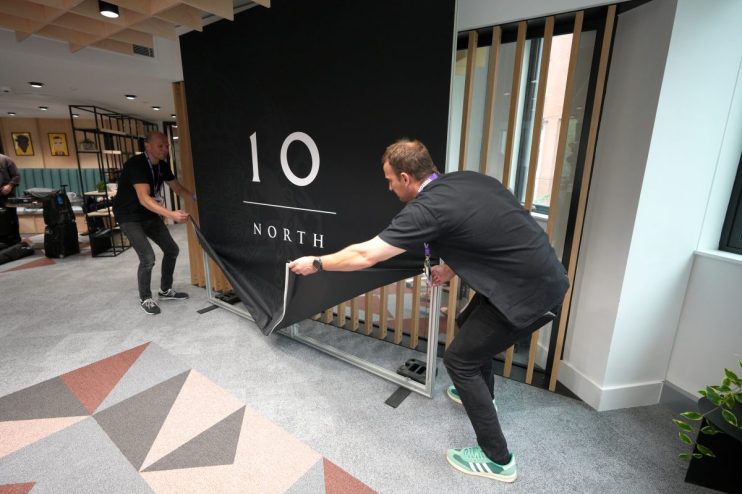
Two men setting up a black banner with 10 NORTH in white text on a grey patterned carpet.
Government staff prepare a number 10 North sign for a media interview during a National Economic Council meeting at No 10 North at Heron House on July 24, 2026 in Manchester, England. Prime Minister Andy Burnham is officially opening No 10 North at Heron House in central Manchester, where Burnham plans to base himself for at least one day a week, alongside senior ministers and aides. (Photo by Christopher Furlong/Getty Images)

Andy Burnham’s ambitions for Number 10 North are nothing new, but successive governments have failed to focus on the key reason for differing regional outcomes, says Paul Ormerod

The creation of Number 10 North symbolises a key aspect of Andy Burnham’s policies. Namely, to revive the economies of the more deprived parts of the UK.

The previous Conservative government came up with the slogan “Levelling Up” to describe such an aspiration. It may now be taboo in government circles. But the new phrase “prosperity in every postcode” expresses the same intention.

Harold Wilson had a similar optimistic view in the run up to the general election of 1964, shortly after being elected Leader of the Labour Party.  

The great 19th century Conservative Prime Minister Benjamin Disraeli had coined the concept of ‘two nations’ within Britain, one rich the other poor. Wilson turned it against the Tories 100 years later, arguing there was still “an over-congested south-east and the starved north”.

We see Disraeli worrying about regional inequalities in the 1860s, and Wilson doing the same in the 1960s, followed by Sunak in the early 2020s and now Burnham in the mid-2020s. 

We can readily deduce from this that it is not an easy problem to solve.

In the six decades following Wilson’s speech there has been a proliferation of regional initiatives. Billions of pounds have been spent. But the inequality persists.

A key reason for this is that much of the activity has failed to focus on the key reasons for differences in regional outcomes.

The main reason why many areas in the regions are poor is because the average firm has relatively low productivity and can therefore only pay relatively low wages and salaries.

Building new transport links, refurbishing shopping centres, providing training courses, all these have only an indirect outcome on regional differences in incomes.

Read more

Can John Healey deliver Burnham’s make-or-break devolution agenda?

John Healey, in a red tie, speaking with Andy Burnham, wearing glasses and a dark blue jacket, outdoors.

Raising productivity

The key aim must be to raise the productivity levels of firms. There are two aspects to this.

First, the industrial structure of the economically weaker areas is weighted towards industrial sectors which themselves have inherently low productivity. A report by the OECD in 2020 gave this as the main reason why the UK’s regional cities lag behind both London and the South East and their counterparts in Western Europe.

The second is that there is a very wide difference between the most and the least productive firms in any given industry, even when the industry is defined very narrowly. The poorer areas of the UK have too many firms in the mid/low end of the productivity distribution and too few at the high end.

In short, the regions need to increase the importance to their economies of high productivity sectors and to help those firms already based there who want to boost their productivity levels.

Policy should be focused directly on achieving these aims.

Useful evidence of the effectiveness of targeting the productivity issue directly comes from a new paper from the Productivity Institute (PI) at the University of Manchester (note: the PI is separate from the Business School to which I am attached). 

UK Research and Innovation (UKRI) funds projects designed to promote collaborations in research and innovation between both companies themselves and companies and universities.

The PI applied sophisticated and powerful analytical techniques to a database of 25,122 projects funded by UKRI over the 2004-2021period involving 44,406 participating firms and institutions across the UK. They examine a wide range of different collaborative structures, for example whether they are within or across regions, whether they are university-industry or private-public.

They find strong evidence that public support for R&D and knowledge collaborations has an unequivocally positive effect on regional economic development.

The lesson is clear. Blanket spending on the regions does very little to narrow the economic gap between them, as the last 60 years demonstrates. Smart, targeted spending can make a distinct difference.

Paul Ormerod is an Honorary Professor at the Alliance Business School at the University of Manchester. You can follow him on Instagram @profpaulormerod

Read more

Where are Andy Burnham’s economic advisers?

Andy Burnham and John Healey at Number 10 North, both wearing suits and ties, with a microphone in the foreground.

Share this article

  • Facebook
  • X
  • LinkedIn
  • WhatsApp
  • Email

Similarly tagged content:

Sections

  • Opinion

Categories

  • Opinion

People & Organisations

  • andy burnham
  • Devolution
  • Harold Wilson
  • Number 10 North
  • productivity
  • regional inequality

Trending Articles

  • Vodafone and Deliveroo look to patch up Reform ties after Yusuf prison threats

  • Jaguar reveals the Type 01’s screen-free interior

  • Trio of firms poised to quit London Stock Exchange as exodus gathers pace

  • Easyjet’s over-60s recruitment push is economically necessary

  • As it happened: FTSE 100 slides as bound rout deepens; Oil jumps as Trump vows more strikes on Iran

More from Morning Wire

  • Can John Healey deliver Burnham’s make-or-break devolution agenda?

    Economics
    John Healey, in a red tie, speaking with Andy Burnham, wearing glasses and a dark blue jacket, outdoors.
  • Where are Andy Burnham’s economic advisers?

    Politics
    Andy Burnham and John Healey at Number 10 North, both wearing suits and ties, with a microphone in the foreground.
  • Lord O’Neill declines job in Burnham government

    Economics
    Jim ONeill, economist and former Goldman Sachs chairman, sitting on a yellow sofa in front of large windows.
  • The Burnham bounce won’t last unless Brits get better off

    Opinion
    Andy Burnham smiling and holding a pint of beer and a smartphone in a pub setting
  • Burnham’s devolution drive could ‘push 90,000 jobs out of London’

    Economics
    In 2022, rolling Tube strikes led to massive queues for crowded buses. (Photo by Chris J Ratcliffe/Getty Images)
  • UK founders cast doubt on Burnham’s pro-business push

    Entrepreneurship
    Andy Burnham, Mayor of Greater Manchester, in a professional setting.
  • Burnham forgets, the Labour Party is a moral crusade or it is nothing

    Opinion
    Andy Burnham, in a dark suit, speaks at a podium outside 10 Downing Street, with onlookers behind him
  • Burnham is ‘not behind’ business confidence bounce

    Economics
    Andy Burnham, Mayor of Greater Manchester, in a suit and glasses, looking serious against a bright sky.
MorningWire

Independent European business, markets and political news for decision-makers.

Morning Briefing

Europe

  • Germany
  • France
  • EU Institutions
  • Europe

Business

  • Markets
  • Business
  • Economy
  • Regulation
  • Competition
  • Public Affairs

Editorial

  • Opinion
  • Editorial Policy
  • Corrections
  • Contact

Company

  • About Morning Wire
  • Privacy Policy
  • Terms of Use
  • Cookie Policy
© 2026 Morning Wire Ltd · Published by Morning Wire Media, Bahnhofstrasse 65, 8001 Zürich, Switzerland
Privacy · Terms · Cookies · Facebook