Burnham forgets, the Labour Party is a moral crusade or it is nothing

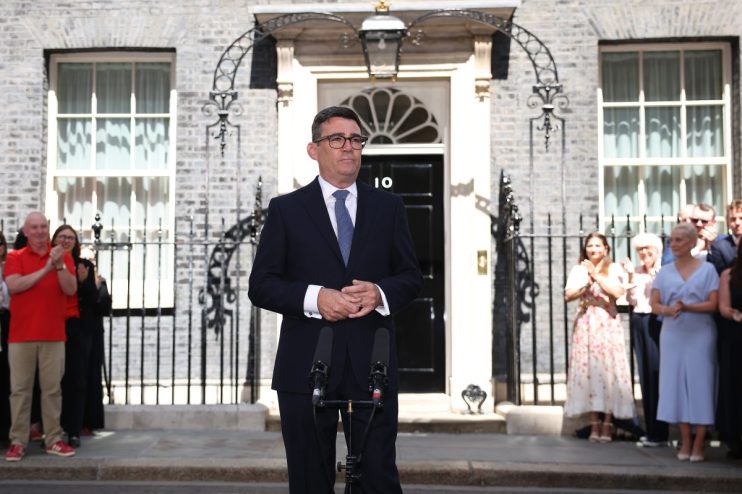
Voters yearn for loftier ambitions. Burnham must think bigger, yes even than devolution, if he is to meaningfully win back the electorate, writes Eliot Wilson
It is just over a month since Andy Burnham became Prime Minister. It is still an unfamiliar phrase in the mouth. I am old enough to remember the premier when he was taking his first ministerial steps at the Home Office in 2005, a 35-year-old parliamentary under-secretary of state responsible for getting the Identity Cards Act 2006 on to the statute book. He was slick-ish but personable, more human than some ministers but his future as head of the government was hardly written in stone.
When the Labour Party decided that Sir Keir Starmer was irredeemable as Prime Minister, Burnham was far and away the front runner to succeed; it is perhaps odd that none of the other 403 Labour MPs was thought anything like as capable. Part of me wonders if the Parliamentary Labour Party will look back in a year or two and wonder how everything seemed so inevitable and obvious.
Burnham’s pocketbook politics
There is no doubt that a new Prime Minister has given Labour an electoral shot in the arm. The party languished just under 19 per cent after May’s local elections, but by the end of July, just a week after Burnham’s formal appointment, Labour had taken a lead in the polls with 26.5 per cent.
Psephological guru Sir John Curtice of the University of Strathclyde told the BBC “Burnham’s arrival has given Labour new hope, but [he]… needs to deliver on the policy challenges facing his government, which remain as formidable as those that beset Sir Keir”. This will be the crux of his premiership: can he think big enough to win back the electorate? I think it’s a weakness, potentially a fatal one.
Much of Burnham’s policy agenda, his mixture of big-state dirigisme, belief that the rich can always be squeezed for that little bit more and apparent conviction that the 1970s represent Britain’s economic belle époque, appals or bemuses me. Undoubtedly, though, he is a first-rate communicator, able to speak directly and authentically to individual voters. As Mayor of Greater Manchester, that was a vital strength, which is why he was elected three times, never with less than 60 per cent of the vote.
His initial policy blitz has focused on what he thinks is central to voters’ concerns, the cost of living, what American politicians call “pocketbook issues”. He has announced a six-month suspension of VAT on household electricity bills, a reduction of 20 per cent in business rates for pubs, clubs and live music venues and the capping of bus fares outside London at £2. He has also pledged to end long-term rough sleeping within three years, and has temporarily halted the early release of convicted criminals from prison.
These are quotidian actions which will not set the political landscape ablaze. The Institute for Fiscal Studies estimated that the average household electricity bill would fall by £25, or about £1 a week. The relief of business rates will save the average pub £20 a week. Every little helps, as Tesco proclaims, and the psychological impact on voters may be more important than the financial: a Prime Minister reaching out to families feeling the pinch, and to the hard-pressed hospitality sector. We all like to feel that someone is listening to us, thinking about us, when we are struggling.
Disenchanted voters need exciting
Self-evidently, however, these measures are not revolutionary. This is not “Rewiring the State”, one of Burnham’s professed intentions and, interestingly, the precise phrase Sir Keir Starmer used when he appointed Sir Chris Wormald as cabinet secretary – a choice he regretted and which has cost more than £500,000 to undo. Burnham’s “big picture” is devolution, particularly of financial powers to elected mayors and exemplified by the establishment of No. 10 North in Manchester.
Can devolution capture the imagination of the electorate? Will it drive voters out to the polling booths and back to the Labour Party? It seems a tall order. Devolution is a process, not an outcome: you pursue it because it makes the state’s exercise of power more efficient, or more effective, or more accountable.
Harold Wilson famously told his party conference in 1962, “The Labour Party is a moral crusade or it is nothing”. Across the party divide, Margaret Thatcher also understood the need for loftiness of purpose. She told her first party conference as leader in 1975: “What is the challenge of our time? I believe there are two – to overcome the country’s economic and financial problems, and to regain our confidence in Britain and ourselves.”
Voters are desperately disenchanted, sceptical, often contemptuous of politics. Turnout at the last election – together with the almost identical figure from 2001 – was the lowest level of participation since 1918. A nudge is not going to be enough. Yes, greater prosperity must be part of the offer, as we have one of the highest tax burdens of any time since the Second World War yet threadbare public services and an alarming national debt.
But parties will have to show plans for prosperity with purpose; they will need to show what they want Britain to look like in 10 or 15 years’ time.
Of course, they will also have to persuade a public battered by broken promises that they can deliver their vision in the real world. But no-one said politics was easy, or everyone would do it.
Eliot Wilson is a writer and historian. He is a senior fellow for national security at the Coalition for Global Prosperity and a contributing editor at Defence on the Brink