Skip to content
Sunday 13 September 2026London --:--Frankfurt --:--Zurich --:--
NewslettersSearchEN · DE · FR
MorningWire

European business, markets and politics

FTSE 100
10,650.44
+0.39%
DAX
25,568.56
+0.82%
CAC 40
8,179.77
+0.78%
STOXX 50
6,325.13
+0.90%
  • Europe
  • Markets
  • Business
  • Economy
  • Regulation
  • Politics
  • Opinion
More
GermanyFranceEU InstitutionsCompetitionPublic AffairsBankingTechnologyEnergy
  • Germany
  • France
  • Europe
  • Markets
  • Business
  • Economy
  • Regulation
  • Politics
  • Opinion
  • DE
Wednesday 06 April 2022 6:15 am  |  Updated:  Tuesday 05 April 2022 5:26 pm

As Rishi wades through the cost of living crisis, static growth is waiting in the wings

By: Paul Ormerod

Add as a preferred source on Google
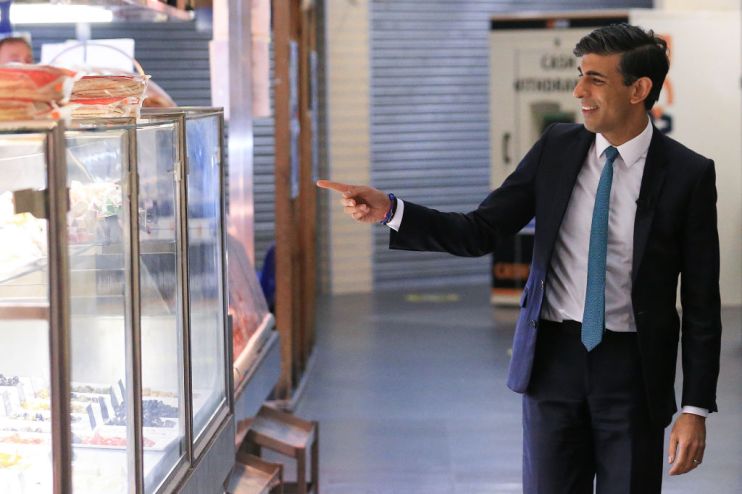
Rishi Sunak Visits Market In Bury, Greater Manchester
Prime Minister Rishi Sunak is looking for ways to raise billions of pounds

The short-term pressures on Rishi Sunak have continued to grow in tandem with the cost of energy and everyday essentials. Conservative MPs are increasingly panicked about being saddled with a label of being “high tax Tories”. But underlying all of this is a much more worrying phenomenon.

Since the financial crisis of the late 2000s, economic growth has slowed. This is not just in the UK but across the West as a whole.

Low economic growth means government receipts from taxes will slow to a trickle.  At the same time, the clamour from electorates for more public spending gets louder.

By 2010 Britain’s economy had returned to the level it was prior to the financial crisis.  From then until 2019, the year before the pandemic, economic growth averaged 2  per cent a year. A perfectly reasonable rate, one might think. But during the same length of time, in the run up to the financial crisis, the average was 2.6 per cent.

If a similar rate had persisted throughout the 2010s, national income and output would have been 8.4 per cent higher than it actually was. In money terms, this translates into a sum of around £180bn. In turn this would have generated an additional £70bn or so in tax receipts.

Putting this into context, total annual government receipts from income tax and employee and self-employed national insurance are just over £350bn. So the Chancellor would have had free rein to make his mark with substantial tax cuts.

The slow-down in growth has been even worse in the nineteen countries of the Eurozone. Between 1998 and 2007, average GDP growth was 2.3 per cent.  And 2010-2019 it was just 1.3 per cent, a rate well below that of the UK.

When modern welfare states were first founded after the Second World War, the presumption was that economic growth would be sufficiently strong to generate the tax base required to satisfy the demands of electorates.

Read more

22 months of cuts: Jobs crisis deepens despite growth boost 

London has defied national trends as job postings in the capital rose.

A 10-year average shows us an accurate picture of the sustainable level of growth, smoothing out the normal year-to-year fluctuations.

This “trend” level of growth in the UK was in the range of three to four per cent a year right up until the mid-1970s. Plenty of cash was generated to pay for health, education, and other public services, and at the same time the level of taxation could be kept within reasonable bounds.  Take-home pay grew steadily.

This was the basis of the famous statement by Harold Macmillan, the then Conservative Prime Minister, in the 1959 election campaign: “You’ve never had it so good”.

The recessions of the mid-1970s and, in particular, the sharp one of the early 1980s led to a drop in the  10 year average growth rate. But by the mid-1980s, in the 2.5 to 3 per cent  range. There it remained up until the financial crisis of 2008.

True, this was below the rates seen in the 1950s and 1960s, but still ample to satisfy spending demands. Our understanding of sluggish growth is imperfect.

There is a wide range of hypotheses, but none of them are well established, making it difficult for policymakers to solve the problem. Their answer, thus far, has been to hope for the best.

Western electorates have not yet woken up to the implications of this fall in trend growth. Their expectations are taking far too long to adjust to the new reality and remain stuck in the past.

Read more

‘Calm before the storm’: City warns Healey growth spurt won’t last

Patrick Healey in a suit with a red tie, looking contemplatively to the left, with an American flag behind him.

Share this article

  • Facebook
  • X
  • LinkedIn
  • WhatsApp
  • Email

Similarly tagged content:

Sections

  • Opinion

Categories

  • Opinion

Trending Articles

  • Wetherspoon boss: ‘Not up to Burnham’ to choose who is on the high street 

  • Primark sales slip as owner dresses up retailer for demerger

  • Badger Beer maker Hall & Woodhouse doubles profit ahead of tie-up with James May

  • Crystal Palace owner Blitzer part of £1bn mega stadium redevelopment

  • Barclays faces legal scrutiny over role in £90m ‘Ponzi scheme within a Ponzi scheme’

More from Morning Wire

  • 22 months of cuts: Jobs crisis deepens despite growth boost 

    Economics
    London has defied national trends as job postings in the capital rose.
  • ‘Calm before the storm’: City warns Healey growth spurt won’t last

    Economics
    Patrick Healey in a suit with a red tie, looking contemplatively to the left, with an American flag behind him.
  • John Caudwell and Stuart Rose blast ‘tax creep’ 

    Economics
    John Caudwell in a formal setting, possibly during a business meeting or public speaking event, conveying professionalism.
  • Give London power to level up the rest of the country

    Opinion
    Business professionals in formal attire engaged in a lively discussion at a corporate meeting in a modern office setting.
  • Andy Burnham is on course to rack up the second highest debt interest bill on record

    Opinion
    UK National Debt Clock showing £3 trillion, with Big Ben and the Union Jack in the background.
  • Industry chief warns ‘resilience not enough’ for growth

    Economics
    Shevaun Haviland, British Chambers of Commerce boss, speaking at a business event, emphasizing economic growth strategies
  • The UN treaty that’s been incentivising Britain’s blockers since 1998

    Opinion
    Stop HS2 banner with a train icon, displayed on a brick wall in front of a house, protesting the HS2 project
  • Jonathan Reynolds’ industrial strategy is straight out of the 60s

    Opinion
    Labour's Jonathan Reynolds unveiled the industrial strategy in June.
MorningWire

Independent European business, markets and political news for decision-makers.

Morning Briefing

Europe

  • Germany
  • France
  • EU Institutions
  • Europe

Business

  • Markets
  • Business
  • Economy
  • Regulation
  • Competition
  • Public Affairs

Editorial

  • Opinion
  • Editorial Policy
  • Corrections
  • Contact

Company

  • About Morning Wire
  • Privacy Policy
  • Terms of Use
  • Cookie Policy
© 2026 Morning Wire Ltd · Published by Morning Wire Media, Bahnhofstrasse 65, 8001 Zürich, Switzerland
Privacy · Terms · Cookies · Facebook