Autumn Budget: The growth case for hiking capital gains tax


It is almost certain that Rachel Reeves will raise capital gains tax in the Budget.
We don’t know exactly what form the changes will take and we don’t know how much the Chancellor expects to raise, but reforms are coming.
This has sparked a wide range of warnings from entrepreneurs and investors that Reeves risks stifling growth at exactly the same time as she claims to be encouraging investment in the UK.
How, they argue, can a Chancellor who professes to be serious about growth consider lifting capital gains tax.
Capital gains tax
Capital gains tax is a levy raised on the increase in value of an asset between the points of purchase and sale.
The highest rate is usually 20 per cent, but it’s 24 per cent for residential property on secondary homes. There’s a further relief for owner managers, known as the Business Asset Disposal relief, which enables owner-managers to benefit from a 10 per cent rate up to a maximum gain of £1m.
The strongest argument for keeping rates on capital gains tax lower than income tax is that it encourages investment and entrepreneurship.
Founders may not draw a salary for years with the promised gain on the eventual exit serving as an incentive for setting up a business in the first place.
And given the share of revenue which comes from a small share of taxpayers, Reeves should be wary of rushing to reform capital gains tax.
The tax raised £15bn last year. Just three per cent of taxpayers – 12,000 people – accounted for two-thirds of revenue. In other words, a small number of taxpayers are contributing a lot.
So is there a way that Labour could reform the taxation of capital gains while still encouraging growth and entrepreneurship? A number of economists think so.
Why? Because lower rates of capital gains tax effectively encourage people to work in ways that are less efficient, but enable them to benefit from a more favourable tax regime.
The prime example would be individual consultants who set up firms on their own to benefit from lower tax rates. They may pay themselves a small salary and then take remaining pay through dividends or capital gains.
These companies may never grow. They may never invest much either. On any sensible measure, this is labour income. However, the tax system treats it as capital gains.
Research from the Centre for the Analysis of Taxation shows graphically the existence of these distortions.
Looking back into HMRC’s records, they plotted the number of liquidations taking place around the time that the government enforced changes which made it more difficult for people who had received income into their business to dispose of their assets.
Fortunately, the government announced the change long before it came into force. Surprise surprise, there was a spike in people liquidating their business to beat the deadline.
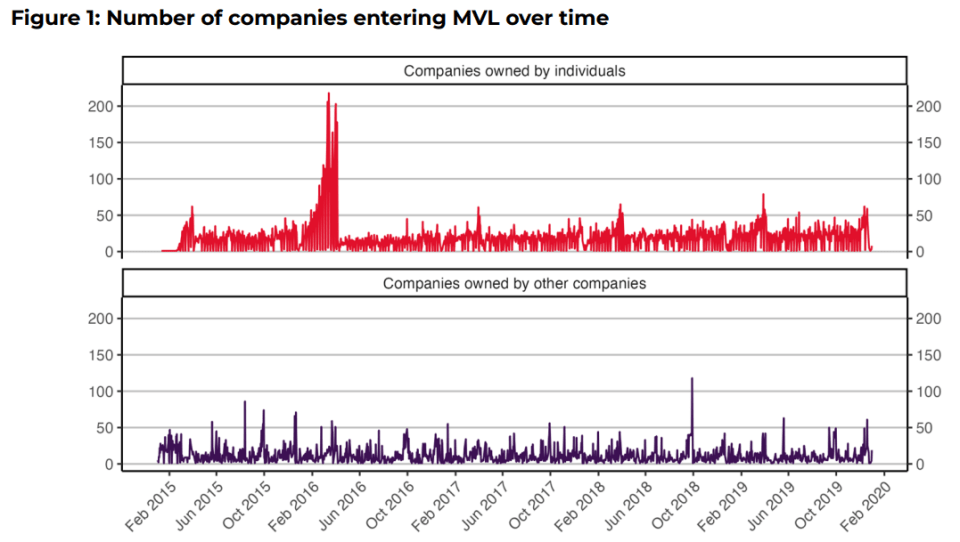
These distortions are therefore clearly taking place. Indeed, if you include the gains made through carried interest, research from the Institute for Fiscal Studies (IFS) suggests that around half of all taxable capital gains are essentially labour income.
Aligning capital gains tax with income tax would eliminate this distortion, ensuring decisions were taken on the basis of economic fundamentals rather than tax incentives.
This was Nigel Lawson’s preferred option. As Chancellor, he famously aligned the two tax rates, saying there was “little economic difference” between them.
The counter-argument is that these distortions are a necessary price to pay for the more important goal of encouraging innovation and risk-taking. This concern should be taken seriously, but there are potentially more effective ways to do this than a lower tax rate.
One way to encourage investment, promoted by CenTax and the IFS, is to create an ‘investment allowance’, which would ensure that ‘normal’ gains on investment – the risk-free rate of return – would not be taxed.
This would be a more generous version of the inflation allowance which used to exist.
The benefit of an allowance is that it is actually a bigger incentive to investment than the current system, which makes some investments unprofitable post-tax.
“For an entrepreneur, having an investment allowance provides the confidence that you have a certain return which you can get entirely tax free. You know that you only have to start paying tax at all if you hit that minimum threshold of success,” Arun Advani, an assistant professor at the University of Warwick, told Morning Wire.
“For growth what we’re interested in is people having a go, so limiting the downside risk in this way could be wonderful for people trying to set up businesses,” he added.
So, there are ways that the government could reform capital gains tax which might make the system more effective at encouraging the sorts of behaviour it is designed to encourage.
However, without these more fundamental reforms, hiking capital gains tax would be counterproductive.