Skip to content
Sunday 23 August 2026London --:--Frankfurt --:--Zurich --:--
NewslettersSearchEN · DE · FR
MorningWire

European business, markets and politics

FTSE 100
10,816.56
+0.64%
DAX
26,136.56
+0.59%
CAC 40
8,484.43
+0.37%
STOXX 50
6,462.22
+0.63%
  • Europe
  • Markets
  • Business
  • Economy
  • Regulation
  • Politics
  • Opinion
More
GermanyFranceEU InstitutionsCompetitionPublic AffairsBankingTechnologyEnergy
  • Germany
  • France
  • Europe
  • Markets
  • Business
  • Economy
  • Regulation
  • Politics
  • Opinion
  • DE
Tuesday 02 July 2024 2:33 pm

Bank of England should become more like the Fed to stem bond losses, Barclays says

By: Chris Dorrell

Add as a preferred source on Google
Bank of England recession warning
Bank of England members could mull backing an interest rate hike.

The Bank of England should structure its balance sheet more like the US Federal Reserve to help stem losses from the unwinding of quantitative easing (QE), analysts at Barclays have argued.

The Treasury is having to shoulder heavy losses from QE, which is attracting a lot of political attention given the parlous state of the public finances. Taxpayers are expected to transfer around £35bn to the Bank of England this year to cover losses resulting from QE.

However, analysts at Barclays suggested these losses could be dramatically reduced by restructuring the Bank’s accounting system.

Through QE, the Bank bought government bonds from financial institutions in exchange for commercial bank deposits. The hope was this would drive down borrowing costs, stimulating economic activity.

However, as interest rates have increased, the Bank now has to pay out more on those newly created deposits than it receives from its bond portfolio.

The value of the bonds has also fallen as interest rates have increased, with the Bank crystallising losses as it is actively selling bonds back into the market.
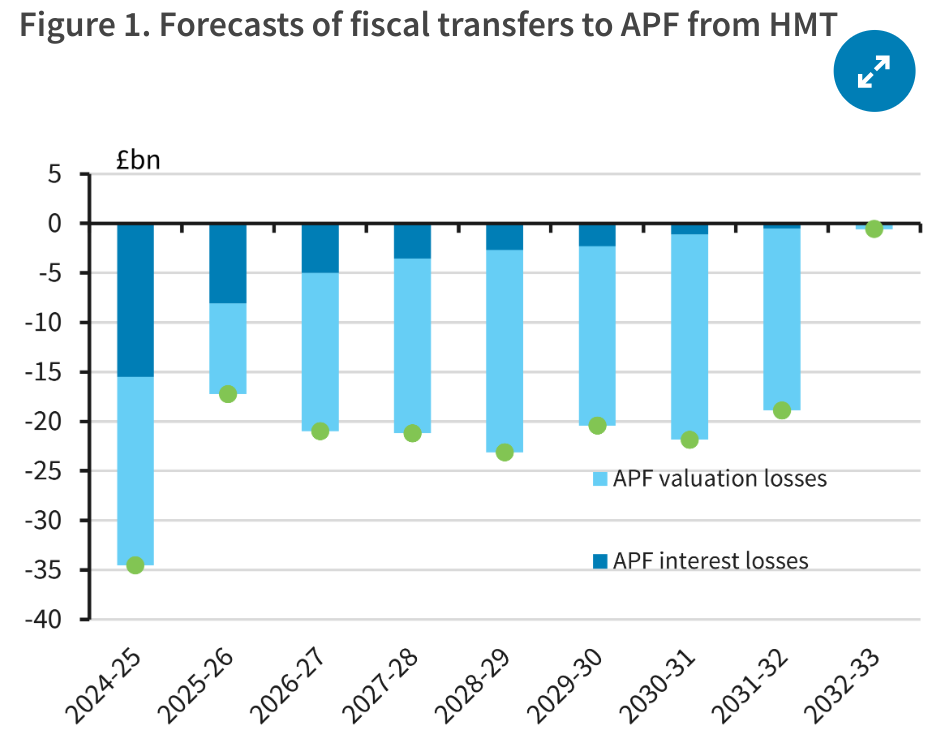
Source: OBR and Barclays

Official estimates suggest losses will fall to £15bn next year but stay around £20bn for the rest of the decade, largely due to valuation losses. Economists at Barclays noted that the annual mental health budget was slightly less than £17bn.

A number of suggestions have been put forward to try and reduce the losses, most prominently introducing a system of tiered reserves in which a portion of bank deposits would not receive interest payments.

Read more

UK economy’s rebound fails to stem two years of mass job losses 

LONDON, UNITED KINGDOM - JANUARY 31: The Shard is seen on the horizon as commuters cross London Bridge during the morning rush hour on January 31, 2023 in London, United Kingdom. The IMF reports that the UK economy will contract by 0.6% in 2023, as opposed to the previous prediction it might grow, and will perform worse than many other advanced economies, including Russia.The cost of living continues to hit households with grocery inflation for the first four weeks of 2023 rising to 16.7% which would add a further £788 per year to family food bills. (Photo by Leon Neal/Getty Images)

However, shadow chancellor Rachel Reeves has ruled this out and many economists warn that this could have unforeseen consequences on the operation of monetary policy. It would also not deal with losses from actively selling bonds back into the market.

Analysts at Barclays suggested a three-step process to help reduce QE’s costs.

First, the assets bought through QE should be transferred to the Bank’s own balance sheet rather than be held in the Asset Purchase Facility (APF). The APF is a vehicle created in 2009 to buy bonds.

Legislation should then be introduced, allowing the Bank to retain seigniorage income, which is currently transferred to the Treasury. Seigniorage is the profit made by a government for issuing currency, reflecting the difference between the value of money and the costs to produce it.

Finally, losses from the gilt portfolio should be framed as a ‘deferred asset’, similar to what the Fed does.

“This would mean that the Bank of England could continue to operate without the need for an immediate capital injection from HMT as it could earmark future seigniorage income to cover the losses, spreading them over a much longer period than just the moment in which they are realised,” the analysts wrote.

Although the Treasury would no longer receive seiniorage, the savings from the scheme would easily outweigh the costs, they wrote.

“The saving implied by this plan could more than cover the real-terms cuts to unprotected government budgets implied by current spending plans across both the Conservatives and Labour,” the analysts argued.

Read more

World Cup leads UK spending boost as confidence rebounds

Excited crowd celebrating, a man in an England jersey cheers with arms raised and beer splashing from a cup.

Share this article

  • Facebook
  • X
  • LinkedIn
  • WhatsApp
  • Email

Similarly tagged content:

Sections

  • Markets & Economics

Categories

  • Economics

People & Organisations

  • Bank of England
  • Barclays
  • quantitative easing
  • quantitative tightening

Related Topics

  • Bank of England
  • Gilts
  • Quantitative easing
  • UK interest rates

Trending Articles

  • Can debt-ridden Morrisons become a Big Four supermarket again?

  • Ratcliffe’s Ineos saves Runcorn plant

  • Mike Ashley’s Frasers offers to pay personal shoppers in Harvey Nichols takeover

  • Amazon says it buys books in bulk to ‘improve products’

  • Burnham predicted to raise taxes for ‘fundamental’ cost of living support

More from Morning Wire

  • UK economy’s rebound fails to stem two years of mass job losses 

    Economics
    LONDON, UNITED KINGDOM - JANUARY 31: The Shard is seen on the horizon as commuters cross London Bridge during the morning rush hour on January 31, 2023 in London, United Kingdom. The IMF reports that the UK economy will contract by 0.6% in 2023, as opposed to the previous prediction it might grow, and will perform worse than many other advanced economies, including Russia.The cost of living continues to hit households with grocery inflation for the first four weeks of 2023 rising to 16.7% which would add a further £788 per year to family food bills. (Photo by Leon Neal/Getty Images)
  • World Cup leads UK spending boost as confidence rebounds

    Banking
    Excited crowd celebrating, a man in an England jersey cheers with arms raised and beer splashing from a cup.
  • Rupert Lowe axes pensions triple lock and pledges tax cuts in economic plan

    Politics
    Rupert Lowe, former Southampton FC chairman, smiles while holding files on a city street, wearing a suit and pink tie
  • Lord O’Neill declines job in Burnham government

    Economics
    Jim ONeill, economist and former Goldman Sachs chairman, sitting on a yellow sofa in front of large windows.
  • 22 months of cuts: Jobs crisis deepens despite growth boost 

    Economics
    London has defied national trends as job postings in the capital rose.
  • Emergency government meeting held over high temperature amid ‘strain on public finances’

    Economics
    Aerial view of dry, brown farm fields affected by high temperatures, with a road and farm buildings.
  • US bond market jitters spark UK economy recession warning

    Economics
    Donald Trump delivering a speech at a podium during a formal event, emphasizing key points to an attentive audience.
  • Monzo faces outage as thousands of users unable to make payments or transfers

    Fintech
    UK fintech Monzo is ramping up its lifestyle reach.
MorningWire

Independent European business, markets and political news for decision-makers.

Morning Briefing

Europe

  • Germany
  • France
  • EU Institutions
  • Europe

Business

  • Markets
  • Business
  • Economy
  • Regulation
  • Competition
  • Public Affairs

Editorial

  • Opinion
  • Editorial Policy
  • Corrections
  • Contact

Company

  • About Morning Wire
  • Privacy Policy
  • Terms of Use
  • Cookie Policy
© 2026 Morning Wire Ltd · Published by Morning Wire Media, Bahnhofstrasse 65, 8001 Zürich, Switzerland
Privacy · Terms · Cookies · Facebook