Bank of England to hoist interest rates to 5.75 per cent as experts warn UK inflation is out of control
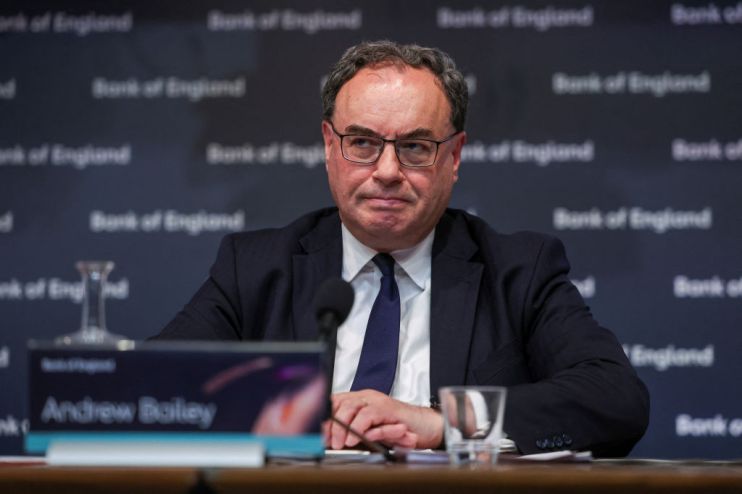
The Bank of England will have to hike interest rates to their highest level since July 2007, the eve of the financial crisis, in a sign that markets think the UK has the worst inflation problem in the rich world.
Traders ratcheted up bets on how high Bank Governor Andrew Bailey and the rest of the monetary policy committee – the nine-strong group that set interest rates in Britain – will have to send borrowing costs this morning after a hotter than feared UK jobs report signalled inflation risks hanging around for longer.
Financial markets now think borrowing costs could leap to a high of 5.75 per cent, up more than a percentage point from their current level of 4.5 per cent.
Before this morning’s numbers from the Office for National Statistics (ONS), which showed wages are rising at their fastest pace on record outside the pandemic, traders reckoned the peak would be at least 5.25 per cent.
The expected rate path has swung up sharply over the last month due to a string of robust data suggesting the UK economy is running extremely hot despite the Bank already raising borrowing costs twelve times in a row.
Last month, the ONS said inflation fell to 8.7 per cent in April from 10.1 per cent, a slower deceleration projected by the Bank and City. That’s also the highest rate in the G7.
Home-grown inflationary drivers are tougher to tame than external shocks.
The UK’s stats office said this morning that wages excluding bonuses climbed 7.2 per cent over the last year to April, a pick up from the 6.8 per cent increase clocked in March. It also topped the City and Bank’s projections.
In the private sector alone, pay grew 7.6 per cent and in the public sector, workers received the largest wage increase since 2003 at 5.6 per cent.
Although April’s jump was mainly caused by a 9.7 per cent increase to the minimum wage, a chunk of the upward drive was sparked by workers demanding pay increases to offset inflation eroding their living standards.
Bank of England and government officials are worried that workers will keep demanding high wage increases to chase down inflation, raising businesses’ costs. That in turn will put pressure on firms to hike prices, creating an inflationary feedback loop known in economics as a “wage-price” spiral.
When accounting for the consumer price index, real incomes have fallen every month since November 2021, among the longest declines on record.
“If there was still any doubt about the direction of monetary policy, these data should solidify another interest rate increase from the Bank of England next [Thursday], and probably more in the coming months,” Yael Selfin, chief economist at KPMG UK, said.
There’s an outside chance the Bank may return to raising borrowing costs by 50 basis points, something it hasn’t done since February, markets suspect.
“The renewed pick-up in wage growth in April will add fuel to the recent rise in gilt yields and expectations for the future path of bank rate, by fanning the impression that the UK has a unique problem with ingrained high inflation,” Samuel Tombs, chief UK economist at Pantheon Macroeconomics, said.
Gilts are a financial product issued by the UK government that investors buy in exchange for a fixed rate of return. The government uses the proceeds to fund spending when its tax income falls behind expenditure.
The rate on such instruments reflects borrowing costs in the UK. This morning, the yield – which moves inversely to price – on short-term gilts scaled to over 4.7 per cent, above the level reached in the aftermath of former Prime Minister Liz Truss’s £45bn tax cutting mini-budget in September 2022.
Rates on short-dated UK government debt also recently climbed above those offered on the US equivalent, a rarity, suggesting traders think the Bank will have to keep monetary policy a lot tighter than the Federal Reserve.
Chair Jerome Powell is tipped to later today to announce a pause in the Fed’s interest rate hike cycle after lifting borrowing costs at every meeting since March 2022 to a range of five and 5.25 per cent. Goldman Sachs economists reckon one more rise of 25 basis points will come in the summer.
European Central Bank officials on Thursday are projected to lift borrowing costs 25 basis points on Thursday to 3.5 per cent. Traders think they will stay at that level after this week’s meeting.
London’s FTSE 100 gained 0.11 per cent, while the pound strengthened around 0.4 per cent against the US dollar.
The gilt yield surge is poised to heap even more pressure on Britain’s mortgage market, which has been in turmoil recently due to providers pulling products as a result of sudden movements in debt markets.
Mortgage lenders price their products based on rates in financial markets. The recent rise in gilt yields has prompted them to withdraw deals and put them back into the market with higher rates to maximise returns.
The average rate on a new two-year fixed mortgage hit 5.86 per cent on Monday, according to the financial data provider Moneyfacts, compared with 5.79 per cent last Wednesday.