Biden and his interventionists should beware: America has changed due to the Iraq effect

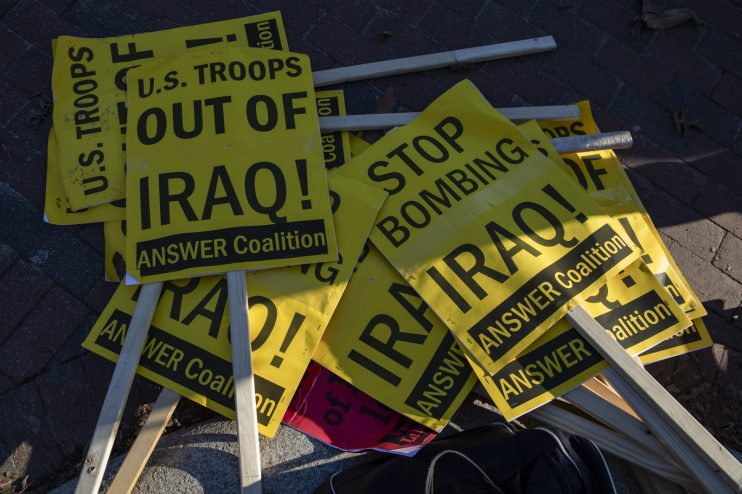
It is not too much to say that my early and fervent opposition to the Iraq War was the seminal professional and ethical moment of my life.
I will never forget it. As it turns out, neither will the American people.
Despite what it cost me, I was against the war for myriad reasons. It assumed omnipotent US power that simply didn’t exist, all the while disregarding the primacy of local Iraqi political, historical, and cultural factors.
It was of deeply flawed moral reasoning to blithely assume America could — or should — impose democracy on Iraq at the point of a gun.
Even then it was easy to forecast (and I did) that the intervention would leave American rival Iran as the dominant power in the destabilised region, costing trillions of dollars, killing thousands, and accomplishing nothing but a draining away of vital US power.
There was a final, conclusive reason I was against the Iraq War: I knew that the American people sensibly would not stand for the utterly disproportional conditions that were the only way such an exercise could succeed — colonialism in all but name.
After successfully invading the place, the US would be in the business of picking Iraqi political winners and losers. Anyone tarred with the brush of being too close to the foreign invaders would inevitably be deemed a stooge of Washington — the US foreign policy elite almost unanimously forgot that other people are nationalists, too — and would lose the precious elixir of local legitimacy.
Therefore, to sustain our new political allies, given their lack of local support, the US would have to remain indefinitely, quasi-colonising a country where America demonstrably has no primary national interests.
Incredibly, at the time, both neo-conservatives on the right and Wilsonian hawks on the left (let us never forget that Hillary Clinton and Joe Biden were squarely for the invasion) made common cause in favour of this calamitous war.
In other words, while American elites of both parties might never have met an intervention they didn’t like, the sensible American people thought otherwise, and ultimately would not permit such a disastrously wrongheaded neo-colonial strategy to proceed.
Which brings us to the present day — and, in a way, to the election tomorrow. One of the most positive aspects of Donald Trump’s rise to power has been his routing of the Republican neo-conservative foreign policy establishment. It is almost impossible to overestimate the importance of the Iraq effect in this political process, as the war’s legacy is utterly toxic.
Despite the siren calls of the Washington foreign policy establishment, President Trump has had the good sense to (mostly) steer clear of the Syrian morass. While he has yet to fully wind down the forever war in Afghanistan, he has taken real steps to end that brain-dead conflict.
Ironically, for all his bluster, Trump is the only President in memory who has not initiated a foreign adventure.
But if the Republican Party is now run by realists who think war — though always a policy option — should be the last choice of American statecraft, and then only if primary national interests are at stake, the same cannot be said of a Democratic Party obsessed with nation-building and humanitarian interventions, particularly in countries where the US has no real interests at all.
Earlier failed attempts at nation-building, often engaged in and championed by Biden’s present inner circle — in Haiti, Somalia, Afghanistan, the Balkans and especially Iraq — amount to the failure of a demonstrably erroneous worldview.
These interventionists hallucinate a world where America is without a superpower rival, where their own modernising instincts are instinctively shared by everyone throughout the globe, and where other countries generally welcome US interventionism, eschewing their own national identity and nationalism itself.
Of course, as Iraq ought to have clearly shown, such a world simply does not exist.
But these real-world data points may not stop the Democratic foreign policy elite, should they win the White House tomorrow. It is unlike Wilsonians to let facts get in way of their theory, however debunked it might be.
What will stop Democratic Wilsonians from their further efforts at promiscuous adventurism over time is the sanity of the American public itself. A recent extensive opinion poll on the US public’s attitude toward foreign affairs, conducted for my political risk firm by Public First, the cutting-edge public policy research organisation, makes for striking reading, decisively charting the “Iraq effect”.
The only modern war a majority of US respondents felt was worth it is World War II, which had 54 per cent support. Not a single other modern conflict managed to garner even a paltry 30 per cent, with Vietnam (17 per cent), Iraq (25 per cent), and Afghanistan (27 per cent) faring almost universally badly.
By a decisive 47 to 17 per cent, respondents felt that American military involvement overseas makes the country less safe. And by an overwhelming 56 to 12 per cent, those polled felt the US intervenes in too many countries’ affairs.
Remember these numbers if Biden wins tomorrow, or indeed the next time the Democratic Wilsonian foreign policy elite heedlessly push American military intervention in a country no one has heard of. After Iraq, Americans are all realists now.
Main image credit: Getty