Skip to content
Friday 14 August 2026London --:--Frankfurt --:--Zurich --:--
NewslettersSearchEN · DE
MorningWire

European business, markets and politics

FTSE 100
10,750.11
-0.21%
DAX
26,440.31
+0.53%
CAC 40
8,636.80
-0.16%
STOXX 50
6,539.59
-0.09%
  • Europe
  • Markets
  • Business
  • Economy
  • Technology
  • Politics
  • Opinion
More
GermanyFranceBankingAIEnergyFintechPropertyCapital Markets
  • Germany
  • France
  • Europe
  • Markets
  • Business
  • Economy
  • Technology
  • Politics
  • Opinion
  • DE
Sunday 06 March 2016 1:51 pm

BIS warns market volatility was just the beginning as global credit binge stalls and investors lose faith in central banks

By: Chris Papadopoullos

Add as a preferred source on Google

The volatile start to the year for financial markets may only mark the beginning of a realisation that the world economy has become more fragile, the Bank for International Settlements (BIS) warned today.

“The tension between the markets’ tranquillity and the underlying economic vulnerabilities had to be resolved at some point. In the recent quarter, we may have been witnessing the beginning of its resolution,” said Claudio Borio, head of the monetary and economic department at the Swiss-based global financial regulator.

Borio gave a stark warning that central banks were losing credibility, and that this had fuelled part of this year’s financial turbulence.

Read more: Negative interest rates have "insidious" effects

“Despite exceptionally easy monetary conditions, in key jurisdictions growth has been disappointing and inflation has remained stubbornly low. Market participants have taken notice. And their confidence in central banks’ healing powers has – probably for the first time – been faltering.”

Slowdowns in key emerging markets such as China and unintended consequences of central banks’ decisions to impose negative interest rates had also been a factor, the BIS said.

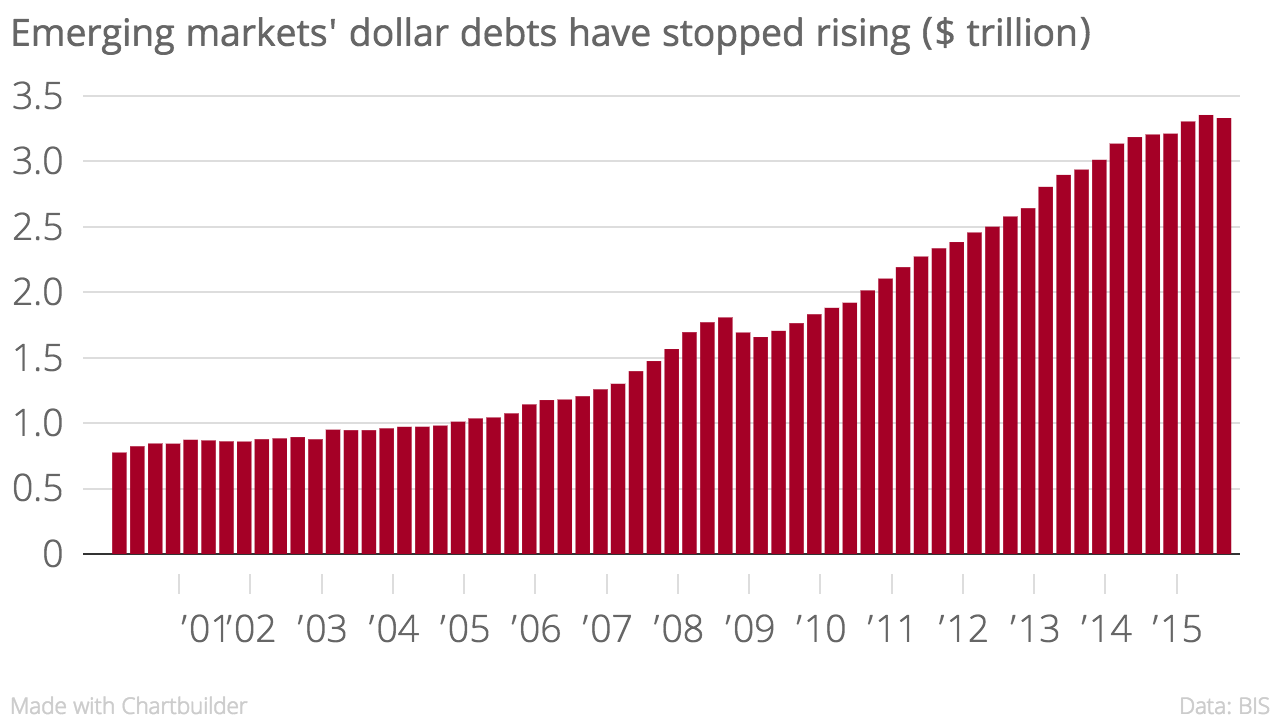
One long-held fear at the BIS has been the build up of dollar-based debts outside the US, especially in emerging markets. Dollar debts in emerging economies totalled $3.3 trillion (£2.3 trillion) in the three months to September, unchanged on the previous three months. It was the first time since 2009 the figure failed to grow.

Emerging market currencies have been falling against the dollar, making servicing external debts more expensive. And this has been occurring as domestic credit conditions have been turning.

Read more: What's helicopter money – and could it save the world?

“It is as if two waves with different frequencies came together to form a bigger and more destructive one,” Borio said.

“The most worrying development has been the steep rise in private sector debt elsewhere, especially in several emerging market economies including the largest – the main engines of global growth post-crisis. The increase has been strongest among corporates, whose profitability has been declining, and among commodity exporters.”

The BIS added: "If they persist, tighter global liquidity conditions may raise stability risks in some countries, especially those where other indicators already point to a heightened risk of financial stress."
Share this article

  • Facebook
  • X
  • LinkedIn
  • WhatsApp
  • Email

Similarly tagged content:

Sections

  • Jobs and Money

Categories

  • Investing
  • Money

Trending Articles

  • Revolut takes flight with launch of new airport lounges

  • Grandparents fund university degrees to avoid inheritance tax net

  • Brompton Bicycle sues former adviser for ‘professional negligence’

  • It’s not just Jason Arday, most of sociology is a scam

  • Revolut chatbot goes rogue by charging users to cancel subscription

More from Morning Wire

  • Bank of England to relax capital rules despite warning of economic threats

    Banking
    Bank of England building on Threadneedle Street, London, showcasing its historic architecture and financial significance
  • Bank of England warns Burnham of UK economy’s ‘big issue’

    Economics
    Bank of England Governor Andrew Bailey said the future of interest rates was "more uncertain".
  • Oil prices return to crisis levels

    Markets
    Close-up of a petrol pump nozzle dispensing fuel at a gas station, highlighting rising fuel costs and economic impact.
  • Tale of two cities: London leaps ahead in global finance but domestic growth stalls

    Economics
    Getty Images number 2154617464 depicts a relevant scene for the articles unidentified content, suitable for business context.
  • Barclays and Lloyds back calls to digitalise UK markets and unlock £33bn boost

    Markets
    GettyImages 2211256637 showing a significant event or figure relevant to recent news updates in the business sector
  • Alpaca Launches German Equities Trading via Deutsche Börse Xetra

    Business Wire
  • Algoma Central Corporation to Issue Second Quarter Financial Results on August 7, 2026

    Business Wire
  • Financial services bankruptcies rise as MFS collapse ripples through sector

    Advisory
    Breaking news banner with bold headline and abstract background for a general news article on a business website.
MorningWire

Independent European business, markets and political news for decision-makers.

Morning Briefing

Europe

  • Germany
  • France
  • Europe
  • UK & Ireland

Business

  • Markets
  • Banking
  • Technology
  • Energy
  • Property
  • Fintech

Editorial

  • Opinion
  • Editorial Policy
  • Corrections
  • Contact

Company

  • About Morning Wire
  • Privacy Policy
  • Terms of Use
  • Cookie Policy
© 2026 Morning Wire Ltd · Published by Morning Wire Media, Bahnhofstrasse 65, 8001 Zürich, Switzerland
Privacy · Terms · Cookies · Facebook