Skip to content
Thursday 3 September 2026London --:--Frankfurt --:--Zurich --:--
NewslettersSearchEN · DE · FR
MorningWire

European business, markets and politics

FTSE 100
10,756.45
-0.30%
DAX
25,839.33
0.00%
CAC 40
8,280.63
0.00%
STOXX 50
6,362.15
0.00%
  • Europe
  • Markets
  • Business
  • Economy
  • Regulation
  • Politics
  • Opinion
More
GermanyFranceEU InstitutionsCompetitionPublic AffairsBankingTechnologyEnergy
  • Germany
  • France
  • Europe
  • Markets
  • Business
  • Economy
  • Regulation
  • Politics
  • Opinion
  • DE
Thursday 06 August 2020 10:38 am  |  Updated:  Thursday 06 August 2020 11:05 am

BoE puts negative interest rates in its ‘toolbox’ for the first time

By: Harry Robertson

Add as a preferred source on Google
BoE puts negative interest rates in its 'toolbox' for the first time
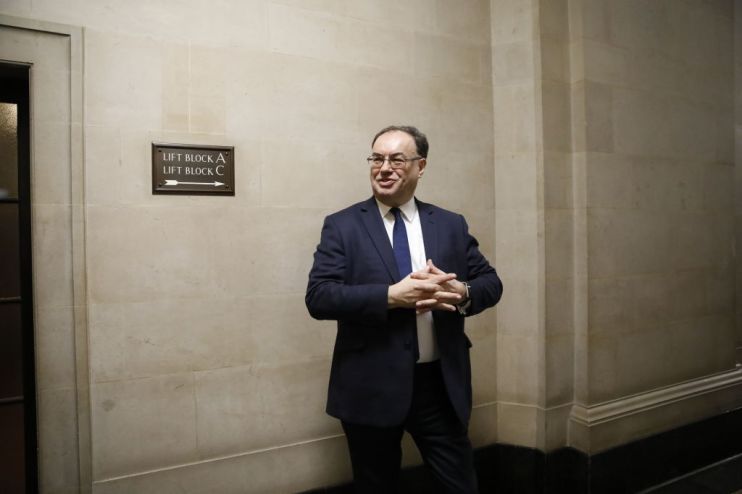
Bank of England governor Andrew Bailey said there is currently 'no plan' to use negative interest rates

The Bank of England has put negative interest rates in its “toolbox” of possible monetary policy measures for the first time, governor Andrew Bailey said today.

However, Bailey cautioned that the Bank does not currently “have a plan to use them”.

Read more: Bank of England says UK economy’s recovery will take longer than expected

It came as the Bank left interest rates on hold at their current record-low level of 0.1 per cent.

Negative rates would mean lenders that keep their money in the Bank of England’s virtual vaults would have to pay interest to do so, in an inversion of the usual system.

A few central banks, such as the European Central Bank (ECB), currently use them in an effort to get banks to lend out their spare cash and boost the economy.

Bailey announced that negative interest rates were under “active review” for the first time in May.

The Bank of England today concluded that they may be useful in some situations. They have therefore been added to the “toolbox” of measures the BoE has at its disposal.

Speaking to journalists, Bailey said: “This is, I think, the first time the Bank of England has said definitively, yes they’re in the toolbox.”

But he added: “We don’t have a plan to use them at the moment.”

Negative interest rates ‘more effective in an upswing’

As part of its review, the Bank of England has analysed the experiences of central banks that have turned to negative rates.

Bailey today said that no country has passed on sub-zero rates to everyday “retail” savers. 

He added: “So the larger the share of retail deposits in your banking system funding, obviously it follows from that the more attenuated the effect would be. And the UK does have a high share of retail deposits [in its bank funding].”

Read more

Economists urge Bank of England to halt bond sales as borrowing costs climb

Bank of England headquarters with financial charts overlay, illustrating private credit stress test analysis

He also said: “There’s a bit of evidence… that probably they’re more effective in an established upswing than they are in a rather difficult downswing.”

The Bank of England slashed interest rates to their current record lows in March. A cut in interest rates lowers borrowing costs throughout the economy and hopefully drives up lending and spending.

Bailey said there is no “hierarchy of the things we’d sort of tick off before doing negative rates”.

He said the Bank could do more “quantitative easing” bond-buying. Or it could change its “forward guidance” to reassure markets that rates would stay lower for longer.

Read more: What are negative interest rates and will the UK turn to them?

David Riley, chief investment strategist at Bluebay Asset Management, said he thought the Bank’s announcement showed it has “has cooled on the idea of negative interest rates”.

“More stimulus is likely to take the form of more purchases of gilts and measures to support bank lending.”

Lenders wary of sub-zero rates

The Bank of England could face opposition from lenders over negative interest rates, however.

They lower the so-called “net interest margin” – the difference between the cost of borrowing and the cost of lending – through which lenders make money. And they also cost banks the interest on their deposits.

Negative interest rates could also hurt savers by reducing the amount of interest they gain on their deposits. ECB President Mario Draghi was depicted as a blood-sucking vampire in the German tabloids for damaging the country’s savers.

The announcement on negative interest rates came as Threadneedle Street produced a more upbeat view of the path of the economy this year. It said it would contract by 9.5 per cent compared to an earlier estimate of 14 per cent.

Yet it said the recovery would take longer than initially expected as lower demand and business investment weigh on growth.

Read more

Mortgage nightmare as investors price in three interest rate hikes 

Bank of England building on Threadneedle Street, London, showcasing its historic architecture and financial significance

Share this article

  • Facebook
  • X
  • LinkedIn
  • WhatsApp
  • Email

Similarly tagged content:

Sections

  • Markets & Economics
  • News

Categories

  • Banking
  • Economics

Trending Articles

  • Vodafone and Deliveroo look to patch up Reform ties after Yusuf prison threats

  • Trio of firms poised to quit London Stock Exchange as exodus gathers pace

  • Easyjet’s over-60s recruitment push is economically necessary

  • Jim O’Neill: Capital gains tax hike ‘looms’ as top option for Burnham

  • ‘Large tax hikes on the way’: How the global bond rout is boxing in Healey

More from Morning Wire

  • Economists urge Bank of England to halt bond sales as borrowing costs climb

    Economics
    Bank of England headquarters with financial charts overlay, illustrating private credit stress test analysis
  • Mortgage nightmare as investors price in three interest rate hikes 

    Economics
    Bank of England building on Threadneedle Street, London, showcasing its historic architecture and financial significance
  • How patient can the Bank of England be?

    AD
    Historic Royal Exchange building in London with modern skyscrapers behind, clear blue sky.
  • How the Treasury got ‘fed up’ with the Bank of England’s payments plan

    Fintech
    The Bank of England's Breeden argued the recent inflation bump was transitory (Photo by Chris Ratcliffe/Bloomberg via Getty Images)
  • El Nino heatwaves to ‘fuel inflation next year’

    Economics
    Firefighter in helmet and uniform watching a blazing forest fire at night, red glow in the sky
  • HSBC kicks off $1bn share buyback after profit smashes forecast

    Banking
    HSBC's stock has taken a hit due to the huge tariffs slapped on Asian countries.
  • Starling plans to ‘come out swinging’ in diversification bid

    Fintech
    Smiling woman, potentially Starling CEO, over city skyline with STARLING branding
  • House prices remain sluggish in ‘subdued’ property market 

    Property
    Real estate signs: a yellow SOLD sign and a blurred green FOR SALE sign, indicating house prices and market activity.
MorningWire

Independent European business, markets and political news for decision-makers.

Morning Briefing

Europe

  • Germany
  • France
  • EU Institutions
  • Europe

Business

  • Markets
  • Business
  • Economy
  • Regulation
  • Competition
  • Public Affairs

Editorial

  • Opinion
  • Editorial Policy
  • Corrections
  • Contact

Company

  • About Morning Wire
  • Privacy Policy
  • Terms of Use
  • Cookie Policy
© 2026 Morning Wire Ltd · Published by Morning Wire Media, Bahnhofstrasse 65, 8001 Zürich, Switzerland
Privacy · Terms · Cookies · Facebook