BP says oil and gas investment needed for 30 more years to avoid energy shortages

The world risks energy price swings and shortages unless there is continued investment in the oil and gas sector over the next three decades, BP has warned.
In its annual energy outlook published today, the fossil fuel giant argued that natural declines in existing oil fields will mean further exploration and development will still be necessary.
“The recent energy shortages and price spikes highlight the importance of the transition away from hydrocarbons being orderly, such that the demand for hydrocarbons falls in line with available supplies,” Spencer Dale, BP’s chief economist, said.
“Natural declines in existing production sources mean there needs to be continuing upstream investment in oil and natural gas over the next 30 years,” he added.
Dale predicted that fossil fuels are still likely to account for about 20 per cent of primary energy in 2050 even under a significant tightening of climate policies.
Despite the call for continued investment in fossil fuels, BP trimmed its outlook for oil and gas demand.
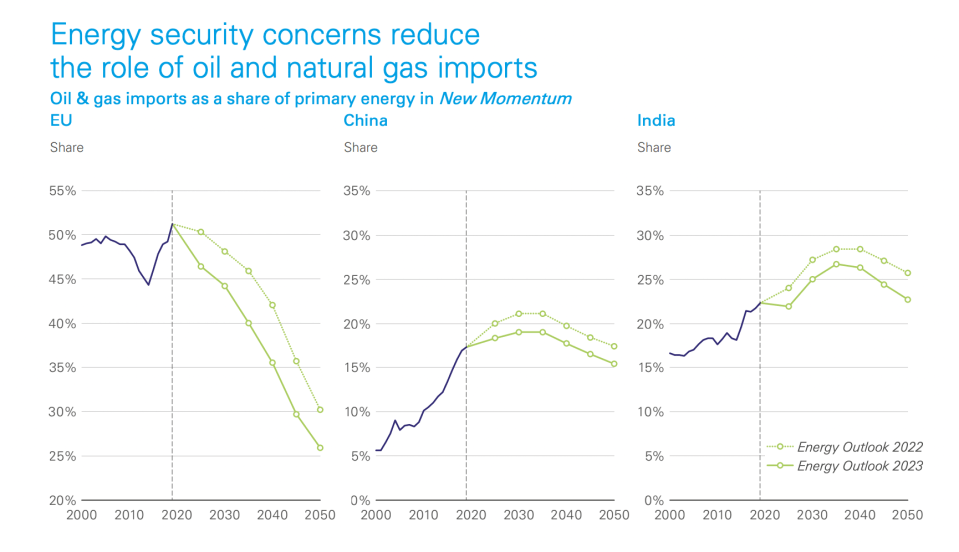
It argued the upheaval unleashed by Russia’s invasion of Ukraine means countries will focus on greater energy security over the next decade by investing in renewables.
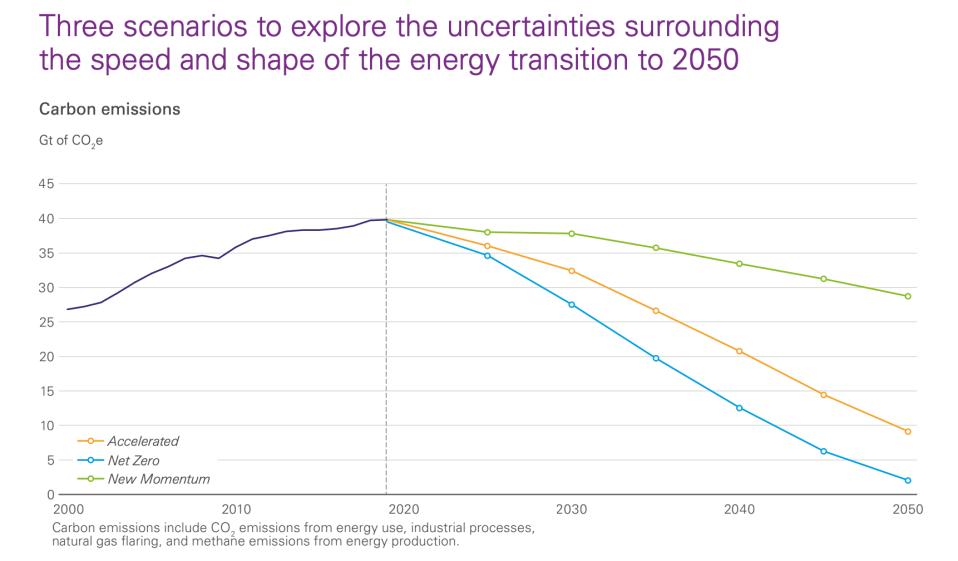
This means global carbon emissions could peak earlier in the 2020s than previously forecast, according to BP’s analysis.
“The experience from the major energy supply shocks of the 1970s suggests that events that heightened energy security concerns can have significant and persistent impacts on energy markets,” Dale explained.
The report outlined three scenarios for the evolution of the energy sector through to 2050.
Under its “new momentum” scenario, which is designed to “reflect the current broad trajectory” of the world’s energy system, it predicted oil demand would drop to around 93m barrels a day in 2035.
This is five per cent lower than it forecast last year, while natural gas demand would be six per cent weaker.
It would also mean global carbon emissions under the new momentum scenario would peak in the 2020s and reach 37.8 gigatonnes in 2030.
BP: Net zero 2050 target remains out of reach
Despite political support for the shift away from fossil fuels, BP warned that governments and industry are still far behind in the race to achieve net zero emissions by 2050.
In the new momentum scenario, global emissions would only fall 30 per cent from 2019 levels by 2050, according to the report.
BP calculated that a 95 per cent drop from 2019 levels was required for the world to achieve net zero emissions.
This would mean oil demand would remain around current levels, close to 100m barrel per say, through “much of this decade” before declining gradually to about 75m barrels per day 2050.
Under the “net zero” scenario, the study’s most aggressive outlook for a reduction in emissions, demand would drop to 70m barrels per day in 2035, before falling to 20m barrels per day in 2050.
Fiona Duggan, policy lead at climate charity Ashden criticised the report, and raised concerns over energy giants dictating terms for the clean energy transition.
She told Morning Wire: “The oil and gas industry should not be allowed to prescribe how fast we move away from fossil fuels, especially as the UK faces a triple whammy of a climate, energy and cost of living crisis.
“Instead of supporting more oil and gas, the UK should be ploughing money into investments that will rapidly reduce prices for struggling families and reduce emissions for a struggling planet. This means increasing the supply of cheap, clean renewable energy, and working to decrease energy demand through a retrofit revolution.”
By contrast, Connor Axiotes, director of communications at the Adam Smith Institute had a warmer outlook towards BP’s findings.
He said: “BP are right: this has been a year of energy turmoil the like of which we have not seen in the UK for decades. A war in Ukraine, supply-side issues, and resultant inflation has proved a potent triple threat to European energy production.
“Renewable energy provides a significant proportion of the UK energy demand, but not enough to rely on fully. The UK, much like Europe, is still reliant on gas from abroad.”
Andy Mayer, energy analyst at free market think tank the Institute of Economic Affairs had a more equivocal view of the report.
He noted that BP’s report makes little reference to potential trade-offs in chasing net zero targets, and whether it undermines security of supply and affordability.
“This is the central question in climate policy. To deliver climate solutions, do we want to prioritise growth rooted in exploiting what we have, or emissions targets rooted in controlling behaviour. Which approach is more affordable, secure, and likely to work?” Mayer said.
In his view “innovation is the only way to solve climate change long-term,” which included the “important role of markets in driving change.”
“The alternative central planning approach underwrites private risk with public money. These bad bets in turn misallocate resources, raise prices, and ensure a slower, less affordable transition,” Mayer concluded.