Britain must speed up to survive the AI era

The AI era will reward the small number of countries that can adapt and build quickly enough and it will punish those that can’t, says Sam Richards
“Well, in our country,” said Alice, still panting a little, “you’d generally get to somewhere else – if you ran very fast for a long time, as we’ve been doing.”
“A slow sort of country!” said the Queen. “Now, here, you see, it takes all the running you can do, to keep in the same place. If you want to get somewhere else, you must run at least twice as fast as that!”
Lewis Carroll’s Through the Looking Glass
For most of my life, Britain has assumed we live in Alice’s world. No need to rush. Our prosperity and security, accumulated over centuries, could simply be maintained by a gentle jog. Growth could be a bit slower. Infrastructure could take a bit longer. Planning rules could become a bit more cumbersome. We muddle through.
If ever that were true, that assumption belongs to a previous age. We are in the Red Queen’s world now. AI is an accelerant. It is already speeding up scientific discovery, software development, research, logistics and innovation. A problem that occupied generations of biologists – predicting the structure of proteins – can now be solved in hours rather than years using AI systems. Software engineers increasingly rely on AI tools to generate code, identify bugs and automate routine tasks that once consumed hours of work.
From drone warfare to spreadsheets; the world will soon be running at a new speed. AI will reward the small number of countries that can adapt to the new pace and it will punish those that cannot.
We are entering the most important technological upheaval since the Industrial Revolution, an invigorating and terrifying period of acceleration, at precisely the moment Britain has become exceptionally slow at just about everything
That should inject all of us with a squirt of panic. We are entering the most important technological upheaval since the Industrial Revolution, an invigorating and terrifying period of acceleration, at precisely the moment Britain has become exceptionally slow at just about everything.
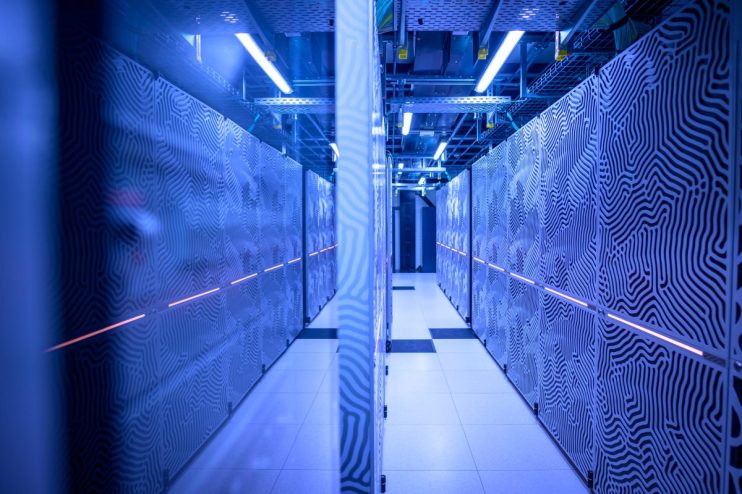
AI requires vast amounts of computing power, “compute”. It is quite possibly the single most important resource of the century. Compute requires data centres. Data centres require electricity. Electricity requires power stations, transmission lines and grid capacity. Almost every part of that chain is constrained by our planning system. It has been over 30 years since we last built a new nuclear power station. The one we are currently building is set to be again delayed because regulators have deemed the £700m spent on fish protection insufficient.
We have somehow convinced ourselves that growth happens independently of physical infrastructure; that you can have a thriving economy without building anything.
Compute is crucial
But the AI economy will be built somewhere, and the stakes on who hosts it, and who therefore captures the growth are much higher than many realise. We’re all too familiar with the consequences of our failure to grow over the last two decades. A weekly shop that takes up ever more of the budget, energy bills that only seem to go up, desperate calls to the GP at 8am to get one of the few available appointments. No growth means every debate has become zero sum; a fight between different groups for their slice of a diminishing pie.
Yet fail to capture the productivity gains of AI and even the disastrous status quo will soon appear a lost utopia.
Today, Britain can buy technologies invented elsewhere. We may not manufacture many semiconductors, but we can import them. We may not dominate cloud computing, but we can rent it. In the future AI will be different, and it will divide the world into makers and takers.
The makers will own the models, the chips, and crucially the compute. They will capture the lion’s share of the economic gains. The takers will consume AI services developed elsewhere, paying ever-increasing rents to foreign firms. It does not take much to imagine a world in which the most powerful AI systems are controlled by a handful of American tech companies and the Chinese state. We live in that world. Now imagine that world accelerated, a world in which, in order to stand still, the businesses, governments, and militaries of every country on the planet are wholly reliant on the scarce, expensive compute that is owned almost exclusively by those actors.
Britain still has a chance to be something different: a country that shapes this revolution as we built the last one. That future branch of history is still available. But it requires us to build now: the energy, the grid, the infrastructure.
Those who argue that a slower, more cautious approach protects what we have are wrong. In the Red Queen’s world, standing still is not safety. It is falling behind under someone else’s terms.
Sam Richards is campaign director and CEO at British Remade