Skip to content
Monday 10 August 2026London --:--Frankfurt --:--Zurich --:--
NewslettersSearchEN · DE
MorningWire

European business, markets and politics

FTSE 100
10,901.09
+0.31%
DAX
26,319.45
+0.69%
CAC 40
8,714.93
+0.17%
STOXX 50
6,523.86
+0.33%
  • Europe
  • Markets
  • Business
  • Economy
  • Technology
  • Politics
  • Opinion
More
GermanyFranceBankingAIEnergyFintechPropertyCapital Markets
  • Germany
  • France
  • Europe
  • Markets
  • Business
  • Economy
  • Technology
  • Politics
  • Opinion
  • DE
Wednesday 15 April 2026 2:11 pm  |  Updated:  Wednesday 15 April 2026 2:46 pm

Britain’s energy future is bright – but we still need Ed Drilliband

By: Simon Hunt

City Editor

Add as a preferred source on Google
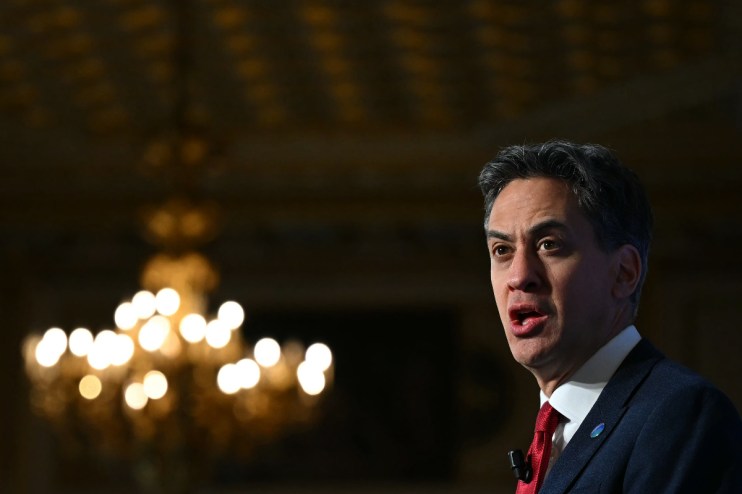
Energy Secretary Ed Miliband's
Energy Secretary Ed Miliband has backed the "fight" for net zero. (Photo by Justin Tallis - WPA Pool/Getty Images)

Amid soaring oil prices and growing fears of jet fuel shortages, it feels as though Britain is trapped in an energy permacrisis of its own making.

So here’s a note of optimism to counter the doom and gloom: Britain has a bright energy future ahead of it. A few examples:

Nuclear power output is going to get massively ramped up with the opening of two new plants in Hinkley Point C in Somerset and Sizewell C in Suffolk. With a combined output of 6.4 gigawatts, they are enough to power about one-seventh of the UK’s electricity demand.

Innovative nuclear technology will boost that capacity further. This week’s announcement that the government is funding the Rolls-Royce small modular reactor (SMR) programme opens the way for the installation of mini nuclear plants across the country, speeding up building and deployment times. 

And Dogger Bank, off the coast of Yorkshire, is set to be the world’s largest offshore wind farm. Its individual sections are expected to deliver a combined 8.1 gigawatts, enough to power more than 12m homes.

Taken together, that means a lot more capacity added to the UK, getting us closer to energy independence.

OK, that’s enough optimism for one day. Because there’s one small problem with all this: it’s years away.

Hinkley C is expected to begin operation in 2030. Dogger Bank won’t be completed till 2031. Rolls-Royce’s SMR scheme is expected at some point in the mid-2030s and Sizewell C isn’t due to be finished till the late 2030s.

By 2040, therefore, we could be in a good place. There’s just the small matter of getting through the next 14 years.

And that matters because in the here and now, Britain has the most expensive electricity of any major country in the world. This is the main driver of industrial decline. Firms are already going bust left right and centre. 

Read more

Sizewell B granted 20-year life extension

Sizewell B nuclear power station in Norfolk with clear skies and surrounding landscape, highlighting energy infrastructure.

A survey of more than 600 senior business leaders, conducted by advisory firm FRP as hostilities in the Middle East began, found that 43 per cent cited rising energy costs as the most important trigger event for their business since the 2024 general election – ahead of AI (35 per cent), government policy (31 per cent) and regulation (28 per cent).

Even if the 2040s looks bright, how much of a toll will high electricity prices have taken on our industrial heartlands? By then, what will be left?

There is another problem, too: the increased domestic capacity won’t bring down prices. 

As lobby group Electrify Britain notes in its latest report: 

“Even if the generation mix becomes cheaper at the margin, retail bills may remain elevated because legacy policy costs remain embedded in electricity prices and network cost recovery continues to rise…That gap between explanation and household experience is precisely what erodes trust and fuels political anger.”

Electrify Britain, which notes that wholesale costs only account for about a third of household energy bills, has called for other aspects like policy costs and VAT to be stripped out.

Time for Ed Drilliband

All this makes it look less like an oversight and more of an act of economic vandalism that the energy secretary, Ed Miliband, is refusing to offer new oil and gas drilling licences in the North Sea. 

Miliband’s ambitions for net zero are noble. But the lesson from the leaders in green energy, Canada and Norway, is that expanding renewable power capacity need not come at the expense of domestic oil production. Instead, taxes from traditional sources can be deployed on expanding electricity infrastructure and bringing down prices.

So yes, Britain’s energy capacity looks to have a bright future. Only it’s years away and we may get little benefit from it.

Read more

Grid operator issues fresh heatwave warning over power supplies

Air conditioning vents in a grid pattern, illustrating cooling solutions during a heatwave

Share this article

  • Facebook
  • X
  • LinkedIn
  • WhatsApp
  • Email

Similarly tagged content:

Sections

  • News

Categories

  • Business
  • Opinion

People & Organisations

  • Ed Miliband
  • electric
  • electricity bills
  • electricity costs
  • Energy
  • energy bills
  • gas price
  • Labour
  • Labour Party
  • nuclear energy
  • UK economy
  • UK Government
  • wind farms

Trending Articles

  • Burnham facing calls to cut employment red tape as job seekers grow for 41 months

  • Government to inject millions into electric vehicle firms despite mandate backlash

  • Silence Therapeutics to Host Conference Call and Webcast to Discuss Topline Results from Phase 2 SANRECO Trial of Divesiran in Polycythemia Vera

  • Stop burying us in swollen corporate reports, says audit watchdog boss

  • Hargreaves Lansdown orders staff back to office

More from Morning Wire

  • Sizewell B granted 20-year life extension

    Energy
    Sizewell B nuclear power station in Norfolk with clear skies and surrounding landscape, highlighting energy infrastructure.
  • Grid operator issues fresh heatwave warning over power supplies

    Energy
    Air conditioning vents in a grid pattern, illustrating cooling solutions during a heatwave
  • Westinghouse and Amentum Partner to Expand Delivery Capacity for APX Fleet Deployment

    Business Wire
  • Quaise Energy Raises $134 Million in Initial Close of Series B to Build World’s First Superhot Geothermal Power Plant

    Business Wire
  • Rehlko Announces €12 Million Expansion of Power Control & Distribution Manufacturing Facility in Cholet, France

    Business Wire
  • Energy minister says AI must ‘bring down bills’ as data centres squeeze the grid

    Tech
    National Grid has raised billions from investors for the energy transition
  • Vance says ‘broken’ Britain must rebuild economy, not just change PM

    Politics
    Andy Burnham returns to Parliament
  • Octopus tells Burnham to ‘cut bills’ with £189 energy plan

    Politics
    Andy Burnham engaged in discussion with Goalhanger, highlighting key insights and perspectives in a dynamic news setting.
MorningWire

Independent European business, markets and political news for decision-makers.

Morning Briefing

Europe

  • Germany
  • France
  • Europe
  • UK & Ireland

Business

  • Markets
  • Banking
  • Technology
  • Energy
  • Property
  • Fintech

Editorial

  • Opinion
  • Editorial Policy
  • Corrections
  • Contact

Company

  • About Morning Wire
  • Privacy Policy
  • Terms of Use
  • Cookie Policy
© 2026 Morning Wire Ltd · Published by Morning Wire Media, Bahnhofstrasse 65, 8001 Zürich, Switzerland
Privacy · Terms · Cookies · Facebook