Skip to content
Wednesday 19 August 2026London --:--Frankfurt --:--Zurich --:--
NewslettersSearchEN · DE · FR
MorningWire

European business, markets and politics

FTSE 100
10,728.04
+0.07%
DAX
26,128.36
0.00%
CAC 40
8,509.36
0.00%
STOXX 50
6,468.17
0.00%
  • Europe
  • Markets
  • Business
  • Economy
  • Regulation
  • Politics
  • Opinion
More
GermanyFranceEU InstitutionsCompetitionPublic AffairsBankingTechnologyEnergy
  • Germany
  • France
  • Europe
  • Markets
  • Business
  • Economy
  • Regulation
  • Politics
  • Opinion
  • DE
Tuesday 03 January 2023 9:45 am  |  Updated:  Tuesday 03 January 2023 12:48 pm

British factories yanked into recession by inflation, energy costs and wilting demand
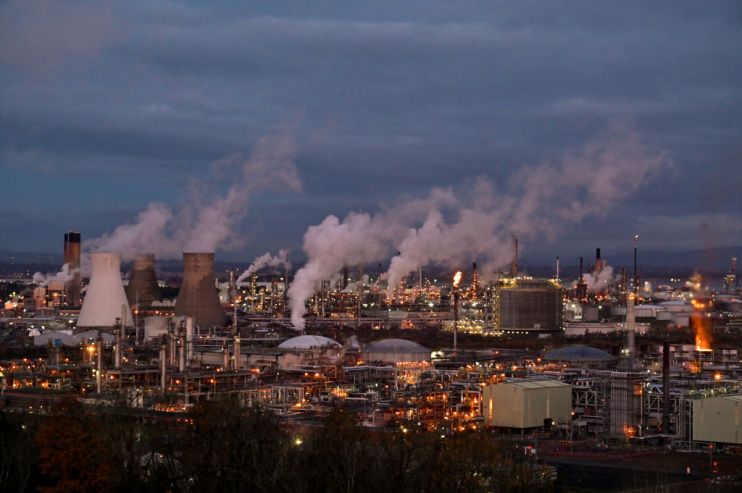
The UK economy is in recession, driven by inflation and lower demand
Higher energy costs sparked by a combination of Russia’s invasion of Ukraine and resurgence in global demand after the end of Covid-19 restrictions has forced factories to scale back unprofitable activity (Photo by Jeff J Mitchell/Getty Images)

British factories are being yanked into recession by inflation, swelling costs and stumbling demand in a further sign the country is now in the early stages of a tough slump, a closely watched survey out today reveals.

S&P Global and the Chartered Institute of Procurement and Supply’s (CIPS) final purchasing managers’ index (PMI) for the British manufacturing industry came in at 45.3 last month, the lowest reading since the early stages of the pandemic and down from 46.5 in November.

But, the reading was bumped up from an initial estimate of 44.7. It was still far below the 50 point threshold that separates growth and contraction.

Higher energy costs sparked by a combination of Russia’s invasion of Ukraine and resurgence in global demand after the end of Covid-19 restrictions has forced factories to scale back unprofitable activity.

A shallower jobs force in Britain since the pandemic and workers demanding inflation busting pay rises has added to factories’ costs.

UK factories are being hobbled by stalling demand
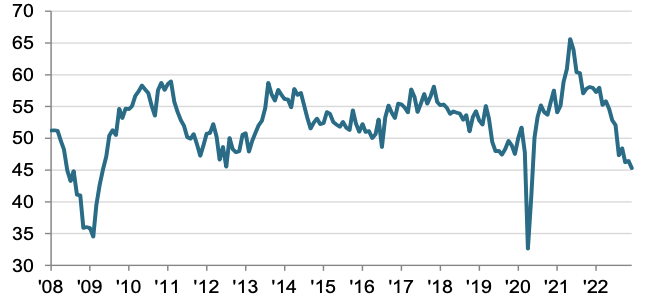
Factories are being spiked by rising costs, forcing the latest PMI to its lowest level since the early days of the Covid-19 crisis.
Source: S&P Global and CIPS

Rob Dobson, director at S&P Global Market Intelligence, said: “The UK manufacturing downturn took a further turn for the worse at the end of the year.”

“Output contracted at one of the quickest rates during the past 14 years, as new order inflows weakened and supply chain issues continued to bite,” he added.

The PMI is the first major piece of data out in a year that is likely to be tough for the UK economy.

‘SLOW-BURN’ RECESSION

Consumer spending is expected to be hobbled by households’ purchasing power being eroded by high inflation, the Bank of England’s nine successive interest rate rises passing through the economy and tax hikes.

Read more

Manufacturers overcome gloomy economy as output surge continues

Manufacturing sector faces mounting tribunal pressures amid economic uncertainty

Inflation dropped to 10.7 per cent in November from 11.1 per cent, prompting experts to bet the rate of price growth has now passed its peak. However, pay increases are still likely to lag inflation in 2023.

Most economists reckon the country is in the early stages of a recession that will last between a year or two years.

Figures out from the Office for National Statistics last month unveiled GDP dropped a deeper than first calculated 0.3 per cent. The economy did grow 0.5 per cent in October on a monthly basis, although output was boosted by the lost working day in September for The Queen’s funeral.

Expectations of a reduction in consumer spending in response to worsening finances are prompting businesses to rein in capital goods purchases, products supplied by manufacturers.

“The decline in new business was worryingly steep, as weak domestic demand was accompanied by a further marked drop in new orders from overseas,” Dobson added.

“Demand for industrial goods likely will be hit again in Q2, as real incomes are squeezed by the watering down of government support for energy bills and higher unemployment, as businesses are forced to consolidate costs,” Gabriella Dickens, senior UK economist at Pantheon Macroeconomics, said.

Factories last month shed workers to rein in expenditure ahead of a reduction in spending. The PMI employment index dropped to 45.5, its lowest level since August 2020.

Output price inflation slowed markedly last month due to firms expecting customers to shun higher prices amid a tight real income crunch.

Read more

Soaring energy bills set to fuel inflation spike

Smartphone displaying an energy bill notification with British coins and a banknote nearby.

Share this article

  • Facebook
  • X
  • LinkedIn
  • WhatsApp
  • Email

Similarly tagged content:

Sections

  • Markets & Economics
  • News

Categories

  • Economics

Related Topics

  • Purchasing Managers' Index (PMI)
  • UK inflation
  • UK interest rates

Trending Articles

  • As it happened: FTSE 100 drops as oil prices rise after Trump makes Hormuz threat

  • Jobless Banquet: Youth unemployment surge ‘sends Neets to KFC’

  • US bond market jitters spark UK economy recession warning

  • Monzo chair makes early exit after boardroom rift

  • New Premier League rules could see £11bn invested into new stadiums

More from Morning Wire

  • Manufacturers overcome gloomy economy as output surge continues

    Industrials
    Manufacturing sector faces mounting tribunal pressures amid economic uncertainty
  • Soaring energy bills set to fuel inflation spike

    Economics
    Smartphone displaying an energy bill notification with British coins and a banknote nearby.
  • Brits dodge the high street as heatwave boosts online shopping

    Retail
    Shoppers carrying various retail bags, including New Look and M&S Food, on a paved street, indicating retail sales activity.
  • Picky Brits: Heatwave fuels surge in finger food spending

    Retail
    Tesco quiche, cured meats, olives, and dip on a wooden board, ready for a party or meal.
  • ‘False dawn’: June inflation falls to 2.6 per cent but analysts say rises ahead

    Economics
    Till sales growth slowed to 2.7 per cent in the last four weeks
  • Four charts revealing scale of Andy Burnham’s economic challenge

    Economics
    Due to the lack of article title, content, categories, and tags, its impossible to create a specific, keyword-rich alt tex...
  • House prices slump as Iran war and interest rates hit demand

    Property
    The price paid for first homes has surged 7.1 per cent in a year
  • Burnham should go on a ‘cost of doing business’ tour

    Economics
    Andy Burnham, Mayor of Greater Manchester, in a dark suit and glasses, listening intently at a wooden table.
MorningWire

Independent European business, markets and political news for decision-makers.

Morning Briefing

Europe

  • Germany
  • France
  • EU Institutions
  • Europe

Business

  • Markets
  • Business
  • Economy
  • Regulation
  • Competition
  • Public Affairs

Editorial

  • Opinion
  • Editorial Policy
  • Corrections
  • Contact

Company

  • About Morning Wire
  • Privacy Policy
  • Terms of Use
  • Cookie Policy
© 2026 Morning Wire Ltd · Published by Morning Wire Media, Bahnhofstrasse 65, 8001 Zürich, Switzerland
Privacy · Terms · Cookies · Facebook