Skip to content
Sunday 9 August 2026London --:--Frankfurt --:--Zurich --:--
NewslettersSearchEN · DE
MorningWire

European business, markets and politics

FTSE 100
10,901.09
+0.31%
DAX
26,319.45
+0.69%
CAC 40
8,714.93
+0.17%
STOXX 50
6,523.86
+0.33%
  • Europe
  • Markets
  • Business
  • Economy
  • Technology
  • Politics
  • Opinion
More
GermanyFranceBankingAIEnergyFintechPropertyCapital Markets
  • Germany
  • France
  • Europe
  • Markets
  • Business
  • Economy
  • Technology
  • Politics
  • Opinion
  • DE
Friday 17 April 2026 5:00 am  |  Updated:  Thursday 16 April 2026 3:54 pm

Can Volkswagen really pivot to defence?

By: Saskia Koopman

Tech Reporter

Add as a preferred source on Google
Volkswagen is suffering from high costs, fierce Asian competition and a prolonged bitter conflict with unions over plant closures.
Volkswagen’s planned workforce reduction is set to lower to 100,000 employees

Can Volkswagen really pivot into defence? Saskia Koopman examines whether one of Europe’s great industrial names can reinvent itself for an era of rearmament.

For most of its eight-decade history, Volkswagen has stood as a symbol of Europe’s industrial might – churning cars out at scale and underpinning entire regional economies.

But at the company’s Osnabrück megaplant, where production is due to wind down, Volkswagen (VW) is now exploring a future far removed from SUVs and family saloons.

Talks with Rafael Advanced Defense Systems over producing components linked to missile defence systems show that the continent’s industrial titans are running out of easy options.

The pressures bearing down on Volkswagen are by now well-documented. Demand for electric vehicles has proved patchier than optimists promised, Chinese rivals are gaining ground at dizzying rates, leaving German incumbents falling behind on both cost and quality.

The company’s own numbers hold a mirror up to those pressures, with profits tumbling and 50,000 job cuts reportedly on the horizon by 2030.

Meanwhile, defence is heading emphatically in the opposite direction. Governments are globally pouring capital into rearmament, order books appear to be swelling, and political backing shows no sign of wavering.

For firms sitting on idle capacity and a highly skilled workforce, the sector offers viability and growth, two increasingly rare gains in European manufacturing: visibility and growth.

There is a surface plausibility to the idea, with VW’s automotive plants already operating highly complex supply chains and large-scale production – capabilities not entirely alien to defence infrastructure.

The German automobile giant has gone to great lengths to stress that weapons production remains off the table, framing any potential involvement as “defence-adjacent”.

Even so, the move redraws the boundary between civilian industry and military supply chains in a way that would have seemed unlikely just a few years ago.
Read more

Volkswagen California 2026 review: plenty of room at the Hotel California

Red Volkswagen VW California camper van with pop-top roof extended, parked on a road with hills in background.
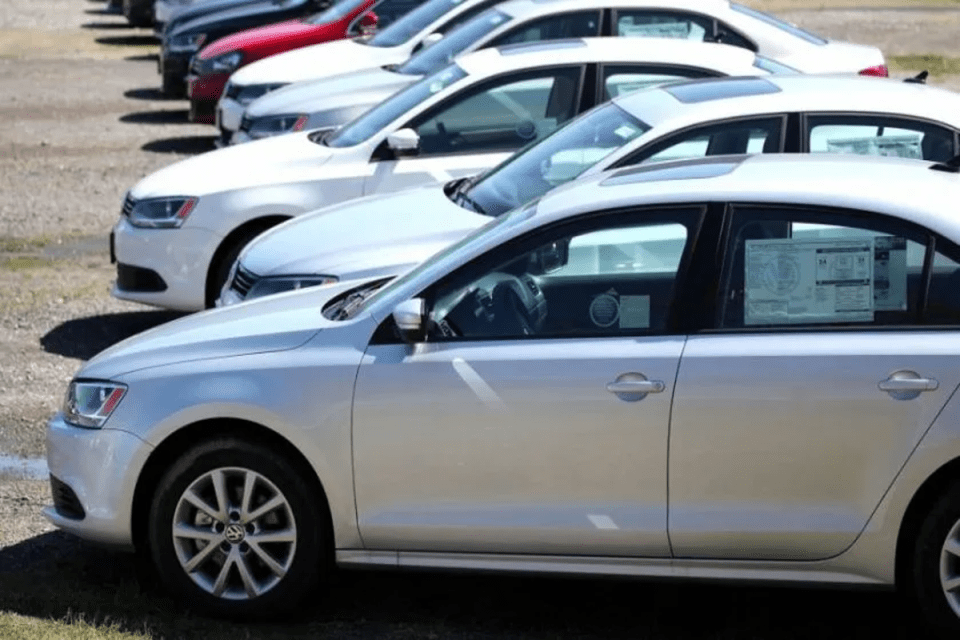
The fall in the value of used cars has hit the finances of a car dealership group. (Getty)
A lot of German marques have fallen behind in the electric vehicle arms race

Various obstacles on the horizon

And yet the distance between aspiration and execution is quite considerable.

Modern defence manufacturing is highly specialised, capital-intensive and tightly controlled. Traditionally, it has also been dominated by incumbents with deep expertise, not to mention in entrenched relationships with governments.

These are not advantages that can be acquired quickly, however capable the new entrant.

New entrants like VW may find a role in the margins, but it is unlikely, at least in the near term, to be transformative.

For the company, the more immediate priority is survival at the plant level. Around 2,300 jobs are currently tied to Osnabrück, and a partnership with Rafael could keep those roles safe, and offer, as well as a credible alternative to closure.

But the complications do not end there. Any tie-up with an Israeli defence giant carried obvious political weight, particularly at a moment when European public opinion on the Middle East is as raw as it is now.

There are ethical considerations, too, for workers asked to move from civilian to military-linked production.

And looming behind it all is Volskwagen’s own history: the company’s involvement in wartime manufacturing still casts a long shadow over any return, however indirect, to the sector.

Europe’s industrial base is being reshaped by various forces that show little sign of relenting. The old reassurances – cheap energy, tech leadership – are under immense strain,

In their absence, companies like Volkswagen are being driven to pursue growth wherever they think it can be found, even when the road leads somewhere they would once have been reluctant to go.

Read more

City watchdog suspends parts of £9bn motor finance scheme after industry backlash

The FCA has appointed Liam Coleman interim chair of the FOS.

Share this article

  • Facebook
  • X
  • LinkedIn
  • WhatsApp
  • Email

Similarly tagged content:

Sections

  • News

Categories

  • Business

People & Organisations

  • auto giant
  • Auto Trader
  • car maker
  • Defence
  • missile production
  • Volkswagen
  • volkswagen plant
  • VW

Trending Articles

  • Thames Water faces fresh threat to survival after pensions regulation breach

  • PwC’s Embankment HQ to get major makeover ahead of Canary Wharf move

  • Family feud: London estate agent Winkworth sues chair over plot with wife to oust son from board

  • As it happened: Stocks rise despite new tensions in Strait of Hormuz; Oil price climbs

  • A tribute to wine legend Matthew Jukes by his friend Libby Brodie

More from Morning Wire

  • Volkswagen California 2026 review: plenty of room at the Hotel California

    Life&Style
    Red Volkswagen VW California camper van with pop-top roof extended, parked on a road with hills in background.
  • City watchdog suspends parts of £9bn motor finance scheme after industry backlash

    Banking
    The FCA has appointed Liam Coleman interim chair of the FOS.
  • AI, drones and data: Defence giants splash record $4.1bn on tech start-ups

    Tech
    Defence
  • Government intervenes on foreign takeover bids for UK defence firms

    Industrials
    UK defence strategy meeting, officials discussing military advancements and security measures in a conference room setting
  • Gradiant Supports Landmark Semiconductor Manufacturing Expansion in Dresden

    Business Wire
  • AI data centres and defence tech lead investment wave

    Tech
    Business professionals in a modern office discussing a strategic plan with charts and graphs displayed on a large screen
  • Exclusive: Jobs lost across Labour’s ‘growth potential’ sectors in blow to Burnham

    Politics
    Jonathan Reynolds, Labour MP, in a suit and tie, holding a notebook, looking right, with a building behind him
  • Babcock and Rolls-Royce stocks rally after Healey appointment

    Industrials
    Defence secretary John Healey is leading calls for further investment in the sector.
MorningWire

Independent European business, markets and political news for decision-makers.

Morning Briefing

Europe

  • Germany
  • France
  • Europe
  • UK & Ireland

Business

  • Markets
  • Banking
  • Technology
  • Energy
  • Property
  • Fintech

Editorial

  • Opinion
  • Editorial Policy
  • Corrections
  • Contact

Company

  • About Morning Wire
  • Privacy Policy
  • Terms of Use
  • Cookie Policy
© 2026 Morning Wire Ltd · Published by Morning Wire Media, Bahnhofstrasse 65, 8001 Zürich, Switzerland
Privacy · Terms · Cookies · Facebook