Champions League was meant to get more exciting. It’s anything but

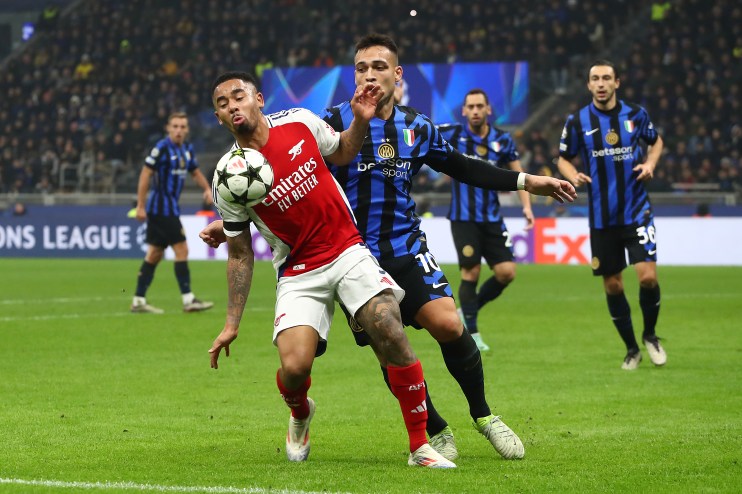
It’s half time in the league stage of the reformatted Champions League and doubters’ concerns about the sporting appeal of the expanded competition appear increasingly well-founded.
Uefa has deepened the financial well of European club competition but its waters may have been poisoned in the process.
First, a reminder. Previously, the Champions League group stages pitted 32 clubs against each other in groups of four – meaning six matches guaranteed for each team. Now, 36 clubs compete under the so-called ‘Swiss’ system in which each plays eight games and all are ranked in one long ladder.
Where the top two teams per group advanced to a round of 16, now the top eight in this league head into the knockout stages, the next 16 play off for the eight remaining places and the bottom 12 are eliminated.
The net effect for clubs is that it takes either 15 or 17 matches to win the trophy (depending on whether they advance with a top eight ranking or have to play a two-legged eliminator). That’s almost half as many as a team faces in a full Premier League season.
Before, the final was the participants’ 13th game in the competition. Overall, there are now 189 Champions League matches, a whopping 51 per cent increase on the previous 125. Total Premier League games in a season? 380.
Uefa says its modelling indicates that 7.6 points should be sufficient to make it through the league stage as a top 24 team. So, a point a game.
Four matches in and, on that basis, nine of the 36 teams are already safely through and seven need just a single point from their remaining games. At the other end of the table, five teams are pointless and increasingly without hope of progressing.
Analysts at Opta have run 50,000 simulations through their computer and conclude that 10 points pretty much guarantees a team progresses; nine points has a 69 per cent success rate. Tougher than Uefa’s own model.
Uefa has claimed that the Swiss system will reduce the number of dead rubber matches and ensure that the final set of games in which all 36 teams play simultaneously will be stacked with excitement.
I predict that this orgy of European football – scheduled for 29 January – will be anything but exciting. Nearly all of the 18 games may have minimal meaning and see managers resting players for upcoming domestic competition.
“There will be so much at stake [on 29 January] and I’ll be sitting on my couch and following everything happening at the same time. I will know that a goal in Paris could eliminate a team in Liverpool, or a penalty in Istanbul may have an influence on the qualification of a team in Amsterdam. The whole of Europe will be connected on that night.”
Stephane Anselmo, Uefa head of competitions strategic development
What meaning might there be? There will be a scuffle to make the top eight cut and avoid an elimination tie (although club finance directors might secretly hope for the additional home game that goes with a lower-placed finish). There will be a fiercer tussle around the 24th place line, although this may involve teams with relatively limited continent-wide TV appeal.
And, thirdly, every qualifying team will have an eye on their final position as this affects seedings for the knock-out stages. Hard to see this last factor setting fans’ pulses racing, however hard broadcasters try to pump up the jeopardy.
Uefa may have killed the first half of its showpiece club competition. If you doubt that, you should have been in my favourite multi-screened, football-watching pub in central London last Wednesday.
Where it used to be rammed on Champions League group stage nights, now it was half empty for the tail end of Aston Villa’s early evening match at Club Brugge and then the Inter versus Arsenal game.
There was no queue at the bar and as many people drinking on the pavement as inside to watch the Gunners. The general consensus was that groups of four are simple to understand; a confected ‘league’ of 36 in which teams play only eight games, not.
And if you can’t easily intuit the import of a sporting contest, you might as well catch up with your mates outside where you can hear each other without the blare of the Champions League anthem and over-excited TV commentary.
Romantics may hark back to the old European Cup’s straight knockout format, but a group stage was first introduced way back in 1991 and the Champions League branding arrived the next season.
With domestic cup competitions of diminishing significance across Europe, and 2021’s attempted Super League breakaway still fresh in memories and doubtless a nagging ambition of its original adherents, it should be no surprise that Uefa is building on the league element of its flagship competition. After all, it reduces the impact of any single surprise result, thus protecting the interests of the dominant teams.
Unhappy with the new-look Champions League? Well, it’s only locked in for three seasons. After that, my bet is that Uefa claims it to be a triumph and pushes for yet more teams in an expanded league.
Forty teams with a minimum of 10 matches each? I’ll leave it to you to judge just how ‘super’ that might then be.
Reach for the stars
And on the subject of ‘super’ leagues, kudos to Cricket West Indies for appropriating the title Global Super League for a tournament involving just five teams spanning a mere 11 matches, all played in one stadium in Guyana and starting later this month.
Hampshire Hawks are one of the participants in a cross-border contest that represents another land grab by franchise cricket.
Why Hampshire as opposed to any other English team to compete against the Lahore Qalandars, Rangpur Riders, Guyana Amazon Warriors and Australia’s Victoria? Perhaps the county’s incoming Indian owners had some sway.
A prize pot of $1m will be part-funded by sponsorship from ExxonMobil, but it’s hard to see how the numbers stack up to cover the expense of staging the event, especially teams’ costs including their players’ fees. There is no Indian participation, so likely no fat broadcast rights fee as a financial underpinning.
Perhaps Cricket West Indies reckon it can sell the brand to the ICC or BCCI further down the line, much like the cunning registrant of a snappy web domain name.
Working for the Aussie dollar
In real time, to the naked eye, Joseph Sua’ali’i’s one-handed flipped pass at Twickenham was simply jaw-dropping. Never mind that the 21-year-old was playing his first ever professional game of rugby union.
In that moment the question was why anyone was querying Rugby Australia’s decision to give the youngster transferring from rugby league a three-year contract reported to be worth AUS$5.35m (£2.74m).
This sum only looks big to rugby. It pales alongside rewards in football and cricket. Witness fellow Australian Mitchell Starc topping last year’s Indian Premier League auction at a price of around £2.3m for playing just a few weeks’ cricket.
With the British and Irish Lions touring Australia next year, Sua’ali’i’s contract should pay for itself many times over in promotional value alone.
Ed Warner is chair of GB Wheelchair Rugby and writes his sport column at sportinc.substack.com