Channel your inner Attenborough with a trip Australia’s Great Barrier Reef

“Look, over there – a bull shark.” My guide, Mark, points out the sleek, contoured shape with its distinctive dorsal fin and bluntly-shaped head – one of the most dangerous of its kind in the world – lazing idly in a sun-dappled patch of translucent, turquoise water.
My heartbeat accelerates slightly, but thankfully there’s no imminent threat; I’m spying on it from 500ft up, in a helicopter that’s whirring me across the Pacific so I can take in the sheer size and scope of one of the seven natural wonders of the world: the Great Barrier Reef.
The water is so clear you can practically see all the way down to the bottom, and during my hour-long trip, I also spot a playful pod of dolphins breaking the surface, and a couple of manta rays. Whales rear their heads here frequently during migratory season (May to November) and the odd, and rare leatherback turtle has been known to bob along in the depths.
There is quite literally nothing else on planet Earth like this reef. The only living thing that can be seen from space, its 3,800 coral banks and islands stretch over 1,600 miles and in total it covers a space equivalent to 133,000 square miles, or the approximate size of Japan.
Composed of living coral (a reef is formed when thousands of tiny creatures establish a colony, or coral polyp, and create hard exoskeletons to protect themselves from predators), each polyp gets its distinctive colour from the algae it harbours. When a polyp dies, a new one will form on the exoskeleton it leaves behind.
It’s estimated that this process has been steadily going on for around 20 million years; yet this phenomenon didn’t really start to come to the attention of the wider world until June 1770, when British explorer Captain James Cook and his crew ran into part of it, crippling their ship, the Endeavour.
By 1820, most of what we now recognise as the Barrier Reef had been officially charted. Today, we know that it’s home to over 1,500 different species of fish, and multiple varieties of whale, turtle, dolphin, shark and more.
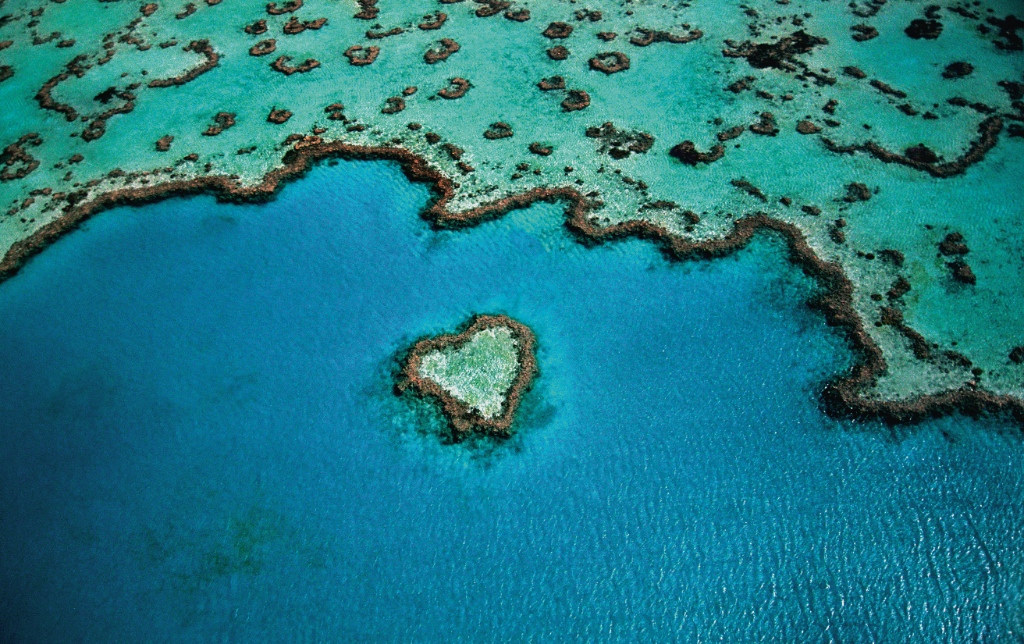
Taking off from the helipad on Hayman Island’s luxurious One&Only resort, situated on the most northern of the Whitsunday Islands, pilot Mark reveals he’s also going to fly me over one of the reef’s most romantic, and iconic, quirks: a coral formation in the shape of a heart.
Known, somewhat unimaginatively, as Heart Reef, it’s adorably Instagrammable, and also the setting for what must be either the world’s most exclusive, or cheesiest proposals. Mark tells me that he has been witness to several.
After being whisked the entire length of the almost fluorescent white, five-mile strip of Whitehaven beach – generally rated one of the world’s most beautiful owing to its composition of 98 per cent silica, making its sand as fine and silky as talcum powder – it’s time to see the Great Barrier Reef from beneath the waves. I’m going to go snorkeling, but with a turbo-charged twist.
The resort offers snorkelling by Sea Bob, a way to see more, going both deeper and faster than you could manage with flippers alone. Once I’ve got to grips with the very straightforward controls of what looks like a miniature, hand-held jetski, I power out of the marina and into open water. Then it’s down, down, down.
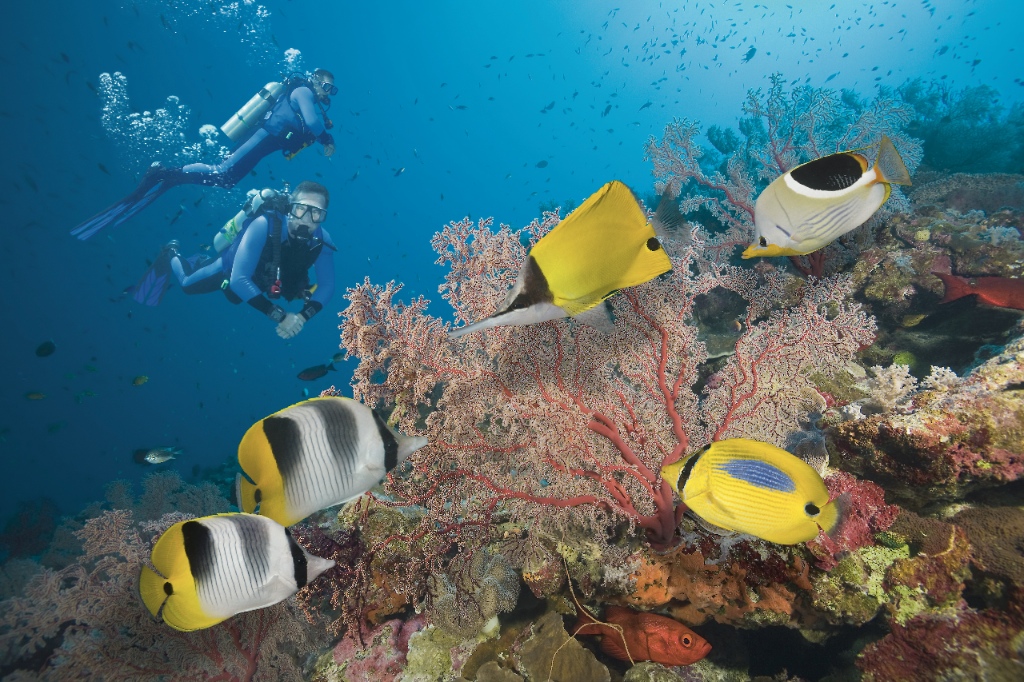
Sea Bobs here can descend to around three metres to join the denizens of the deep in their silent, psychedelic world. Electric blue damselfish, turquoise and lemon yellow surgeon fish, neon orange clownfish and iridescent parrotfish dart endlessly around tree-like formations of coral that rear out of the sea bed in every colour between boring beige and chalk blue. I poke at a rather phallic looking sea cucumber, which goes from floppy to rigid when squeezed (ahem), while the odd manta ray flaps past idly, its kite-shaped body pulsating as it glides through the sea.
It’s exhilarating, so it’s no wonder over two million people flock here every year. But in recent years there have been concerns about the future of the reef due to increases in tourist numbers, not to mention global warming. According to a study published in October 2012, the reef has lost more than 50 per cent of its coral cover since 1985. The conservation message is being spread, loud and clear, but perhaps it’s better to visit sooner, rather than before it’s too late.
I’m combining this trip with a visit to the Blue Mountains, whose rust-coloured sandstone ranges start just 31 miles outside Sydney; the name stems from the haze caused by the oil released by the eucalyptus trees that blanket them. A three-hour drive (or a 45 minute helicopter ride) from the city’s airport brings you to Wolgan Valley, home to another One&Only resort ringed by the mountains and flanked by two national parks. Set on over 7,000 acres of conserved parkland, it used to be home to a cattle ranch, and the 39-suite property pays a nod to its heritage with its stylish décor of mountain-lodge chic crossed with The Shining’s Overlook Hotel: all stone walls, open fireplaces, wood-panelled libraries, and cosy lounge bars.
This is your chance to play the great outdoorswoman. The land is crisscrossed with hiking and mountain-biking trails, although, in the spirit of the ranchers who originally moved here in 1832, I saddle up and go for a ride. Wildlife is never far away; you can barely move a few feet without tripping over a kangaroo, wallaby or wallaroo (a distant kanga relative), there are over 150 species of birds, and if you’re lucky, you might even spot a wombat.
I didn’t, but then after my not-so-close encounter with a shark, there’s only so much excitement a girl can take. Whether on land or under water, Australia will thrill you all the way.