From China with Love: Xpeng’s Luxury Ambition

China is changing the car industry at extraordinary speed. For affluent professionals used to proven premium brands, the next chapter of that transformation is becoming ever more challenging to turn a blind eye to, writes our motoring journalist Tim Barnes-Clay.
I had seen more Chinese cars than you can shake a stick at before, but this was different. I was flying to China itself – and it was my first time.
Once I had navigated Guangzhou-Baiyun Airport and immigration, made sure my eSIM and VPN were working, and downloaded Alipay and WeChat – vital tools in a land operating behind the Great Firewall – I felt significantly more confident about discovering Guangzhou. That is where Xpeng is headquartered.
The city proved an appropriate setting for a company trying to reframe what a modern automaker can be. You feel very much like a guest rather than a business traveller. The people were extremely polite, while the food was another highlight. I really enjoyed the restaurants, where the dishes were inventive and beautifully presented.
Then there was the technology. Flashing lights along some roads are used as anti-fatigue laser beams, devised to help keep night drivers alert. Meanwhile, blue lights on the exterior of some vehicles, including Xpeng models, signal when an intelligent or semi-autonomous driving system is operating. However, I understand these sapphire-esque luminosities are now being phased out.
There were androids, too. Xpeng’s ‘Iron’ robot, designed as a general-purpose humanoid tasked with handling routine and repeatable jobs, will be rolled out soon. By taking over repetitive tasks, the automaton aims to free up human workers to focus on responsibilities that need intuitive judgment. I got to put my arm around one or two for a photo shoot. Honestly, it was all mind-blowing – but in the most fantastic Doctor Who-like way.
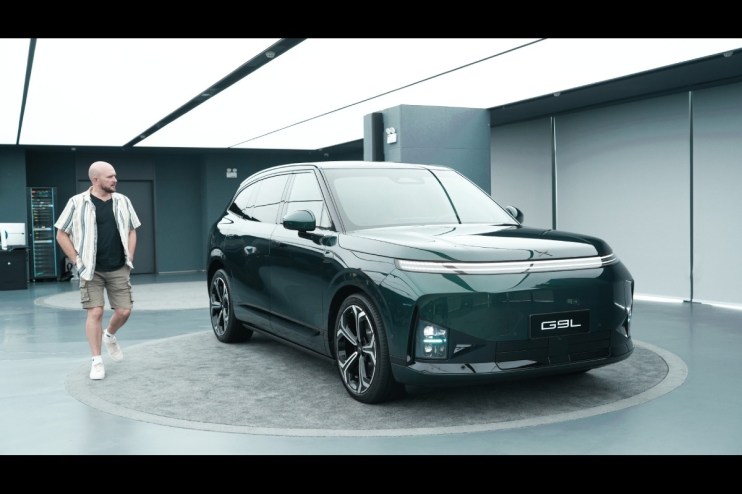
Against this backdrop, I caught an early look at Xpeng’s latest battery electric and range-extended model: the G9L. The ‘L’ stands for luxury, and the Chinese manufacturer is positioning it as a more premium evolution of its G9 SUV, which is sold in select markets across Europe. The G9L will make its European premiere at the Paris Motor Show in October.
A design for life
Joan Melenchon, Creative Design Director at Xpeng, says the G9L was conceived as a premium SUV, without the visual overkill sometimes associated with luxury cars.
“We wanted the power of the design to come from its proportions, the quality of the finishes and the overall design language,” he told me.
For a London executive or professional commuter, that approach makes sense.
A premium car should look elegant and feel both calming and invigorating, particularly when it’s being used for everything from meetings in the capital to motorway miles.
Xpeng has steered clear of filling the G9L with gratuitous flourishes. Melenchon describes it as expressive and sporty while keeping the space and practicality expected of a generously-sized SUV.
“I can see it in London, Barcelona and many other European cities,” he says.
China’s automotive talent
One of the more illuminating conversations in Guangzhou was about who is designing China’s fresh generation of vehicles.
There remains a perception in Europe that Chinese manufacturers crave Western design expertise. Melenchon believes that view is becoming passé.
“There is an amazing amount of local Chinese talent now,” he says.
The Chinese automotive industry has established a colossal pool of engineers, designers and technology experts, while international experience continues to add another stratum.
The result is a development process able to move exceptionally quickly.
The progress is no longer limited to exterior styling, either. Interiors, software and user experience have all advanced swiftly.
For premium car buyers, that creates a more thought-provoking question than whether a Chinese whip can compete on price.
Xpeng’s bigger tech play
During my time with Xpeng, I also spoke to Yeqing Zheng, Vice President, General Counsel.
Technology, he says, will be central to the company’s expansion into international markets.
“We already have the G6 in the UK and are planning to introduce many more cars. We believe they can offer a different experience, particularly in assisted driving,” he told me.
For commuters spending hours behind the wheel, that could become increasingly significant.
“Europeans are generally more conservative than Chinese consumers when it comes to accepting AI,” Zheng says. “But once people experience the results, they become much more receptive. We want AI to feel natural rather than intrusive.”
But Xpeng’s ambitions stretch well beyond cars.
“We started as an EV company, but at our core we see ourselves as a technology business,” Zheng says. “We believe physical AI can be used across different products, including EVs, robots and flying cars.”
The company sees itself as an explorer of future mobility, interested in anything that could change how people move from A to B.
“First came electrification. Now AI is transforming how people move.”
That shift is already changing what buyers can expect from a car. Power, efficiency, comfort and practicality remain essential, but they are increasingly being joined by questions around intelligence, interaction and software.
Xpeng is betting that these will become just as important to the driving experience.
A luxury SUV to keep an eye on
There is still much we don’t know about the European edition of the G9L. Xpeng has justifiably kept some details close to its chest ahead of the car’s Paris Motor Show debut.
But seeing the car in Guangzhou, rather than reading about it from thousands of miles away, provided a useful understanding of the rationale behind it.
The G9L is not a peacock vying for attention; its approach is more dignified: clean proportions, a strong lighting identity and a loving focus on quality.
That could work well in Britain. After all, a premium SUV needs to feel comfy in the UK’s biggest car park – otherwise known as the M25, calming on a long journey and practical enough for daily life in and around London.
My first trip to China left me with the sense that its automotive industry is moving way beyond trying to catch up with established Western manufacturers. It now appears to be providing a standard in some areas.
And that’s what makes the Xpeng G9L fascinating. It is not simply another box-fresh SUV. It is part of a much bigger change in how cars are made, driven and absorbed into our lives.
For now, the full picture will have to wait until the Mondial de l’Automobile in Paris.
But after my first taste of China – from coping with the Great Firewall and Guangzhou’s science fiction roads to eating extraordinary food, meeting remarkably polite people, hugging robots and seeing Xpeng’s aspirations at source – I left with one prevailing thought: the future of motoring may already have landed. We simply need to catch up with it.