Skip to content
Thursday 10 September 2026London --:--Frankfurt --:--Zurich --:--
NewslettersSearchEN · DE · FR
MorningWire

European business, markets and politics

FTSE 100
10,607.71
-0.58%
DAX
25,390.58
-0.73%
CAC 40
8,120.45
-0.44%
STOXX 50
6,270.32
-0.65%
  • Europe
  • Markets
  • Business
  • Economy
  • Regulation
  • Politics
  • Opinion
More
GermanyFranceEU InstitutionsCompetitionPublic AffairsBankingTechnologyEnergy
  • Germany
  • France
  • Europe
  • Markets
  • Business
  • Economy
  • Regulation
  • Politics
  • Opinion
  • DE
Tuesday 29 November 2022 6:30 am  |  Updated:  Monday 28 November 2022 5:06 pm

China has become a bio-police state, but finally its citizens have had enough

By: Sophia Gaston

Add as a preferred source on Google
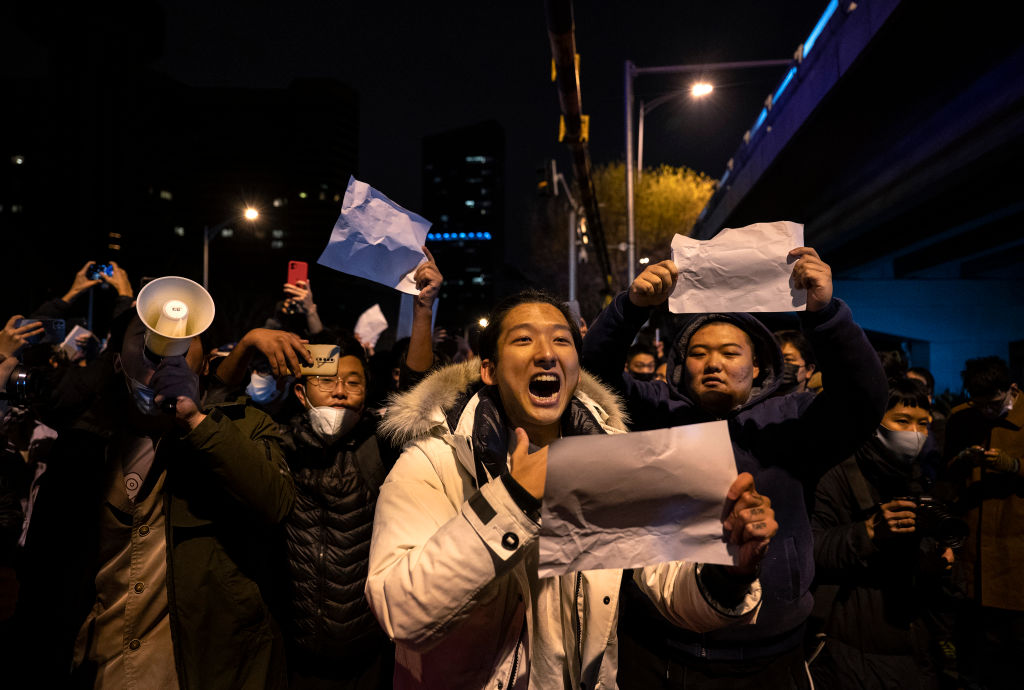
Protest in Beijing Against China Covid Measures
BEIJING, CHINA – NOVEMBER 28: A protester shouts slogans against China’s strict zero COVID measures on November 28, 2022 in Beijing, China. Protesters took to the streets in multiple Chinese cities after a deadly apartment fire in Xinjiang province sparked a national outcry as many blamed COVID restrictions for the deaths. (Photo by Kevin Frayer/Getty Images)

The Chinese people have taken to the streets, and their message is clear: their government has lost the argument on its draconian zero-Covid strategy. Citizens would rather live alongside the rest of the world with the risk of the virus than continue to surrender their freedoms in a bio-police state. The sight of thousands of international football fans celebrating in stadiums in Qatar, without a face mask or testing station in sight, has broken the spell of the Chinese Communist Party’s propaganda. We are now in a new era.

The sight of these rare moments of social unrest in a deeply repressive state has been welcomed in the West. While they are significant and unusual, it is important to note the motivations behind the protests vary. This is not yet a democracy movement. That said, history tells us that grievances around specific government policies or economic conditions do have the potential to become wider movements coalescing around more abstract, vital human needs. Certainly, these protests will draw a response from the authorities commensurate with the risk of escalation to a more centrally organised and cohesive movement.

The disquiet about the seemingly interminable restrictions has been gathering pace over recent months. In October, a brave man unfurled a banner over a Beijing overpass, challenging President Xi Jinping to end the relentless cycle of Covid-19 lockdowns and restore freedom to the Chinese people. Protests of increasing violence have broken out in factories enforcing mandatory isolation on their workers, who already toil under challenging conditions to make consumer goods. At one of the largest factories making iPhones, workers climbed over fences to escape the factory compound. They are now being offered lucrative compensation from the factory owners and local authorities to return.

The Chinese authorities have created an intractable dilemma for themselves. The West excelled at creating highly effective vaccines at a record pace. China has refused to allow the provision of Western vaccines to its population and its Sinovac product remains vastly inferior, and with strikingly low coverage amongst the elderly. This is not helped by an already problematic ageing population. In 2019, 28 per cent of people in China were over the age of 60.

The CCP’s zero-Covid strategy has kept infections low, but also prevented the spread of immunity to the virus. Tearing off the zero-Covid plaster without any community resistance could create a short-term health crisis in a population made deeply fearful of the virus by government messaging. But as the Chinese people begin to push back against the deprivation of their freedoms, the government must choose between two pathways of social disorder.

Liberal nations have become attuned in recent years to the security risks posed by an increasingly confident China, and the friendship between President Xi and President Putin has become a source of greater alarm since Russia’s invasion of Ukraine. The West has watched the evolution of these autocratic regimes with deep concern, and at times we have not felt entirely convinced of the future of our mature democracies.

As with Putin’s miscalculations in the early stages of its Ukrainian campaign, this colossal tactical failure of the Chinese regime, which has caused untold misery for its population, makes a convincing case for the structural weaknesses inherent in authoritarian regimes. The strong hand with which Xi Jinping will seek to suppress these protests reflects the powerful and credible fear he perceives in free and open societies.

As the Chinese people take to the streets to champion these principles, we should draw confidence from their yearning to defend their future in the international order.

Read more

Pernod Ricard’s results highlight the challenges for Scotch

The Glenlivet 56-year-old single malt scotch whisky bottle on a black stone pedestal with gold branch-like accents.

Share this article

  • Facebook
  • X
  • LinkedIn
  • WhatsApp
  • Email

Similarly tagged content:

Sections

  • Opinion

Categories

  • Opinion

Trending Articles

  • Tesco and Boots lead 100,000 jobs pledge to tackle Neets crisis

  • Airport chaos latest: Heathrow, London City ‘starting to recover’ after air traffic control failure

  • Hedge fund billionaire Chris Rokos joins UK wealth exodus 

  • Primark sales slip as owner dresses up retailer for demerger

  • Crystal Palace owner Blitzer part of £1bn mega stadium redevelopment

More from Morning Wire

  • Pernod Ricard’s results highlight the challenges for Scotch

    Whisky
    The Glenlivet 56-year-old single malt scotch whisky bottle on a black stone pedestal with gold branch-like accents.
  • Align Technology Prevails in China Patent Infringement Action Against Angelalign

    Business Wire
  • Richard Tice: A Reform government would scrap EV mandate to save Jaguar Land Rover

    Opinion
    Reform UK deputy Richard Tice has called for government to have more of a say on interest rates decisions made by the Bank of England.
  • From China with Love: Xpeng’s Luxury Ambition

    Motoring
    Tim Barnes-Clay observing the new dark green Xpeng G9L electric SUV in a modern showroom in China.
  • Donald Trump is creeping towards a shrewd sanctions policy

    Opinion
    Donald Trump holding a red TRUMP 2028 hat, wearing a tuxedo with an American flag in the background
  • Badenoch bets on experience as Griffith and Tugendhat claim shadow cabinet top spots

    Politics
    Shadow business secretary Andrew Griffith has said he would make it easier for small businesses to open bank accounts. (Photo by Dan Kitwood/Getty Images)
  • Don’t underestimate the free trade agreement Britain just joined

    Opinion
    A person holds small UK and Canadian flags, symbolizing international relations.
  • Is the Zeekr 9X Super Hybrid the new luxury SUV to beat?

    Motoring
    Dark brown Zeekr X9 electric MPV with large chrome grille, parked indoors with warm golden lighting.
MorningWire

Independent European business, markets and political news for decision-makers.

Morning Briefing

Europe

  • Germany
  • France
  • EU Institutions
  • Europe

Business

  • Markets
  • Business
  • Economy
  • Regulation
  • Competition
  • Public Affairs

Editorial

  • Opinion
  • Editorial Policy
  • Corrections
  • Contact

Company

  • About Morning Wire
  • Privacy Policy
  • Terms of Use
  • Cookie Policy
© 2026 Morning Wire Ltd · Published by Morning Wire Media, Bahnhofstrasse 65, 8001 Zürich, Switzerland
Privacy · Terms · Cookies · Facebook