Ignore the parades, China has no claim to any kind of greatness

Seventy years ago this week, Chairman Mao Zedong inaugurated the People’s Republic of China after his decisive victory in the Chinese Civil War over the rival Kuomintang.
With the defeated Chiang Kai-shek having fled to Taiwan, the new dictator set in motion his vision of what China should look like and aspire to.
Much of this was to prove ferocious in its intensity. Obsessed with Marxist dogma, Mao’s Great Leap Forward attempted to rapidly industrialise China’s peasant economy, but proved nothing short of disastrous. The ensuing famine led to anywhere between 10 and 40m Chinese dying between 1959-61 in the worst example of its kind in human history.
The 1960s may have been the era of liberation in the west, but for China, it was marked by the social and economic disruption of the Cultural Revolution.
Launched to remove Mao’s real and imagined enemies in the Communist Party – in classic Stalinist style – it ended up acquiring a life of its own and destroying much of China’s social balance and even tangible history, such was the orgy of cleansing that accompanied it.
Only with Mao’s death in 1976 did the China we have come to know today begin to take shape. His eventual successor, Deng Xiaoping, began the process of abandoning Communist ideology through market reform, the success of which proved the catalyst for the economic transformation of the country to the global powerhouse it is today, responsible for lifting more people out of absolute poverty than ever before.
China’s economics may have evolved, but its politics have not. Deng instituted a Chinese form of perestroika, but any dreams of an accompanying glasnost were crushed in the devastation of the Tiananmen Square massacre of 1989, when the students protesting for a freer future were crushed by a military mailed fist.
His successors have not relinquished that grip on power. Contemporary China remains fearful of internal dissent. Citizens are constantly monitored, and rewarded or punished for their behaviour.
The Communist Party maintains a rigorous and intrusive network within businesses. Non-conformist religious minorities like the Falun Gong or the Muslim Uighurs in Xinjiang province are suppressed or condemned to rot in largescale concentration camps.
Meanwhile in its foreign relations, China seems to revel in adopting a Tiananmen-style approach to dispute resolution.
It would rather seize land in its nearby seas than reach agreements with neighbours or adhere to international legal norms. And it prefers vinegar to honey when dealing with what it regards as recalcitrant and rebellious regions like Taiwan.
All this creates a curious paradox. The world’s second largest economy, seemingly so confident on the global stage when it comes to extolling the virtues of its system, frequently appears an aggressive bully when addressing political and military issues abroad and its own internal critics.
Ample proof of this came on Tuesday in the juxtaposition of China’s official national celebrations of the Communist triumph of 1949, and the explosion of state violence against demonstrators in Hong Kong.
Never let it be said that China’s Communist leadership does not know how to throw a good party to celebrate itself.
As seventieth birthdays go, this was an extraordinary one. Around 15,000 military personnel, 580 pieces of military equipment, and 160 aircraft were paraded through the streets of Beijing, showcasing China’s military prowess – and its threat potential.
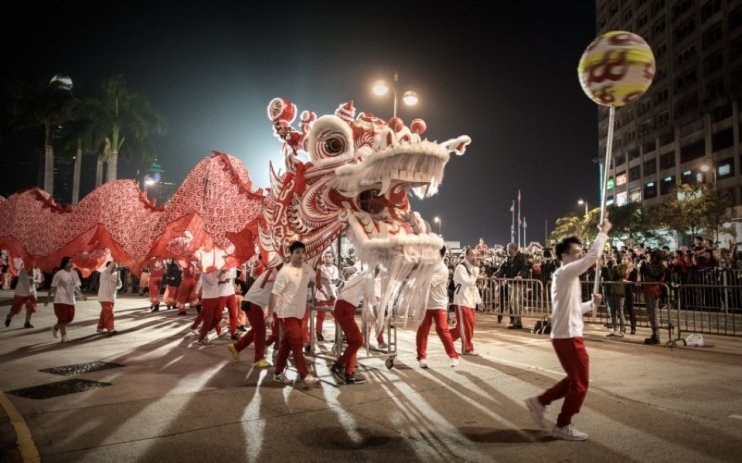
Cheering crowds were then regaled by a cast of civilian performers on floats nearly 100,000 strong, followed by a gala performance in Tiananmen Square.
In Hong Kong, however, on the same day, a very different face of China was on display. There, as they have done for many days since the summer, tens of thousands of ordinary Hong Kongers came out to protest against what they term the creeping undermining of their freedoms and civil liberties that China pledged to uphold when it resumed control of the province in 1997.
China’s response to an admittedly unruly crowd was devastating. Tear gas was used liberally and 269 arrests made. And for the first time since the protests began, live ammunition was used to dissipate the demonstrators, resulting in a teenage boy being shot in the chest.
Beijing and Hong Kong may be thousands of miles apart geographically, but in that moment of impact they were intertwined completely.
China can host all the self-aggrandising events it wants to demonstrate its importance and grandeur, but until it learns to develop a path to reform that better reflects the desires of those it purports to govern – or intends to govern one day – its claims to greatness will be hollow ones.
Truly great nations work with their people rather than against them, and are reflective of their hopes, dreams and desires rather than dictatorial about them.
China has risen thus far in spite of its flouting of this immutable reality. But the next seventy years could prove as nasty and brutish as what has already passed if it does not heed the call for change that has been so clearly expressed.
Main image credit: Getty