The Clegg cliché: How politicians turn fact into fiction

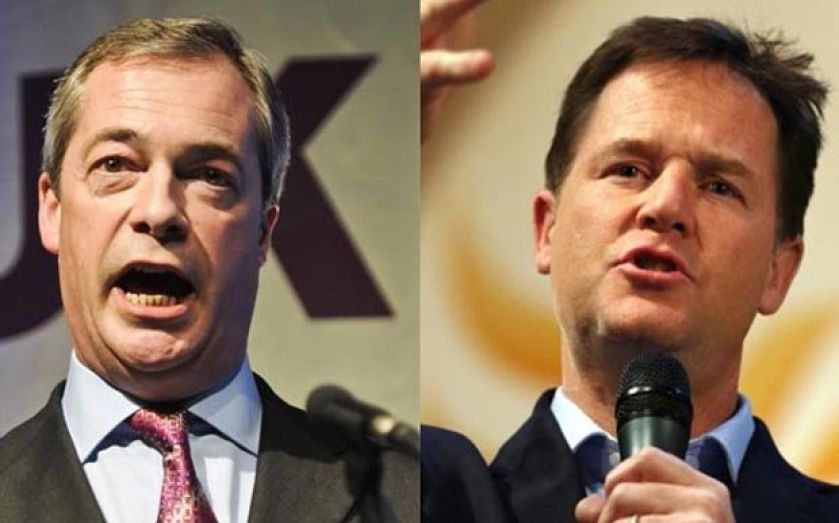
IT’S TIME to cast aside the dogma and look at the facts”. Sound familiar? Anyone who watched last week’s Europe debate between Nigel Farage and Nick Clegg would have seen the latter use lines like this. But this is more than just rhetorical cliché. It’s part of a narrative that permeates far more widely than the In/Out Europe debate. It says that certain (typically Eurosceptic or free market) opinions are “dogmatic”, while Europhiles and those politicians who see themselves as managerial interventionists are just enlightened purveyors of the facts, unbound by the constraining influence of ideology.
This, of course, is bogus. To a certain extent, we all have an idea of the sort of world we’d like to see, and this determines the facts we are interested in. Some may note, for example, that the Eurozone is going through a protracted economic crisis, at least in part due to the euro. Yet if your goal is a federal Europe, a single currency is a necessary prerequisite for political union. Likewise, a country’s economy may be going gangbusters. But if your ideology says that equality is the primary goal, growth accompanied by rising inequality might be something to lament, rather than celebrate.
It’s therefore untrue that there is an obvious non-ideological set of policies that a rational individual, with access to the key facts, would choose. Sadly, however, many politicians delude themselves that they are non-partisan truth-tellers. This often means either bringing in facts that are entirely irrelevant, or selecting “facts” that suit their agenda.
Two examples of the former cropped up in the debate. The first was Clegg alluding to 3m jobs being linked to trade to EU countries (although the Centre for Economic and Business Research thinks it is actually 4.2m). This is largely irrelevant to the debate about whether Britain should stay in the EU. Jobs induced through trade aren’t created by politicians, but by firms and individuals. There’s no reason to suspect that opting to leave a political union would lead to a big loss of trade, and therefore jobs.
Another example was in the discussion of immigration. When questioned on how many people could come to the UK given the free movement of people, Clegg sought to explain how little EU immigrants cost in benefits spending. Although I agree, by and large, with Clegg’s position on maintaining fairly free movement, it was clear his facts were largely irrelevant to the matter under discussion (the numbers, not the cost).
This happens domestically. Those concerned about dependency and problems within the benefit system are bombarded with facts about how little fraud there is. But fraud is rarely anything to do with the critique being made – whether it's the system’s cost or disincentives to work.
Finally, we get selective facts. Clegg claimed that the House of Commons library thinks less than 7 per cent of UK law originates from the EU. In fact, the report suggests under 7 per cent of primary legislation had a role in implementing EU obligations. This ignores secondary legislation and implementing regulations. When they are included, the paper estimates that anywhere between 15 per cent and 50 per cent is a more accurate figure. Farage is also guilty here. “We send £55m to the EU every day”, he says. This is technically true, but ignores the cold, hard cash of the UK’s rebate.
So be sceptical of those who are claiming to just “set out the facts”. We need to ask: which facts are they interested in; are their facts relevant to the topic; are their facts selective?
Ryan Bourne is head of public policy at the Institute of Economic Affairs.