Skip to content
Wednesday 19 August 2026London --:--Frankfurt --:--Zurich --:--
NewslettersSearchEN · DE · FR
MorningWire

European business, markets and politics

FTSE 100
10,728.04
+0.07%
DAX
26,128.36
0.00%
CAC 40
8,509.36
0.00%
STOXX 50
6,468.17
0.00%
  • Europe
  • Markets
  • Business
  • Economy
  • Regulation
  • Politics
  • Opinion
More
GermanyFranceEU InstitutionsCompetitionPublic AffairsBankingTechnologyEnergy
  • Germany
  • France
  • Europe
  • Markets
  • Business
  • Economy
  • Regulation
  • Politics
  • Opinion
  • DE
Monday 18 November 2024 5:06 am  |  Updated:  Thursday 14 November 2024 3:16 pm

COP29: A missed opportunity to take the heat out of global warming

By: Eliot Wilson

Add as a preferred source on Google
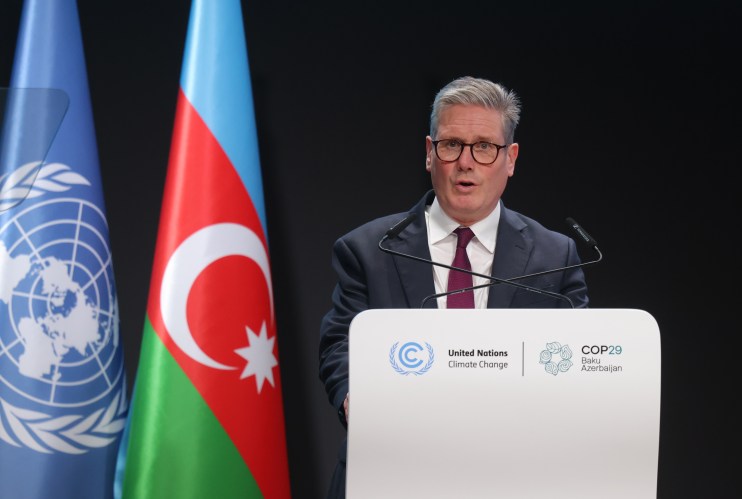
BAKU, AZERBAIJAN - NOVEMBER 12: British Prime Minister Keir Starmer delivers a national statement during the high level segment on day two of the UNFCCC COP29 Climate Conference at Baku Stadium on November 12, 2024 in Baku, Azerbaijan. The COP29, which is running from November 11 through 22, is bringing together stakeholders, including international heads of state and other leaders, scientists, environmentalists, indigenous peoples representatives, activists and others to discuss and agree on the implementation of global measures towards mitigating the effects of climate change. According to the United Nations, countries made no progress over the last year in reducing global emissions from the burning of fossil fuels. (Photo by Sean Gallup/Getty Images)

Those who shout the loudest about climate change tend to have a disproportionate influence, but we’ll never solve this challenge without being realistic and practical, says Eliot Wilson

There was a time when climate change – ”global warming” was the argot when I was young – was accepted by politicians as a major challenge. Margaret Thatcher gave an historic address to the United Nations General Assembly in 1989 in which she declared the threat “has grown clearer than any other in both urgency and importance – I refer to the threat to our global environment”. That consensus has since fractured, and differences over the scale, pace and mitigations have become fiercer, to the point that the climate has been subsumed into wider ideological clashes.

Those on the extremes, shouting loudest, are having a disproportionate influence. When Rishi Sunak tried to steer a middle course on achieving net-zero emissions in 2023, it had the opposite effect: the left howled at his betrayal and the right hailed the defeat of climate alarmists. We urgently need to restore a sense of pragmatism and reality to the issue, to address the threat and maximise the opportunities of mitigation and resilience. It was opportune, then, that last week saw the United Nations Climate Change Conference (COP29) in Azerbaijan.

Unfortunately, the Prime Minister, having hurried to Baku from remembrance events in London and Paris, has chosen a course of action likely to exacerbate divisions rather than minimise them. Sir Keir Starmer told the delegates that his aim was “renewing UK climate leadership” and he was therefore setting “ambitious targets” to reduce greenhouse gas emissions by 81 per cent by 2035 compared to 1990 levels.

Politicians are susceptible to the lure of targets as a substitute for action. To announce an eye-catching ambition is gratifying, headline-grabbing and cost-free, yet gives an impression of seriousness of purpose. That was part of the motivation behind Gordon Brown’s government passing the Climate Change Act 2008, which mandated an 80 per cent reduction in emissions by 2050. The Conservatives then raised this target to 100 per cent with the Climate Change Act 2008 (2050 Target Amendment) Order 2019.

Constitutional graffiti

This was declaratory legislation, the worst kind of constitutional graffiti: enshrining the target in statute did nothing to affect its achievability or otherwise, but allowed ministers to appear purposeful. It is the same trap into which Starmer has now fallen. Setting arbitrary targets is also a damaging act of self-delusion. The Climate Change Act showed how arbitrary these targets are: how likely is it that 80 per cent was a reasonable level of reduction to expect to achieve by the suspiciously convenient year of 2050? These are numbers picked for headlines rather than the outcome of rigorous scientific assessment.

The Prime Minister has also made a political miscalculation. When soi-disant moderates and pragmatists decide to take on extremists by doubling down, they generally succeed instead in making the situation worse and pushing the two sides further apart. 

Sure enough, GB News wheeled out public relations veteran Piers Pottinger to denounce the “absurd conference, under the auspices of the UN” as a “pointless exercise”. The government’s new targets had been plucked out of thin air, “net zero by 2050 is not going to happen” and “it’s just because [Ed] Miliband is a mad zealot that we’re having to listen to this nonsense”.

Claire Coutinho, the shadow energy secretary, was more moderate but pointed to problems. She argued that the government’s policies will increase energy bills, and “all that would happen is that we would end up importing more from China, the world’s largest polluter. It makes no sense for the climate, the economy or for the British people.”

This is an area where we need to be realistic and practical. Emissions will fall as we wean ourselves of fossil fuels, as we must. Of course there must be a sense of urgency, but we should balance that against the undoubted economic opportunities in renewable energy and new technologies. There will be short-term compromises, but the overall goal remains the same.

There was an opportunity to take some of the heat out of global warming, but the Prime Minister has instead chosen virtue-advertising ambition in the hope we will be admired internationally. John Bunyan had extraordinary foresight: “the path made by the pilgrims… lay through this town of Vanity”.

Eliot Wilson is a writer

Read more

Meet the new energy minister who believes lower growth is “good news”

Katie White, a woman with curly blonde hair, smiling in a navy blazer and white collared shirt against a dark background.

Share this article

  • Facebook
  • X
  • LinkedIn
  • WhatsApp
  • Email

Similarly tagged content:

Sections

  • Opinion

Categories

  • Opinion

People & Organisations

  • Climate change
  • COP29
  • Ed Miliband
  • Keir Starmer

Related Topics

  • Climate change

Trending Articles

  • As it happened: FTSE 100 drops as oil prices rise after Trump makes Hormuz threat

  • Jobless Banquet: Youth unemployment surge ‘sends Neets to KFC’

  • US bond market jitters spark UK economy recession warning

  • Monzo chair makes early exit after boardroom rift

  • New Premier League rules could see £11bn invested into new stadiums

More from Morning Wire

  • Meet the new energy minister who believes lower growth is “good news”

    Opinion
    Katie White, a woman with curly blonde hair, smiling in a navy blazer and white collared shirt against a dark background.
  • ReNew Reports 25.6% Reduction in Scope 1 & 2 Emissions and 24.7 Billion Units of Clean Power Generated in FY 2025-26

    Business Wire
  • From Mongolian camels to Tibetan verbs: the absurdity Ed Miliband’s aid spending plans

    Opinion
    Ed Miliband speaking at a podium during a press conference, addressing energy policy reforms and climate change initiatives.
  • Arch Construction Risk Report Reveals Top Challenges Facing Sector Amid Rising Volatility

    Business Wire
  • El Nino heatwaves to ‘fuel inflation next year’

    Economics
    Firefighter in helmet and uniform watching a blazing forest fire at night, red glow in the sky
  • Scottish Government Selects Planet for AI-Enabled Monitoring to Support Sustainable Agricultural Reform

    Business Wire
  • Gatwick expansion green-lit as court throws out activists’ appeal

    Transport & Infrastructure
    20m passengers have flown through Gatwick this year
  • Tories say households could save £540 a year by scrapping net zero

    Energy
    Kemi Badenoch speaks, gesturing with hands, while Claire Coutinho listens intently at a table with coffee cups.
MorningWire

Independent European business, markets and political news for decision-makers.

Morning Briefing

Europe

  • Germany
  • France
  • EU Institutions
  • Europe

Business

  • Markets
  • Business
  • Economy
  • Regulation
  • Competition
  • Public Affairs

Editorial

  • Opinion
  • Editorial Policy
  • Corrections
  • Contact

Company

  • About Morning Wire
  • Privacy Policy
  • Terms of Use
  • Cookie Policy
© 2026 Morning Wire Ltd · Published by Morning Wire Media, Bahnhofstrasse 65, 8001 Zürich, Switzerland
Privacy · Terms · Cookies · Facebook