Skip to content
Tuesday 25 August 2026London --:--Frankfurt --:--Zurich --:--
NewslettersSearchEN · DE · FR
MorningWire

European business, markets and politics

FTSE 100
10,873.04
+0.17%
DAX
26,326.34
+0.84%
CAC 40
8,484.89
+0.38%
STOXX 50
6,479.92
+0.50%
  • Europe
  • Markets
  • Business
  • Economy
  • Regulation
  • Politics
  • Opinion
More
GermanyFranceEU InstitutionsCompetitionPublic AffairsBankingTechnologyEnergy
  • Germany
  • France
  • Europe
  • Markets
  • Business
  • Economy
  • Regulation
  • Politics
  • Opinion
  • DE
Thursday 26 March 2020 12:06 am  |  Updated:  Wednesday 25 March 2020 7:04 pm

Coronavirus: The government’s job retention scheme needs some more tweaking

By: Andy Mayer

Add as a preferred source on Google
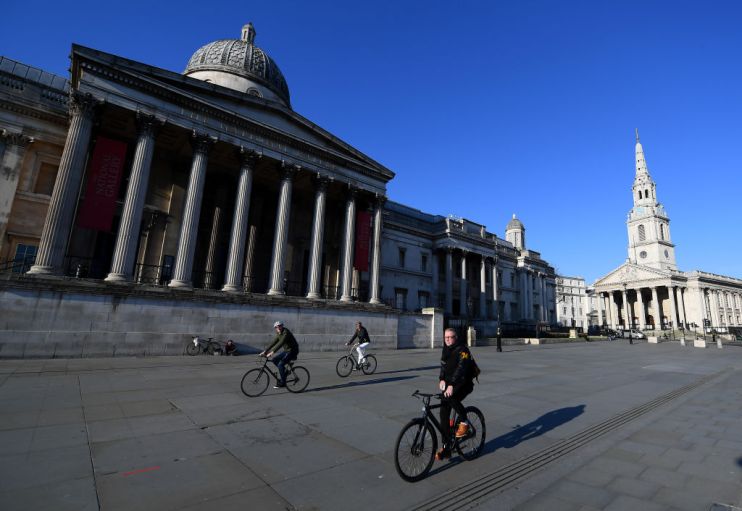
Trafalgar Square was empty yesterday as the UK went into lockdown

With businesses ordered to close and workers to self-isolate, the government is attempting to protect the wages of those impacted to avoid them breaking quarantine to go job-hunting.

The Coronavirus Job Retention Scheme (CJRS), which offers payments to affected workers of 80 per cent of income, capped at £2,500 a month, provides some security, but not for all.

The scheme targets employees on Pay as Your Earn (PAYE). This is because the Treasury can reasonably confirm their employment and salaries are genuine. In this context, the CJRS can be thought of as a temporary super-benefit, but only for certain workers. The scheme doesn’t cover the 15 per cent of the workforce who are self-employed.

It is clearly unfair to support some workers over others based only on how they pay their taxes. Faced with immediate criticism from many quarters on this point, the government knows it has to address this gap imminently, perhaps based on weighted past income for the self-employed.

Another flaw is partial redundancy. For most firms, the impact of the pandemic is not bipolar between full closure and business as usual. Most have lost markets and need to reduce payroll to manage cash flow. But most cannot furlough half their workers to protect the rest, as the Institute for Fiscal Studies suggested they might. Jobs may be codependent.

The Institute of Economic Affairs has noted that charities might be well advised to furlough nearly everyone and have them back as volunteers, which may not be illegal in a policy rushed through so quickly. But this is clearly not what was intended.

Businesses desperate to save operations are then likely to be terrified of either furloughing the wrong people or risking conviction for fraud while navigating these flaws. Some will shut unnecessarily. Others will furlough perfectly useful people who should be seeking different ways of working, or those who could transfer to temporary jobs in the growing food distribution, care provision, and virtual working sectors.

Read more

Goldman: Junior white-collar workers squeezed hardest by AI hiring slump

People waiting outside a job centre, highlighting unemployment issues and job search challenges in the current economy.

People can only do this if they are secure in the knowledge that doing so will not jeopardise their qualification for this benefit, or a return to their old role. In this, the Treasury appears to have assumed incorrectly that security means putting workers on ice, rather than encouraging adaptation and innovation.  

Alternatives include allowing part-qualification for this scheme, or relaxing employment law such that employers can reduce employees’ hours, without being forced to fire people or go bust.

Other alternatives include super-benefits for short periods (for example, three months before regular benefits) as a fairer solution to the employee-contractor split. Or perhaps payment holidays for all payroll taxes for the next quarter, not just deferment. The fact that tax payments are a major part of cash flow means that deferment only postpones the issue they create.

These things together might provide better security and incentives, rather than a cliff edge between the worst hit and the rest.

As the lockdown kicks in, the government should take the time to think again and refine the scheme. Unchanged, this could do significant damage to our ability to work through this crisis.


Andy Mayer is chief operating officer at the IEA.

Read more

Net zero and DEI targets cut from procurement rules as firms pressed to raise pay and hire NEETs

Louise Haigh, Andy Burnham, and another man smiling in front of a dark door with 10 visible.

Share this article

  • Facebook
  • X
  • LinkedIn
  • WhatsApp
  • Email

Similarly tagged content:

Sections

  • News
  • Opinion

Categories

  • Business
  • Opinion

Related Topics

  • Coronavirus

Trending Articles

  • Andy Burnham hints at tax rises in Autumn Budget

  • Can debt-ridden Morrisons become a Big Four supermarket again?

  • As it happened: Stocks rally; US to unveil ‘economic D-Day’ Iran sanctions

  • Budget 2026: Which taxes will Burnham and Healey hike?

  • Poundland loss doubles as discount retailer nears sale

More from Morning Wire

  • Goldman: Junior white-collar workers squeezed hardest by AI hiring slump

    AI
    People waiting outside a job centre, highlighting unemployment issues and job search challenges in the current economy.
  • Net zero and DEI targets cut from procurement rules as firms pressed to raise pay and hire NEETs

    Politics
    Louise Haigh, Andy Burnham, and another man smiling in front of a dark door with 10 visible.
  • IHT pension scramble shows ‘no sign of slowing down’, says Royal London boss 

    Investing
    Royal London shared £181mn with its 2.3m customers in April
  • Thames Water faces fresh threat to survival after pensions regulation breach

    Water
    Thames Water infrastructure with pipes and maintenance workers, highlighting water management efforts in London
  • Skilled tech visa applications fall again despite AI talent push

    Tech
    UK work and study visas have fallen as Labour faces pressure to reduce immigration.
  • Burnham is wrong. Devolution will only grow Whitehall

    Opinion
    Whitehall SW1 street sign in the City of Westminster, London, mounted on a white stone wall with decorative trim.
  • Top business group urges Healey to cut NICs to ‘solve Neets crisis’ 

    Economics
    Man in suit and red tie speaking at a podium to an audience in a modern building.
  • London IPO candidate Utmost sees inflows slide

    Investing
    Pedestrians walk across a modern pedestrian bridge with steel cables and supports over brown water.
MorningWire

Independent European business, markets and political news for decision-makers.

Morning Briefing

Europe

  • Germany
  • France
  • EU Institutions
  • Europe

Business

  • Markets
  • Business
  • Economy
  • Regulation
  • Competition
  • Public Affairs

Editorial

  • Opinion
  • Editorial Policy
  • Corrections
  • Contact

Company

  • About Morning Wire
  • Privacy Policy
  • Terms of Use
  • Cookie Policy
© 2026 Morning Wire Ltd · Published by Morning Wire Media, Bahnhofstrasse 65, 8001 Zürich, Switzerland
Privacy · Terms · Cookies · Facebook