
Could quantum computing render blockchain obsolete?

‘What happens when quantum computers become reality?’: one of my favourite moments at a cryptocurrency seminar last year was when someone asked this. After a long pause, the speaker said something akin to: “We will figure that out when we get there.”
Let me explain. The premise of blockchain technology and the cryptocurrencies, non-fungible tokens (NFTs) and smart contracts built on it is that distributed ledgers are secure and cannot be hacked with modern computers.
I am oversimplifying but in order for a transaction to be accepted by the blockchain, more than 50 per cent of the computers on the network that share the blockchain need to agree that the computer that claims to be the new owner of a cryptoasset is indeed the legitimate owner. And the network only accepts claims that have a proof of work (PoW), which is essentially a massive multiplication exercise of several very large numbers. Again, I am oversimplifying.
Once such a PoW has been submitted to the blockchain network and more than half the computers accept it, a new block is added to the chain and the longer blockchain is considered the true blockchain. Submitting a PoW for a new cryptocurrency is what creates a new token or coin. Similarly, submitting a PoW creates a contract that proves ownership of certain assets without relying on centralised databases or potentially corrupt government officials.
Quantum computing will change the game
Now, let’s imagine you can churn out these PoWs faster than all the computers in a network can check the PoW’s veracity. Then you could constantly outrun the verification process and generate new blocks in the blockchain before the rest of the network could check them. And since all blockchain technology assumes the longest blockchain is the legitimate one, you could effectively ‘hack’ the system. All the other computers would simply accept your blockchain as the one against which to compare any new PoW.
With modern computing power, it is impossible to create such a so-called 51 per cent hack. But quantum computers (which are based on the principles of quantum theory) will be so much faster that at some point, they will easily outpace any network of traditional computers. In fact, speed won’t be their only advantage.
Conventional computers are based on transistors that differentiate between two binary states — called ‘bits’ — 0 and 1. But quantum computers can take on both 0 and 1 at the same time and superimpose these ‘Qbits’. If that sounds weird, think of a typical old-fashioned computer that encodes letters or numbers as a series of eight bits. There are 256 different characters or numbers that can be coded with these eight bits and, at any given time, a transistor in a standard computer will be in one of those 256 possible states. But a quantum computer with eight Qbits could take all 256 states at the same time and use them for computations simultaneously. So, the advantage of quantum computers grows exponentially as they include more Qbits.
This means that algorithms in quantum computers have to be redesigned in order to leverage these computational capabilities. But it also means quantum computers will be so much more powerful. They will easily crack problems that traditional computers couldn’t solve within the remaining lifetime of the universe.
Blockchain will need to adapt
Now, assume you are the first company to build a fully functioning quantum computer. Since all the world’s networks are based on conventional computers, you could take over every blockchain on earth within seconds. Only once the majority of computers in a network also become quantum computers will the blockchain be safe again. But by then it may be too late.
This benefit of quantum computers holds even when they haven’t really achieved what is called a true quantum advantage, or when they can solve problems that no traditional computer can. Once the problem-solving capacity of standard computers is outpaced enough by their quantum counterparts, all the blockchains in the world will become hackable by anyone with a quantum computer.
So, when quantum computers become reality, blockchain technology will have to be completely recreated from scratch or lose all its decentralisation and security advantages.
But quantum computers are still just science fiction, aren’t they? Yes. But they are being developed. And if you extrapolate current advances in the speed of computing power into the future based on Moore’s Law, a single quantum computer will be able to hack the bitcoin blockchain by about 2045 (see chart: a ‘hash rate’ is a measure of how many calculations can be performed per second).
Quantum Computer vs. Bitcoin Hash Rate
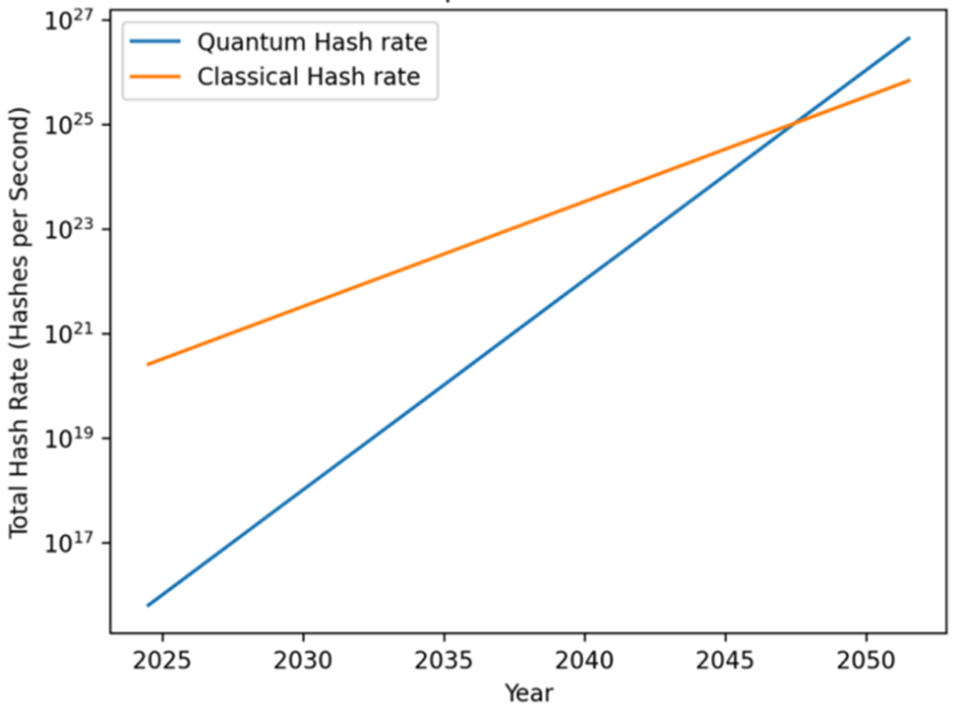
The above estimate is based on two assumptions: first, that quantum computing advances at the same rate as traditional computing (we know, however, that new technologies tend to progress much faster than well-established ones); second, the 2045 date applies to the bitcoin blockchain, which is by far the most complex and computationally intensive one.
Other blockchains, such as Ether or those underlying commercial applications, employ much smaller networks. And according to a study on quantum computing advantages, quantum computers could hack such blockchains as early as 2023.
I don’t think 2023 is realistic. But the more I read about advances in quantum computing, the more I believe it could be sometime this decade. And what happens then?
Unless all blockchain applications have been fundamentally redesigned ahead of time, they will likely be rendered unsafe and useless.
If you liked this post, don’t forget to subscribe to the Enterprising Investor.
By Joachim Klement, CFA, a trustee of the CFA Institute Research Foundation and offers regular commentary at Klement on Investing.
All posts are the opinion of the author. As such, they should not be construed as investment advice, nor do the opinions expressed necessarily reflect the views of CFA Institute or the author’s employer.
Image credit: ©Getty Images / ALFRED PASIEKA/SCIENCE PHOTO LIBRARY