Countdown to Christmas 2015: Six of the most amazing discoveries humans made this year

This year, humans around the world have made big leaps forward in unravelling the secrets of the universe and answering some of science's most complex questions.
From disease prevention to space exploration and artificial intelligence, pretty much every aspect of science has been lifted by an important discovery in 2015.
And new findings are constantly coming in – only this week, materials experts from the US discovered a new phase of solid carbon, called Q-carbon, which can be manipulated to create diamonds in a lab.
But of all the achievements made this year, these are the six we think are the most impressive.
There's water on Mars
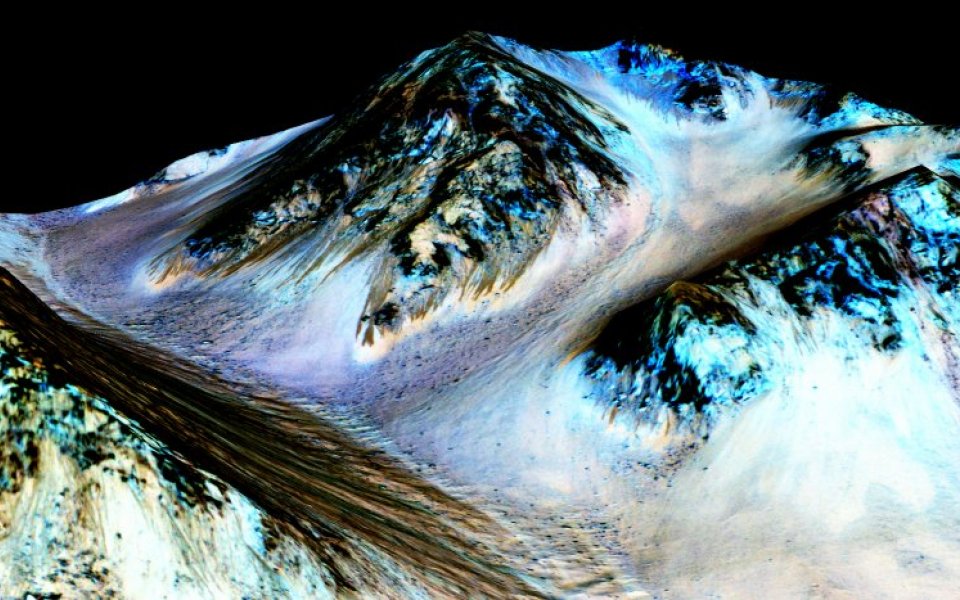
It turns out Earth isn't the only planet in our solar system to have water on it – traces of it can also be seen on the surface of Mars.
When studying images taken by its Mars Reconnaissance Orbiter, Nasa noticed how certain steaks faded during cold periods and darkened during warm periods. The US space agency said this change according to season indicated the presence of water flowing in a liquid form.
While the existence of water on Mars is interesting in itself, the really fascinating part is what it means for the possibility of life on the red planet. Organisms (on Earth, at least) require water to survive, so the fact that there is water increases the chance that there were once life-forms on Mars.
A new vaccine could prevent all strains of HIV
The medical world has made huge progress in its battle against HIV and Aids in recent years. But like any virus or bacterium, HIV has different strains, which means a medicine is unlikely to be effective against all of strains.
However, scientists at the Scripps Research Institute think they have found a solution for this problem – they have developed an HIV vaccine which, as far as they can tell from initial tests, works against HIV-1, HIV-2 and simian immunodeficiency virus.
If further tests show promising results, it means the world could have a super-vaccine for all forms of HIV in the not too distant future.
The first new antibiotic was discovered in 30 years
The more we use antibiotics to treat bacterial infections, the greater the resistance the bacteria build up against the antibiotics available to us.
This problem has been creeping up on humans for decades, but unfortunately no new antibiotics were developed during that time.
However, earlier this year scientists from Northeastern University in the US discovered the first new antibiotic in three decades.
Called Teixobactin, it kills bacteria by stopping them from building their outer coats. It successfully stopped a whole host of infections in mice, and although tests on humans haven't been carried out yet, teixobactin holds a great deal of promise.
Everyone could see perfectly in eight minutes, and never have to wear glasses again
A doctor from British Colombia has developed a bionic eye lens that could leave anyone with super-human vision, no matter what their age or how bad their eyesight was beforehand.
Not only that, but the surgery to introduce the lens takes just eight minutes. It is folded like a taco in a syringe filled with saline, and is then inserted into the eye. In just 10 seconds it unravels and arranges itself in the correct position.
It replaces a person's natural lens, rather than going over the top of it, so it's a permanent fixture that leaves a person never needing glasses again.
It's not actually available yet, but once it is it could transform the treatment of eyesight disorders.
There might be two extra planets lurking at the edge of our solar system
We suffered the loss of Pluto from our planetary line-up when scientists decided it didn't count a few years ago, but we could soon have new additions to make up for it.
After studying a belt of space rocks known as “extreme trans-Neptunian objects” (Etnos), which lie beyond Neptune, scientists said “at least two” planets as big as Earth “could be on the edge of our solar system”.
They came to this conclusion because of how the Etnos were orbiting the sun – they should move randomly, but some of them seemed to be influenced by the gravitational pull of something unseen. This left them thinking, maybe it's the sun?
If it turns out that these are indeed planets in our solar system, it will take the total number up from eight to 10.
The path was paved for the first ever male birth control pill
Scientists have been trying for years to create a male equivalent of the female birth control pill, and finally in October it seemed that they were close.
By carrying out tests in mice, researchers in Japan managed to block a key sperm protein called PPP3CC/PPP3R2, which is responsible for pushing sperm through the egg's tough outer membrane.
This, they discovered, made the rodents temporarily infertile, with reproductive ability returning a week after treatment ended.
While they don't know for certain that the same result would arise in human males, the researchers believe there's a strong chance it would create reversible, fast-acting infertility in a similar manner.
“Considering these results in mice, sperm calcineurin may be a target for reversible and rapidly acting human male contraceptives,” they wrote.