Don’t let the Vegas tech giants fool you: We’re in the age of disruption

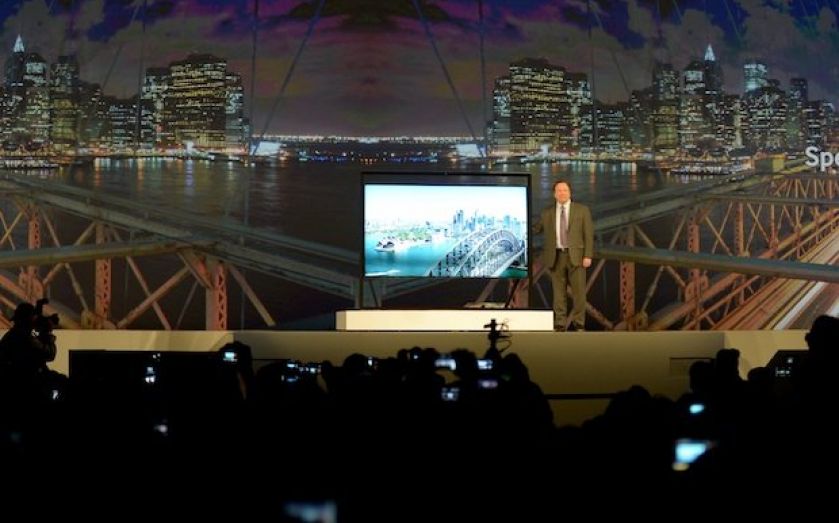
IT’S HARD to think of a better parable about the effects of technology than Samsung’s embarrassing product launch at the Consumer Electronics Show (CES) in Las Vegas on Monday.
The Korean tech giant had lined up high-octane movie director Michael Bay to launch its new curved television at the show, where the world’s techies come every January to unveil new gizmos. But his endorsement of the product fell flat as his autocue failed. It was an embarrassment for Samsung. But it is also a powerful symbol of how even the most tech-savvy incumbents have a habit of being wrong-footed by innovation.
The major trends on show at this year’s CES certainly have great potential to upset the status quo. They challenge the business models of large companies, and raise big questions for how governments run public services and seek to control the economy.
One much-touted development is the rise of wearable technology, with the launch of the Pebble smart-watch and Intel’s Edison, a powerful computer the size of a thumbnail. Computing is continuing its move from our desktop and phones into our clothes and the stuff that surrounds us.
One consequence is that people will be able to take charge of monitoring their own health, diet and exercise to an unprecedented extent. Early adopters of the so-called Quantified Self movement are increasingly expecting doctors and hospitals to incorporate these biometric systems into the care they provide. A big question for consumers will be whether the world’s healthcare systems can adapt to deal with this. Their track record has not been great: witness the IT disasters of healthcare.gov in the US and the National Programme for IT in the NHS.
Another implication of ubiquitous computers is what is known as the Internet of Things: the idea that our homes, offices and cities will increasing be connected and controllable. Devices like matryoshka-like Mother, which monitors your home using sensors, and the Nest digital thermostat have been attracting attention. These technologies offer a challenge to the companies that make money from privileged access to people’s homes, whether through a set-top box, a burglar alarm, or a utility meter. Imagine the effect on costly monitored alarm services, as people realise they can install their own monitors and link it to their mobile phone for the cost of a couple of months’ service charges.
At the same time, it ups the ante in the debates over privacy, government surveillance and internet security: if we dislike the government reading our Facebook statuses, how much more outraged would we be if they can peer into our homes, our offices and even our bodies?
Also on display were a range of robots and drones. Shopping deliveries by drone, as recently promised by Amazon, may still be some way off. But the announcement by Google of a major partnership to roll out its Android operating system to cars will hasten the day when vehicles communicate with one another and increasingly drive themselves. This poses a challenge to car-makers: think of how the profits of the PC industry migrated from hardware to software in the age of Windows. It’s also a challenge to governments: our current regulations and infrastructure are hardly fit for an age of drones and self-driving cars.
The final trend worth watching is a subtle one: the rise of crowdfunded products. Several of this year’s most interesting launches, from the Pebble Watch to the Robox 3D printer, were financed not by big companies or financial investors but by thousands of individuals, brought together by platforms like KickStarter. The rise of crowdfunding platforms and their cousins, the peer-to-peer lenders, ought to trouble venture capitalists and bankers alike.
All this is great news for consumers: technological progress has improved our lives immeasurably, and holds out immense possibilities for the future. This year’s technologies offer the promise of better healthcare, more comfortable homes, safer cars and even a more efficient financial system.
But don’t let the well-scrubbed smiles and big-name launches of the corporate presenters deceive you. Their visions of tomorrow may not be far wrong. But much as they’d like you to think the future is in their control, the technologies on show won’t be so easily tamed. From drones to ubiquitous computing, they offer a stark challenge to established ways of doing business, and threaten to consign today’s incumbents to irrelevance.
For all the slick confidence of technological incumbents, this is an age of disruption.
Stian Westlake is executive director of research at Nesta, an innovation charity.