Skip to content
Friday 14 August 2026London --:--Frankfurt --:--Zurich --:--
NewslettersSearchEN · DE
MorningWire

European business, markets and politics

FTSE 100
10,772.67
-0.56%
DAX
26,299.74
0.00%
CAC 40
8,650.56
0.00%
STOXX 50
6,545.47
0.00%
  • Europe
  • Markets
  • Business
  • Economy
  • Technology
  • Politics
  • Opinion
More
GermanyFranceBankingAIEnergyFintechPropertyCapital Markets
  • Germany
  • France
  • Europe
  • Markets
  • Business
  • Economy
  • Technology
  • Politics
  • Opinion
  • DE
Tuesday 10 February 2015 4:51 am

Labour paternity leave pledge: How does the UK compare to other OECD countries?

By: Billy Ehrenberg

Add as a preferred source on Google

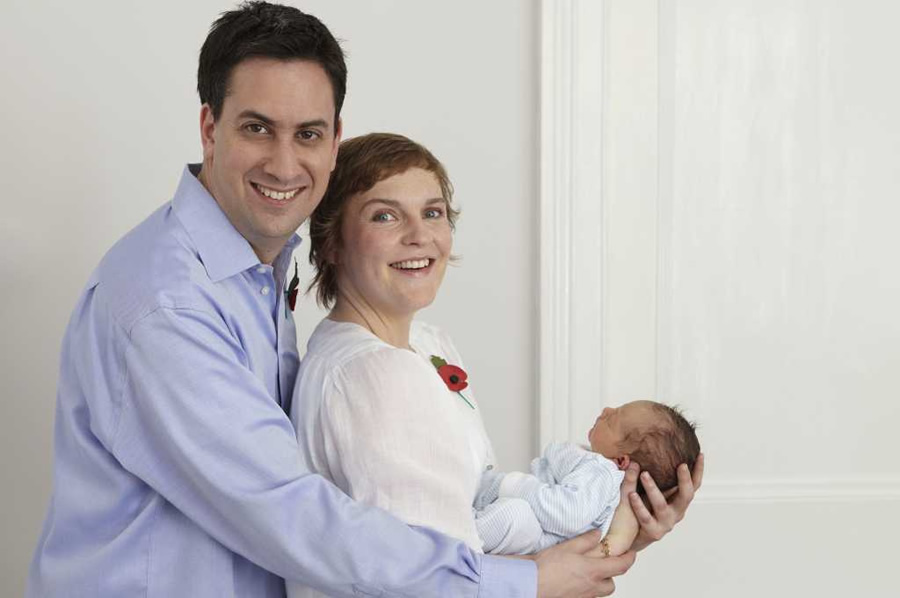
Ed Miliband is advocating an increase in paternity leave (Source: Getty)

Labour leader Ed Miliband has promised that if his party gets into power this May, it will dramatically increase paternity leave and pay.

New fathers will get four weeks off and £260 a week under the new proposals: double the time and £100 a week extra.

But the plans, which were first suggested by the Institute for Public Policy Research last year, have been criticised by some in the business sector as likely to put a strain on smaller businesses. 

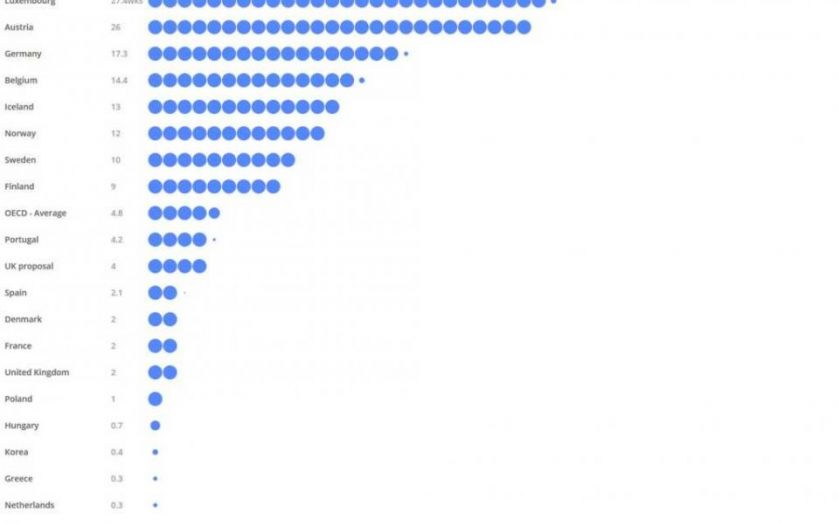
But how does the UK compare to other countries anyway? The Organisation for Economic Co-operation and Development (OECD) publishes data on 21 countries, showing the average time for fathers to receive paid leave in the region is 4.8 weeks (four weeks and four days), larger than Milliband’s proposed changes.

The rate is dragged up by countries such as Luxembourg (27.4 weeks) and down by the likes of the US, Australia and New Zealand, all of which offer no paid paternity leave at all.

Here’s how the UK compares…

var margin = {top: 10, right: 0, bottom: 0, left: 0}, width = 800 - margin.left - margin.right, height = 1440 - margin.top - margin.bottom;

dataset = [{"country":"Luxembourg","weeks":27.4},{"country":"Austria","weeks":26},{"country":"Germany","weeks":17.3},{"country":"Belgium","weeks":14.4},{"country":"Iceland","weeks":13},{"country":"Norway","weeks":12},{"country":"Sweden","weeks":10},{"country":"Finland","weeks":9},{"country":"OECD - Average","weeks":4.8},{"country":"Portugal","weeks":4.2},{"country":"UK proposal","weeks":4},{"country":"Spain","weeks":2.1},{"country":"Denmark","weeks":2},{"country":"France","weeks":2},{"country":"United Kingdom","weeks":2},{"country":"Poland","weeks":1},{"country":"Hungary","weeks":0.7},{"country":"Korea","weeks":0.4},{"country":"Greece","weeks":0.3},{"country":"Netherlands","weeks":0.3},{"country":"Australia","weeks":0},{"country":"Canada","weeks":0},{"country":"Czech Republic","weeks":0},{"country":"Ireland","weeks":0},{"country":"Italy","weeks":0},{"country":"Japan","weeks":0},{"country":"Mexico","weeks":0},{"country":"New Zealand","weeks":0},{"country":"Slovak Republic","weeks":0},{"country":"Switzerland","weeks":0},{"country":"Turkey","weeks":0},{"country":"United States","weeks":0}]

var svg = d3.select('#cam-paternity-leave') .append('svg:svg') .attr('width', width + margin.right + margin.left) .attr('height', height + margin.top + margin.bottom) .attr('viewBox', '0 0 800 1440') .attr('perserveAspectRatio', 'xMinYMid') .attr('id', 'cam-chart-paternity-leave') .attr('class', 'cam-chart-paternity-leave');

var main = svg.append("g") .attr('transform', 'translate(' + margin.left + ',' + margin.top + ')') .attr('width', width) .attr('height', height) .attr('class', 'main');

for (var j = 0; j 0) { for (var farp = 1; farp 0) { return 11*portion; } else { return 11; } } else { return 11; } }); } } }

var the_chart = jQuery("#cam-chart-paternity-leave"), aspect = the_chart.width() / the_chart.height(), container = the_chart.parent();

jQuery(window).on("resize", function() { var targetWidth = container.width(); the_chart.attr("width", targetWidth); the_chart.attr("height", Math.round(targetWidth / aspect)); }).trigger("resize");

Source: OECD (most recent data 2011)

From April new rules on shared parental leave come into place. Under the new rules, after an initial two weeks, up to 50 weeks of leave and 37 weeks of pay can be shared between new parents.

Share this article

  • Facebook
  • X
  • LinkedIn
  • WhatsApp
  • Email

Similarly tagged content:

Sections

  • News

Categories

  • Business
  • Politics

Related Topics

  • General Election 2015

Trending Articles

  • FTSE 100 Live: Stocks to rise as oil’s ‘slowing demand’ in focus; Iran threatens to extend war

  • Britain should back the North Sea if it wants energy security and net zero

  • Exclusive: City giants tighten trans policies

  • Pre-season tours: Inside the economics of football’s summer money-spinners

  • Tory and Labour councillors spar over £300m Hammersmith Bridge plans

More from Morning Wire

  • Goldman Sachs criticises £1.45m paternity payout

    Lawsuit
    Goldman Sach bosses said that US stocks were increasingly less preferable than those in the UK and Europe.
  • Sadiq Khan lobbies Burnham to appoint Miliband as Chancellor 

    Politics
    Sadiq Khan addressing media at a press conference in formal attire, discussing recent developments in London policies
  • Shabana Mahmood set to be named Chancellor by Burnham

    Politics
    Shabana Mahmood, potential Chancellor, in a professional setting, poised and confident, reflecting leadership qualities
  • Miliband opponents pour cold water on Chancellor hopes

    Politics
    Ed Miliband outside Downing Street
  • Pip & Nut boss: My partner took nine months off to look after our baby. I want to normalise it

    Opinion
    Pip & Nut CEO Pippa Murray with husband, both smiling, showcasing leadership and partnership in business and personal life
  • From Mongolian camels to Tibetan verbs: the absurdity Ed Miliband’s aid spending plans

    Opinion
    Ed Miliband speaking at a podium during a press conference, addressing energy policy reforms and climate change initiatives.
  • Making Miliband chancellor would be a ‘mistake’, Trump officials warn

    Politics
    Donald Trump speaking at April event, wearing a suit and tie, with an expressive gesture and a serious facial expression
  • Europe has made a ‘major mistake’ on slow electrification, IEA chief warns 

    Energy
    UK industrial electricity prices are the highest in the G7 and 46 per cent above the average of the International Energy Agency.
MorningWire

Independent European business, markets and political news for decision-makers.

Morning Briefing

Europe

  • Germany
  • France
  • Europe
  • UK & Ireland

Business

  • Markets
  • Banking
  • Technology
  • Energy
  • Property
  • Fintech

Editorial

  • Opinion
  • Editorial Policy
  • Corrections
  • Contact

Company

  • About Morning Wire
  • Privacy Policy
  • Terms of Use
  • Cookie Policy
© 2026 Morning Wire Ltd · Published by Morning Wire Media, Bahnhofstrasse 65, 8001 Zürich, Switzerland
Privacy · Terms · Cookies · Facebook