Skip to content
Wednesday 19 August 2026London --:--Frankfurt --:--Zurich --:--
NewslettersSearchEN · DE · FR
MorningWire

European business, markets and politics

FTSE 100
10,743.35
+0.14%
DAX
26,091.33
-0.14%
CAC 40
8,501.91
-0.09%
STOXX 50
6,444.46
-0.37%
  • Europe
  • Markets
  • Business
  • Economy
  • Regulation
  • Politics
  • Opinion
More
GermanyFranceEU InstitutionsCompetitionPublic AffairsBankingTechnologyEnergy
  • Germany
  • France
  • Europe
  • Markets
  • Business
  • Economy
  • Regulation
  • Politics
  • Opinion
  • DE
Thursday 01 June 2023 10:41 am  |  Updated:  Thursday 01 June 2023 10:54 am

Euro inflation slumps faster than expected to 6.1 per cent leaving UK further afield

The Office of Rail and Road has been investigating whether a lack of competition in railway station catering has been bumping up costs for passengers.

Inflation in Europe is falling much faster than expected, further marking Britain out as suffering the toughest price pressures in the developed world.

The rate of price increases in the 20 countries using the euro dropped to 6.1 per cent last month, down from seven per cent in the previous month, according to eurostat.

That drop was much steeper than the fall to 6.3 per cent that analysts had predicted.

In a big boost to the European Central Bank, core inflation – which strips out volatile food and energy price movements and is seen as a more accurate measure of underlying price pressures – dropped to 5.3 per cent, down from 5.5 per cent, again, lower than analysts’ forecasts.

It was also the third month in a row that core inflation has dropped, signalling it may have turned a corner.

Last month’s fall was mainly driven by energy prices continuing to descend from their historic highs reached after Russia’s invasion of Ukraine.

The cost of gas, electricity and other energy materials fell 1.7 per cent over the year to May, down from a more than two per cent rise in April. In May last year, energy prices increased nearly 40 per cent.

Russian president Vladimir Putin yanked gas supplies out of the European energy market in response to sanctions levied on the Kremlin after their full-scale invasion of Ukraine.

That propelled energy prices and prompted economists to warn Europe was course for sweeping blackouts and a tough recession, neither of which have really materialised due to the bloc rapidly pivoting to liquified natural gas imports.

Germany however, the common currency area’s economic powerhouse, did slip into a recession over the winter after GDP figures last week for the first three months of this year were revised sharply lower.

Europe’s inflation fall further illustrates that the UK is grappling with the stickiest inflation problem in the rich world. 

Read more

‘False dawn’: June inflation falls to 2.6 per cent but analysts say rises ahead

Till sales growth slowed to 2.7 per cent in the last four weeks

US inflation has been steadily falling since last summer and is running at 4.9 per cent.

Numbers from the Office for National Statistics last week revealed the rate of price increases in the UK dropped to 8.7 per cent in April, a much shallower slip than the Bank of England and City projected.

Core inflation leapt to 6.8 per cent from 6.2 per cent, while services inflation – which the Bank monitors closely – hit 6.9 per cent.

How UK shapes up with its peers on inflation
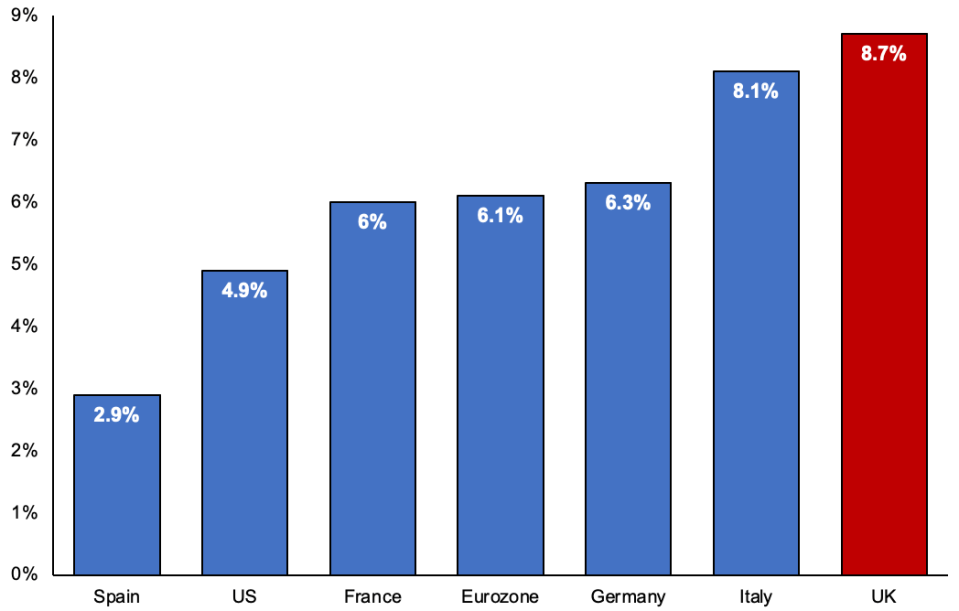
Source: ONS, eurostat, US Bureau of Labor Statistics

UK has yet to report inflation figures for May. They are expected to show another drop.

That upside surprise has prompted economists to round behind bets on Bank governor Andrew Bailey and the rest of the monetary policy committee lifting interest to at least 5.25 per cent, possibly even 5.5 per cent.

That would mean at least three more rate rises will be pushed through this year.

European Central Bank officials meanwhile are tipped to raise rates at least one more time this year, while the US Federal Reserve is anticipated to pause raising borrowing costs at its next meeting.

Their respective official rates at 3.25 per cent and a range of five and 5.25 per cent.

The European “labour market still looks very tight – other data published this morning showed that the unemployment rate edged down to 6.5 per cent in April. As a result, we suspect that the core inflation rate will come down only slowly and it will be a long time before it hits two per cent,” Jack Allen-Reynolds, deputy chief eurozone economist at consultancy Capital Economics, said.

“And we still think the ECB will raise interest rates by 25basis points at its meeting on 15thJune and probably once more at the July meeting,” he added.

Hiking rates to 5.25 per cent would mean the Bank of England would surpass the Fed in its tightening cycle.

Read more

Soaring energy bills set to fuel inflation spike

Smartphone displaying an energy bill notification with British coins and a banknote nearby.

Share this article

  • Facebook
  • X
  • LinkedIn
  • WhatsApp
  • Email

Similarly tagged content:

Sections

  • Markets & Economics
  • News

Categories

  • Economics

Related Topics

  • Bank of England
  • Eurozone
  • Eurozone inflation
  • UK inflation
  • UK interest rates

Trending Articles

  • Jobless Banquet: Youth unemployment surge ‘sends Neets to KFC’

  • As it happened: FTSE 100 drops as oil prices rise after Trump makes Hormuz threat

  • US bond market jitters spark UK economy recession warning

  • Amanda Blanc has worked her magic at Aviva

  • City law firm sues prominent Emirati business family

More from Morning Wire

  • ‘False dawn’: June inflation falls to 2.6 per cent but analysts say rises ahead

    Economics
    Till sales growth slowed to 2.7 per cent in the last four weeks
  • Soaring energy bills set to fuel inflation spike

    Economics
    Smartphone displaying an energy bill notification with British coins and a banknote nearby.
  • Temporary inflation slowdown set to boost Burnham

    Economics
    Rising inflation graph with increasing percentage symbols, highlighting economic trends and financial market impact
  • Bank of England holds interest rates but warns of rises to come

    Economics
    Bank of England headquarters in 2025, showcasing modern architecture and iconic London skyline in the background.
  • Bank of England may set the stage for interest rate hikes this year

    Economics
    Bank of England recession warning
  • Bank of England to hold interest rates as oil price surge threatens UK economy

    Economics
    Bank of England building on Threadneedle Street, London, showcasing its historic architecture and financial significance
  • Hold interest rates but ‘sound hawkish’, Morning Wire Shadow MPC tells Bank of England

    Economics
    Andrew Bailey, Governor of the Bank of England, with the Bank of England building and Union Jack flag in the background
  • Inflation leaps to 2.9 per cent in blow to Burnham 

    Economics
    Burnham cityscape showcasing modern architecture, bustling streets, and vibrant community life in a thriving urban setting
MorningWire

Independent European business, markets and political news for decision-makers.

Morning Briefing

Europe

  • Germany
  • France
  • EU Institutions
  • Europe

Business

  • Markets
  • Business
  • Economy
  • Regulation
  • Competition
  • Public Affairs

Editorial

  • Opinion
  • Editorial Policy
  • Corrections
  • Contact

Company

  • About Morning Wire
  • Privacy Policy
  • Terms of Use
  • Cookie Policy
© 2026 Morning Wire Ltd · Published by Morning Wire Media, Bahnhofstrasse 65, 8001 Zürich, Switzerland
Privacy · Terms · Cookies · Facebook