Eurostar is our green gateway to Europe — we cannot abandon it

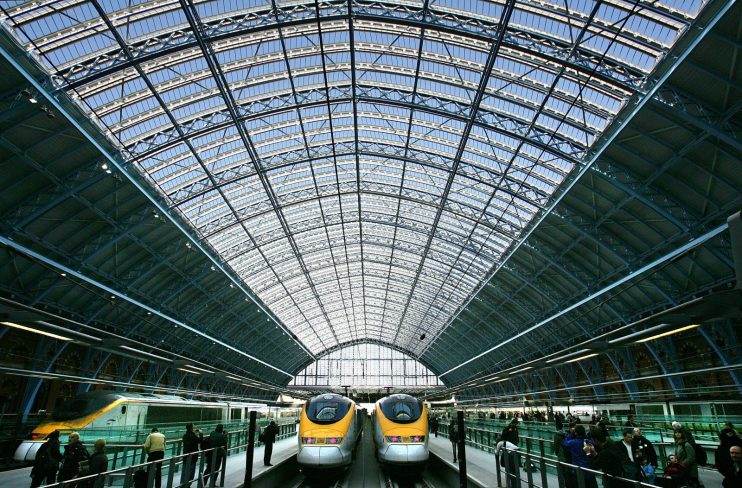
As the end of the EU transition period looms, the UK must be able to showcase the strength of its post-Brexit trading role, whatever the outcome of negotiations.
Our connectivity with Europe, even as a standalone nation, is crucial to demonstrating this.
Yet Eurostar, the most iconic connection between the UK and mainland Europe, is currently fighting for its survival, having suffered a 95 per cent drop in traffic since March. This lays bare the true impact Covid-19 is having on the travel and transport industry, and this symbolic link across the Channel.
Some 26 years ago, we celebrated the start of a new era of high-speed cross-Channel travel as the first Eurostar train left London for Paris. Today, millions of people rely on the international high-speed rail link for both business and leisure. Businesses travelling by high-speed train contribute around £130m to the UK economy each year, while tourists arriving via HS1 — the line that links London with the Channel Tunnel — inject £2bn into the UK economy, supporting the equivalent of 3,600 jobs.
2020 hasn’t been the year any of us were expecting. Coronavirus has upended the way we all live, putting the brakes on the notion of jumping on a train for a weekend away or a business meeting in person. Having carried 11m passengers in 2019, Eurostar has seen a complete collapse in demand for its service, and is now operating just two trains a day. HS1 is funded principally from access charges paid by Eurostar, so there is a direct link between the two businesses, putting them both at serious risk.
With continuing restrictions on international travel such as lockdowns and quarantine measures, the impact on the industry is already severe. But in the case of Eurostar and HS1, it is even more acute.
While domestic rail services and airlines have received funding from specific government schemes, with airports set to receive another financial support package equivalent to their business rates liabilities, high-speed international rail has been forgotten. At a minimum, existing support must be extended to international rail.
This is crucial not just for the economy, but for the government’s green ambitions. The recently unveiled environmental plan puts huge emphasis on the UK’s commitment to meeting ambitious climate change targets. A journey by rail uses at least 80 per cent less emissions per route than the equivalent flight, saving 60,000 short-haul flights per year, and just last month we hailed the achievements of HS1 in becoming the first train line in the UK to run entirely on renewable energy.
Is it right, therefore, that we should give an advantage to high-carbon transport, but leave the most environmentally friendly choice for short-haul travel to fend for itself? If we want to truly commit to a low carbon future and benefit from the unique connection that Eurostar and HS1 provide when life returns to normal, we must step in now.
There is a simple answer to this challenge: restructure charges for accessing the high-speed line. This would stabilise both Eurostar and HS1. Charges in the UK are already over three times higher per kilometre than in France, so there has to be a way forward — if only on a temporary basis — to stop these businesses from going under.
If we fail to act, the consequences for Eurostar and HS1 will be profound. Surely the transport secretary would not want to preside over the demise of Eurostar and HS1? And we have to ask ourselves, what is the point of building the HS2 link if we cannot even finance HS1?
Recent news of vaccines gives us all a glimmer of hope that life as we know it will resume soon. When it does, we need to make sure our international high-speed rail businesses are in a strong position to respond and meet demand. That means fighting to safeguard cross-Channel rail — our green gateway to Europe, and the key to our future connectivity in a post-Brexit world.
Main image credit: Getty