Skip to content
Monday 31 August 2026London --:--Frankfurt --:--Zurich --:--
NewslettersSearchEN · DE · FR
MorningWire

European business, markets and politics

FTSE 100
10,824.26
+0.29%
DAX
26,258.11
-1.17%
CAC 40
8,334.50
-0.79%
STOXX 50
6,420.16
-1.01%
  • Europe
  • Markets
  • Business
  • Economy
  • Regulation
  • Politics
  • Opinion
More
GermanyFranceEU InstitutionsCompetitionPublic AffairsBankingTechnologyEnergy
  • Germany
  • France
  • Europe
  • Markets
  • Business
  • Economy
  • Regulation
  • Politics
  • Opinion
  • DE
Tuesday 05 January 2016 10:03 am

Eurozone inflation stays at 0.2 per cent in December


By: Chris Papadopoullos

Add as a preferred source on Google

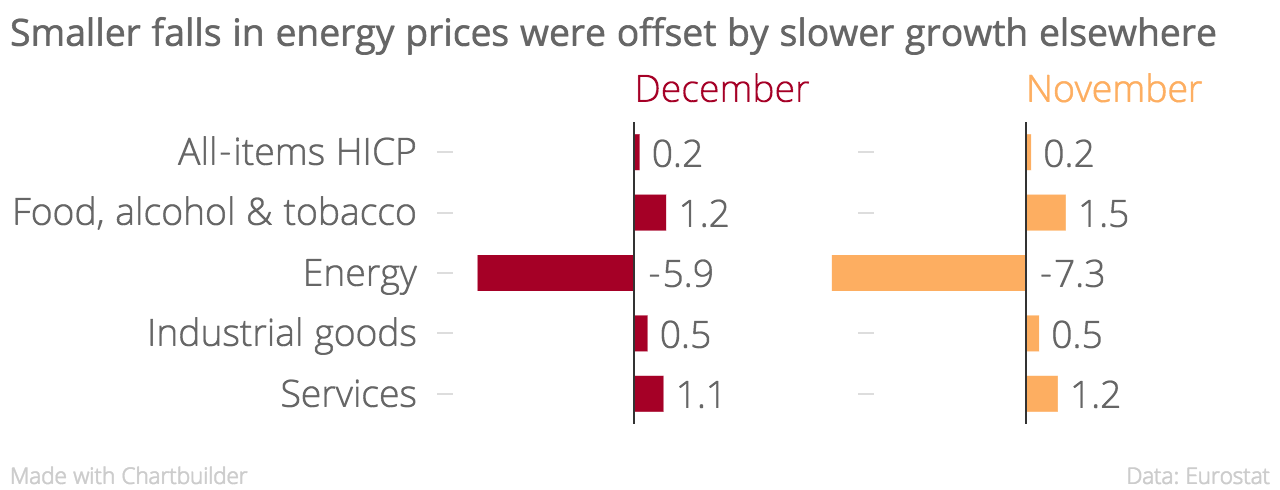
Inflation in the Eurozone was 0.2 per cent in December, unchanged from the month before, according to official estimates released this morning.

The rate of energy price declines slowed to 5.9 per cent from 7.3 per cent, the figures published by Eurostat, the statistical office of the European Union, reveal. However, this was offset by slower growth in food, alcohol and tobacco prices, which were 1.2 per cent higher in December compared with the same month last year. It marked a slowdown from November's growth rate of 1.5 per cent.

Inflation, measured by the year-on-year change in the harmonised index of consumer prices, has been below the European Central Bank's (ECB) target of just below two per cent since early 2013. It fell sharply into negative territory early last year as collapsing oil prices and cheap commodities weighed on prices and has hovered around zero since. 

The European Central Bank extended its €60bn (£44bn) a month asset purchase programme at the end of last year by another six months. The programme, launched in March 2015, is now planned to continue until March 2017 by which time the ECB plans to have completed nearly €1.5 trillion of purchases of mostly public debt.

"The soft inflation print increases the pressure on the ECB next week, and also increases the risk of additional easing. But we think the central bank will refrain from adding stimulus, opting to wait for a bit more data in Q1 [January to March] before potentially acting. Another disappointment in the January inflation data likely would see the central bank adding to its stimulus," said economist Claus Vistesen from Pantheon Macroeconomics.
Share this article

  • Facebook
  • X
  • LinkedIn
  • WhatsApp
  • Email

Similarly tagged content:

Sections

  • Markets & Economics
  • News

Categories

  • Business
  • Economics

Trending Articles

  • Mead Johnson Welcomes Defense Verdict in Inman Case

  • Everest Publishes 2025 Global Loss Triangles

  • Angel’s Profits Grew Robustly in the First Half of 2026 with Europe and North America Turning Profitable Ahead of Schedule

  • Badenoch bets on experience as Griffith and Tugendhat claim shadow cabinet top spots

  • Sex Education star makes investment into women’s football vehicle

More from Morning Wire

  • Soaring energy bills set to fuel inflation spike

    Economics
    Smartphone displaying an energy bill notification with British coins and a banknote nearby.
  • How patient can the Bank of England be?

    AD
    Historic Royal Exchange building in London with modern skyscrapers behind, clear blue sky.
  • Inflation leaps to 2.9 per cent in blow to Burnham 

    Economics
    Burnham cityscape showcasing modern architecture, bustling streets, and vibrant community life in a thriving urban setting
  • Supermarkets ‘actively shielding’ shoppers as food inflation falls again

    Retail
    Shopper in a supermarket produce aisle browsing various packaged vegetables and fruits.
  • UK economy’s rebound fails to stem two years of mass job losses 

    Economics
    LONDON, UNITED KINGDOM - JANUARY 31: The Shard is seen on the horizon as commuters cross London Bridge during the morning rush hour on January 31, 2023 in London, United Kingdom. The IMF reports that the UK economy will contract by 0.6% in 2023, as opposed to the previous prediction it might grow, and will perform worse than many other advanced economies, including Russia.The cost of living continues to hit households with grocery inflation for the first four weeks of 2023 rising to 16.7% which would add a further £788 per year to family food bills. (Photo by Leon Neal/Getty Images)
  • House prices in wealthy London boroughs fall by up to £300,000

    Property
    Waverton Investment Management and London & Capital combined into W1M.
  • El Nino heatwaves to ‘fuel inflation next year’

    Economics
    Firefighter in helmet and uniform watching a blazing forest fire at night, red glow in the sky
  • Picky Brits: Heatwave fuels surge in finger food spending

    Retail
    Tesco quiche, cured meats, olives, and dip on a wooden board, ready for a party or meal.
MorningWire

Independent European business, markets and political news for decision-makers.

Morning Briefing

Europe

  • Germany
  • France
  • EU Institutions
  • Europe

Business

  • Markets
  • Business
  • Economy
  • Regulation
  • Competition
  • Public Affairs

Editorial

  • Opinion
  • Editorial Policy
  • Corrections
  • Contact

Company

  • About Morning Wire
  • Privacy Policy
  • Terms of Use
  • Cookie Policy
© 2026 Morning Wire Ltd · Published by Morning Wire Media, Bahnhofstrasse 65, 8001 Zürich, Switzerland
Privacy · Terms · Cookies · Facebook