The pandemic is distorting forecasters’ economic data, argues chief economist

The pandemic already forced economic forecasters out of their comfort zone, but the terrain is now getting even more perilous. It is no longer sufficient to make a simple assumption about ‘the virus’.
According to Neil Shearing, group chief economist at economic research firm Capital Economics, forecasts now have to consider factors such as vaccine rollout, vaccine efficacy, virus mutations, the lifting of lockdowns and the increasing likelihood that some restrictions will be with us for many months, if not years, to come.
“And if all that wasn’t enough, there is growing evidence that the pandemic is distorting some of the economic data we would normally rely on to guide us,” London-based Shearing warned.
GDP figures
Shearing argued there are three ways in which the pandemic has complicated the production of economic statistics.
The first is measuring the bedrock of all economic analysis: GDP. “This owes more to the philosophical approach that national statistics offices have taken to measuring output during lockdowns than it does to anything else,” he explained.
The issue centres on the public sector. Output in the private sector can be estimated by looking at the turnover of a representative sample of businesses.
“But this can’t be done for public sector services, and this has given rise to different approaches,” Shearing remarked, stressing that most countries estimate public services output by looking at how much is spent.
“And since this has been broadly unchanged during the pandemic, teachers, civil servants and public healthcare workers have still been paid – there has been little effect on the reported level of output,” he noted.
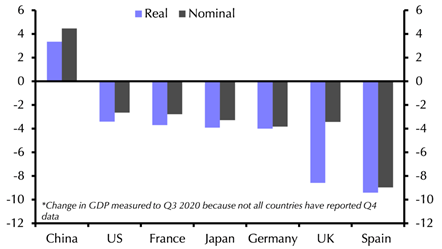
A handful of countries, notably the UK and France, have taken a different approach, however. They have instead used a range of data, such as the number of operations in hospitals, visits to GP surgeries and pupils in schools, as proxies for public services output.
“Since many of these measures have fallen during lockdowns, the reported volume of public sector output has also fallen sharply. This is one reason why the UK has suffered one of the biggest declines in real GDP since the pandemic began,” Shearing said.
In contrast, the fall in nominal GDP, where the public services element is based on cash spending, has been fairly modest. 2Viewed through this lens, the UK sits somewhere towards the middle of the pack in terms of economic performance,” he added.
More slack in the US labour market
The second area in which the pandemic has distorted the data according to Shearing is the labour market.
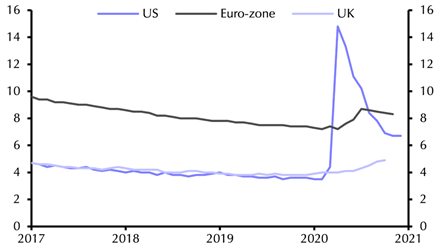
“This relates in part to the effect of government support programmes. It has been well-documented how government-backed furlough and short-time work schemes have prevented a surge in unemployment in Europe,” he explained.
He pointed out that this contrasts with the US where, rather than keeping workers tied to jobs, government support has taken the form of transfers to households and increases unemployment insurance.
As a result, the US unemployment rate surged during the depths of the crisis. It fell back over the second half of last year but, unlike in Europe, remains well above pre-pandemic levels.
“At face value, this suggests there is substantially more slack in the US labour market than there is in Europe, but in practice this is simply a consequence of the different approaches governments have taken to fiscal support,” Shearing said.
Moreover, statistics offices have faced the added challenge of having to capture the effect on the labour market of unusual shifts in migration caused by the pandemic, he argued.
“This appears to have been a particular issue in the UK, where there is evidence of a large fall in the population caused by immigrants returning home at the start of the pandemic,” he said.
“The way this has been accounted for by the Office for National Statistics means that the official data may be over-stating the actual level of employment in the UK.”
Inflation
The final area where the pandemic has affected the production of statistics is inflation. On a practical level, statistics offices have faced the problem of having to measure prices when many items were simply not available for purchase due to lockdowns.
“They also need to account for shifts in the timing of seasonal sales caused by the pandemic. And they must grapple with a shift in consumption habits due to lockdowns, with households spending relatively more on goods and less on services, which then needs to be reflected in the weights within inflation baskets,” Shearing explained.
More caution
As a result of the distorted data, markets, investors and policymakers should treat economic data with more caution than usual, Shearing argued, singling out best- and worst-performing economies through the pandemic, to estimating the amount of slack in labour markets and anticipating the build-up in inflation pressures.
One consequence is that it will become even more difficult for policymakers to extract the signal from the noise in the data.
“The experience of the past decade suggests that, if in doubt, governments and central banks should err on the side of caution and keep policy support in place, the costs associated with premature tightening far outweigh those associated with leaving support in place for too long,” he said.
Ultimately, data distortions could lead to policy missteps or complicate efforts by central banks to communicate their intentions to financial markets.
“This is perhaps less of a concern for the Fed, given that its shift to an average inflation target and long-standing dual mandate give it more room for manoeuvre. But it’s easy to see how the policy debate in Europe could get more contentious,” Shearing concluded.