Inside the furore over the future of the Foreign Office

A pamphlet by former senior diplomats has triggered an identity crisis: must we cling onto tradition or embrace a new vision of Britain? Lucy Kenningham investigates
Is the Foreign Office working?
No, according to a pamphlet published on Monday by several very senior recent diplomats, former cabinet secretary Lord Sedwill included, which claims the Foreign, Commonwealth and Development Office (FCDO) is “rooted in the past” and “struggling to deliver a clear mandate”. They recommend the department be abolished and replaced with a newly-named Department for International Affairs – dropping the colonial-esque commonwealth and ‘development’. The DIA would have a broader, more modern mandate covering climate change, development, trade and aid as well as foreign policy. They suggest power is currently too concentrated in the hands of individual ministers on short tenures leading to a policy merry go round that serves no one.
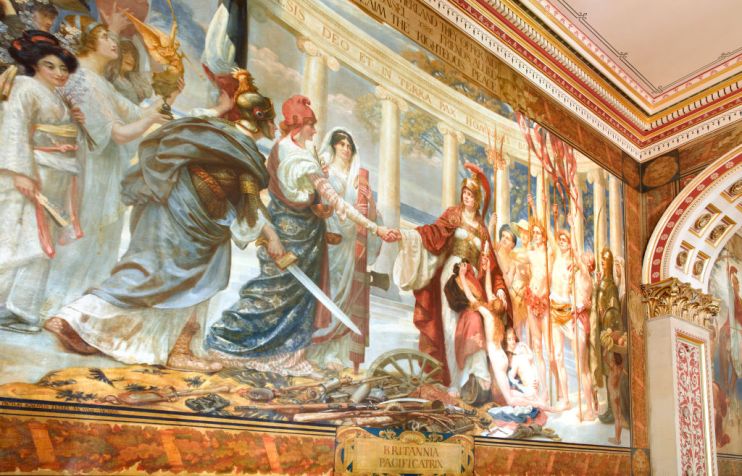
The authors also argue that the very walls of the FCDO holds Britain back. “The physical surroundings on King Charles Street also hint at the Foreign Office’s identity[…] Modernising premises – perhaps with fewer colonial era pictures on the walls – might help create a more open working culture and send a clear signal about Britain’s future”. That’s images like the mural pictured above, of which there are five by the artist Sigismund Goetze showing the Anglo-Saxon empire in hagiographical reverence. In one, a young Swahili boy “is included to remind us of our obligations” to quote the artist’s stated intentions. Not surprisingly, many, including foreign diplomats, object to them. In 2020, Lisa Nandy, then shadow foreign secretary, wrote to Dominic Raab, himself then foreign secretary, requesting they be removed.
Cultural vandalism or history in progress?
Many shudder at the thought of removing or tearing down any artwork, seeing it as an act of historical vandalism. Others see a good revamp as history in progress. “A healthy attitude balances respect for the past with a realistic and positive approach to the future,” one former FCDO staffer suggested. So, is a desire to modernise a sign of shame in our history? Or is clinging onto our past a greater sign of shame in our present reality?
Another foreign policy expert told Morning Wire that whilst the report was “overall, a useful contribution to the discussion” it was perhaps unfair in its harsh assessment of progress made on making new friends post-Brexit. “Brexit brought about a significant reorientation in foreign policy including efforts to make new friends in Asia, such as with the Asia Pacific trade deal, as well as efforts made in Latin America and the Gulf”.
As for the murals, they are part of the walls and could be hard to remove – but, at the very least, a note with a written explanation wouldn’t go amiss.
A brief history of the FCDO
Just as the era of the nation state started to really take off, Britain’s Foreign Office (FO), as it was first called, was created in 1782. Since then, it has existed to promote the UK’s interests, both ideological and commercial, overseas; and to support our citizens living abroad. Its tools are soft power and diplomacy. You’ll find it in King Charles Street on Whitehall in a grand building built to impress foreign visitors at the height of the British empire in the 1860s, where this nascent context is now provoking questions about its future.
The FO became the FCO when it merged with the Commonwealth Office in 1968. In 2020, it added a new consonant becoming the FCDO (or “F*CkeD Off” amongst some of our great country’s more potty-mouthed civil servants) when the FCO merged with the Department for International Development (known as Dfid – which had been founded by Tony Blair in 1997). This merger came at the same time as the aid budget was slashed from 0.75 per cent of GDP to 0.5 per cent, which was criticised by many former diplomats as being short sighted and immoral.
Nowadays, the FCDO operates from embassies, consulates and high commissions in almost 270 overseas locations. Its global network provides a platform for 42 other UK public bodies. Its diplomats negotiate our relationships with other countries, guided by foreign policy as set by the secretary of state. Once, the FCDO was very much the domain of the elite. Etonians and aristocrat associates trod a gilded path from the University of Oxford over to Whitehall. But that has been changing, fast.