Fancy a brew? Annabel Palmer talks craft beer with Draft House’s Charlie McVeigh

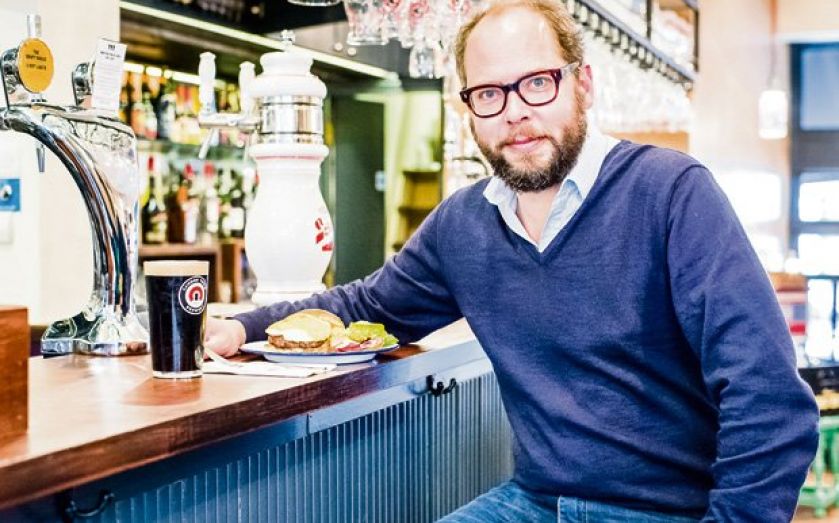
Draft House founder Charlie McVeigh talks about the perils of the hospitality industry, and how he’s taking advantage of Britain’s real ale renaissance
A CRAFT beer revolution has taken hold in Britain. Consumption of independently-brewed beer rose by 22.3m pints to 415m pints in 2012, according to the Society of Independent Brewers. And figures suggest the trend continued on its upwards course in 2013. Nonetheless, it was pure coincidence that Charlie McVeigh – the entrepreneur behind Draft House public houses, and born-again beer nut – found himself in the industry back in 2009.
Real ale was rescued from oblivion by the Campaign for Real Ale (Camra) in the 1970s. But McVeigh thinks Camra was too preoccupied with preserving the British cask beer market in aspic. He says: “Pubs approved by Camra were what you could call ‘old man’s pubs’. We wanted to take interesting new beers, and make them as exciting as wine. Why not? Beer has every bit as much provenance and quality.”
Fortunately for those brewers, in 2002 then-chancellor Gordon Brown introduced Progressive Beer Duty, giving tax breaks to smaller producers. They quickly began to grow in number.
CHANGE OF DIRECTION
But long before craft beers had their extreme makeover, McVeigh was a managing consultant working on a project for P&G. After four years of “living in hotel rooms in Eastern Europe and the Far East,” he got homesick and returned to London. Yet rather than pursue another role in professional services, he bought derelict nightclub Woodys in Notting Hill in 1998. It was McVeigh’s first foray into the hospitality industry, and it was a huge success. He bought the Grand Union pub next door, and a restaurant, Bush Bar & Grill, nearby. They were later sold for “a lot of money”.
But in 2004 came a costly experiment: Italian pub Matilda’s. “It was a silly idea in hindsight, and it left us with a site that wasn’t really making any money,” he says. But like many entrepreneurs, McVeigh says he learns far more from his mistakes than successes. “After my first three ventures, I felt everything I did would be sucessful. I was lazy, I didn’t put enough thought into the project. But once you’ve had a failure, you never take things for granted again.”
Draft House began its life at the site of the failed Matilda project. Then a gastropub, its opening coincided with the launch of Sambrooks Brewery next door, and both establishments set out on a mission to capitalise on the trend for “going local” and the rising demand for traditional beer.
And the recession provided yet another opportunity. “One of the success stories from the financial crisis was the branded dining and bar business – look at Byron, Realpubs or Geronimo Inns. When I tell people I work in this sector, they give me a look of pity. But in London, and other prosperous areas of the UK, pubs are thriving.”
Indeed, the branded restaurant market is forecast to grow by £5.6bn to £22bn over the next five years. Consumers’ eating-out habits have changed dramatically in the past decade, becoming less structured, less formal and with less commitment. “When you go into a pub, you can convince yourself that you’ll have one pint and a packet of crisps. But you might end up having a burger and three pints. When you go to a restaurant, however, you know you’re headed for a £60 tab.”
SIZEABLE OBSTACLES
Riding on the popularity of both gastropubs and craft beer, Draft House opened its third site, by Tower Bridge, in 2010. However, McVeigh found the transition from two locations to three “very difficult operationally. It was hard to maintain quality and consistency.” He needed guidance, and who better to provide it than Luke Johnson – best known for his chairmanship of Pizza Express, under which the chain expanded from 12 owned restaurants to over 250.
But he also helped with Draft House’s biggest challenge: the rollout. First, choosing sites in London is “incredibly difficult. Anyone in this sector would agree that it’s the hardest thing.” The business now five sites: Battersea, Clapham, Charlotte Street, Seething Lane, and Tower Bridge, and McVeigh plans to open two to three sites this year. “That said, it’s March and I still haven’t found any. There is huge demand and insufficient supply. As a result, we’re considering – sooner than we would like – expanding Draft House outside the capital.” But it’s a different world outside London economically, McVeigh says. Some companies have seen success, like the Loungers; others have not.
And in the bar business, scaling up consumes a lot of capital – another reason Johnson came on board. “You can spend a premium on a lease and hundreds of thousands on a fit out. And the return might be over two to three years.” The business achieved net profitability in 2012, and its primary objective this year is to significantly increase revenues.
INDUSTRY AT RISK
But while the sector is thriving in some areas, McVeigh worries for the 26 pubs being forced to close every week. For some, he fears closure is inevitable – “they are simply located in the wrong place”. For others, he thinks survival rests on JD Wetherspoon founder Tim Martin’s VAT campaign, which aims to reduce the level of VAT in the hospitality sector from 20 per cent to 5 per cent.
“A key reason pubs cannot survive in less-affluent areas is the competition from supermarkets, which sell alcohol at below-cost price for volume purchases to drive traffic into their stores, and which do not pay 20 per cent VAT on food. The government needs to find a way to create a level playing field.”
Nonetheless, McVeigh is confident that the popularity of the wet-led pub will only grow. “Just look at the US [currently home to around 2,600 independent breweries] if you want to see the direction of travel.” McVeigh’s favourite London pub is The Cow, though he never “has time to go to it”. What would he say to budding entrepreneurs? “Starting your own business is fun. But it’s not fun like going to the pub.”
CV CHARLIE MCVEIGH
Company name: The Draft House
Founded: 2007
Turnover: £5m
Number of staff: 75
Job title: Founder
Age: 47
Born: New York
Lives: Ladbroke Grove
Studied: English Literature at the University of Edinburgh
Drinking: Magic Rock Circus of Sours
Eating: Stilton Patty Melt
Reading: Mick Tyson: The Undisputed Truth, by Mike Tyson
Favourite Business Book: The Rise and Fall of Alan Bond, by Paul Barry
First ambition: To be Jacques Cousteau
Talents: Ideas, energy and determination
Heroes: Bob Dylan, The Ultramagnetic MCs
Motto: Onwards and upwards
Awards: Best Bars in London, Shortlist 2013; Best in Class “Beer, Bourbon and Burgers” Waitrose Awards 2012
Most likely to say: Too much
Least likely to say: Too little