Farage’s revenge on the banks proves he is more Trump than Thatcher

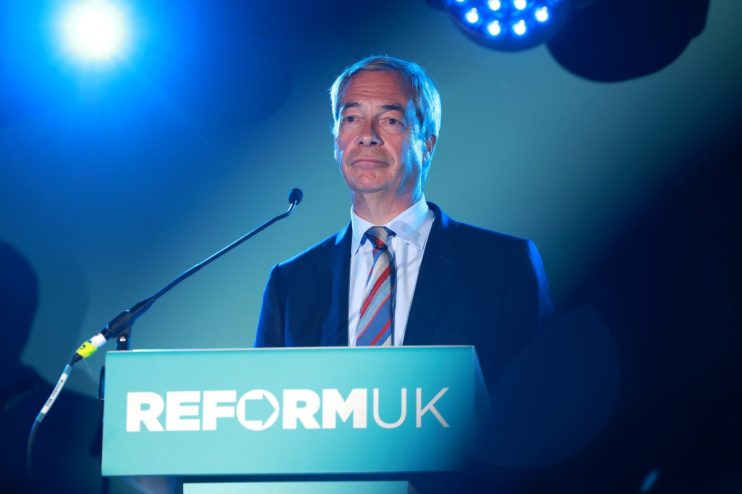
Nigel Farage’s promise to tax banks more shows his Trumpian revenge coming out to play, and exposes the contradictions at the heart of Reform’s economic policies, writes Eliot Wilson
Seeing Nigel Farage at the World Economic Forum in Davos is almost as perplexing for onlookers as it must be for him. For a right-wing populist, Davos is the lair of the beast; the annual gathering of exactly the out-of-touch, net-zero promoting, ESG-embracing globalists who have brought ruination on Europe’s traditional industries and culture. Farage is there as an act of defiance, the tribune of the common man who will twist the tail of the establishment, warning them that the world order is changing.
Certainly he pulled no punches. Interviewed by Bloomberg’s Stephanie Flanders, he reaffirmed a commitment from Reform UK’s 2024 manifesto to scrap the interest the Bank of England pays to commercial banks on their reserves. This, the party claimed at the last election, would save £35bn “and has been endorsed by senior figures at the Financial Times, New Economics Foundation and IFS, as well as two former deputy governors of the Bank of England”.
In fact, Paul Johnson, director of the Institute of Fiscal Studies (IFS) is lukewarm at best on the idea; he has said on social media that such a move “is unlikely to raise even half the £40bn annually that has been suggested, and only in the short term”. But opposition from the financial and economic establishment is grist to the populist mill. Commercial banks have argued it is in effect a tax, but Farage is undeterred: “They are just not going to get free money anymore… this will be tough for banks to accept, but I am sorry, the drain on public finances is just too great.”
There was another deeply revealing motivation Farage was unable to hide, one which had more than a hint of Trumpism about it.
“Some of the banks won’t like it. Well, I don’t like the banks very much because they debanked me, didn’t they?”
Economic policy or revenge, that dish best served cold? For Donald Trump there is no meaningful difference, and it seems that Farage, who once described the President as “the single most resilient and bravest person I have ever met in my life”, is equally ready to conflate the personal and the political. (Trump characteristically has gone one step further and is now suing JP Morgan Chase and its CEO, Jamie Dimon, for $5bn for alleged “debanking”.)
The contradiction at the heart of Reform UK
That conflation exposes a fundamental contradiction within Farage and Reform UK. Who is Nigel Farage? Part of him is a classic product of the City in the 1980s; he left Dulwich College at 18 and, rather than going to university, became a commodities broker at Maclaine Watson, a venerable British brokerage which had three years before become a subsidiary of Wall Street pugilists Drexel Burnham Lambert. In 1986 he moved to Crédit Lyonnais Rouse but was eventually, according to some accounts, asked to leave after a drunken incident at the London Metal Exchange.
Some of the style of the 1980s Canada is in Farage’s blood: pinstriped suits, cigars, long and convivial “proper lunches”. He once remarked that “some of the City excesses of the 1980s in the cold light of day do look pretty appalling, [but] it was huge fun”. After the Iron Lady’s death in 2013, he described himself as the only politician “keeping the flame of Thatcherism alive”.
Reform UK, however, remains an economically incoherent party, because it has united the angry and aggrieved. That 2024 manifesto, sententiously titled Our Contract with You, promised to “slash wasteful spending”, “cut unnecessary regulations” and “take 7m people out of income tax”. The party wanted a smaller state, and those instincts might even have been in line with the Thatcherite principles formed in the Grantham grocer’s shop which was so formative.
But this is no party of chilly but necessary discipline. The manifesto also pledged to provide “40,000 new front-line [police] officers”, to “increase the criminal justice budget” and defence spending, to “bring 50 per cent of each utility into public ownership” and subsidise farming to the tune of £3bn. There was little detail of the “incentives” for boosting the defence industry but it reeked of continental dirigisme.
Farage has since rowed back on the scale of tax cuts. He has talked of reopening uncompetitive steelworks and of nationalising British Steel. He has cannibalised the vote of Labour and the Conservatives by promising to fulfil the most ardent desires of the interventionist left and the free-market right. And the polls demonstrate the success Reform UK has achieved.
This is Boris Johnson’s cakeism: “My policy on cake is pro having it and pro eating it”. Johnson also rode high for a while by turning a blind eye to contradictions. But even the most recalcitrant child knows that indulgence cannot go on forever. Reform UK is the broadest of churches because it has been against things more than in favour of them. But, proverbially, gouverner, c’est choisir; and the next words of Pierre Mendès France are often forgotten: si difficiles que soient les choix, however difficult the choices may be.
Is Farage a bank-hating, anti-capitalist champion of state intervention? Or does he crave a bonfire of regulations, a free market truly unleashed to find the economic growth which has eluded the current government? The man who was so comfortable on the trading floor in his youth must know that the differences cannot be willed away – nor can they be concealed for much longer.
Eliot Wilson is a writer, historian, commentator and contributing editor at Defence On The Brink