Fielding expertise: WeFarm founder Kenny Ewan on mangoes, peer reviews, and foot and mouth

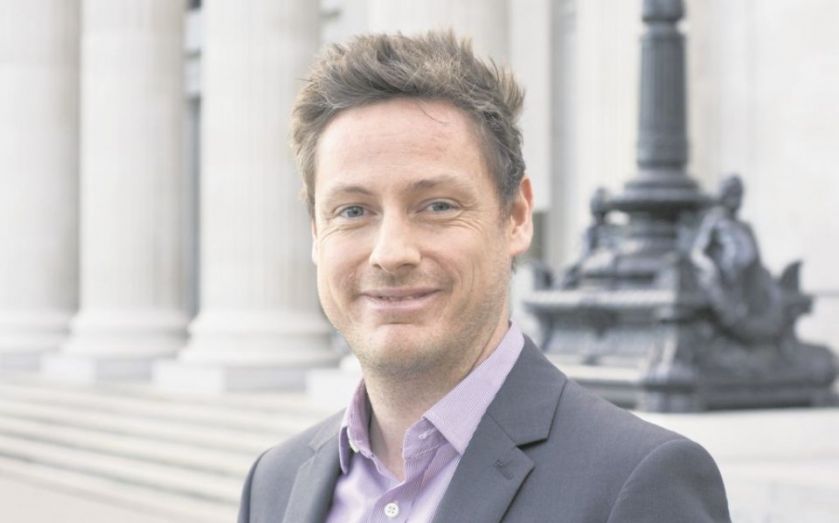
Look on the We Farm home page, and you’ll see a feed of questions like, “please, I need a reason as to why my coffee leaves are changing into yellow”. Answer: “It’s mainly due to lack of nitrogen. Foliar spray with a good foliar fertiliser like Omex will help clear this.” Or, “what is the appropriate spacing of pumpkin plant?” – “five to six feet between plants and 10-15 feet between rows.” These questions are being sent in by farmers across Kenya, Uganda and Peru – you can see where they are from the GPS-enabled map next to the feed. And, via the We Farm platform, they’re being answered by other farmers, using their knowledge and experience.
Kenny Ewan first came up with the idea of We Farm with a colleague, while working at charity Cafedirect Producers’ Foundation (CPF), where he’d been brought on as one of the startup team members. The concept grew far faster than they’d expected, with successful pilots run in Tanzania, Kenya and Peru. “We realised fairly early that, in order to make it sustainable and scalable, we’d need to be a separate business, not a charity project.” The original intention was to sell some equity to raise money, but last summer, We Farm won the Google Impact Challenge, allowing it to set itself up as a subsidiary of CPF. In the New Year, it’ll open its A round of funding, with a view to raise £2m.
PERFECT SIMPLICITY
The We Farm model is beautifully simple: farmers send a text message to the platform, which (and it’s fully automated) pings it out to others who are involved in the same kinds of farming. In much of the developing world, mobiles are ubiquitous, but wifi is not – so a text holding crowdsourced knowledge is extremely valuable – 96 per cent of We Farm’s users are offline. Since launching in February, it has grown to 35,500 users. Last week, 1,400 farmers in Uganda signed up to the free service in just four days. So far, there have been 4.2m interactions (i.e. questions asked and answered). Ewan points out that 57 per cent of We Farm’s earliest adopters are still regular contributors. As a comparison, Twitter’s stand at 13 per cent.
I ask Ewan what will happen when the internet catches up and people can just use Google – but he doesn’t see that as an issue. “We are already online, and the point about We Farm is that it’s connecting people to other users who know what they’re talking about. And the web is overwhelmingly Western-based in terms of content.” Crucially, We Farm allows users to peer rate and review answers – much like Reddit. “We want to make sure we’re passing questions to the most relevant users, and we’re working on how best to maximise farmers’ specialisms. Later, the reputation-based element can probably be used more cleverly – to really incentivise the community.” We Farm will also look at leveraging outside experts (vets, for example) once it’s better established.
GLOBAL IMPACT
Of course, there are lots of clever ways We Farm can be used. Already, Ewan is talking to some of the UK’s biggest retailers. “Farmers in the developing world account for 70 per cent of the world’s food chain. “We were with a high street retail the other day and, just in the time we were talking to them, they lost a shipment of mangoes – the whole lot has rotted. We can start to track the data and information at source – a good three months before that moment happens – and stop it happening.”
Just a couple of weeks ago, Ewan’s team spotted a couple of questions that seemed to be about foot and mouth. “Imagine if we could say to a government, ‘we’ve seen what could be a potential case’ weeks before it’d otherwise be picked up.” He’s also partnered with local providers and co-operatives – fertiliser companies, for example – so that farmers can be put in touch with suppliers and local experts far more quickly.
We Farm can take a revenue share from this kind of activity – and Ewan doesn’t see monetising We Farm as too much of a challenge. “This is a scale model, so it’s when we hit critical mass – 10m-100m users – that we’ll be able to provide local communities, governments, companies with information and aggregated data that they simply don’t have access to at the moment.”
But not everyone is so forward-thinking. “The trouble is, we still live in a world where the mindset is, ‘poor people just need to be told what to do’. We recognise that access to information is key, but we want to tell them exactly what that information is.” Ewan says he gets a lot of “confused looks” when he explains that he’s crowdsourcing information. “But ultimately, that’s the only scalable way to get the information people need to them. Can you imagine if Google had 100 people in a room answering people’s web queries? Almost literally, that’s how a lot of NGOs work. We tried to partner with NGOs, and a lot said, ‘we don’t want any information going up that isn’t vetted by us’. For me, that’s a pretty scary concept.”
Coupled with this mindset is the fear of innovation, says Ewan. “People have become obsessed with social impact metrics. Obviously it’s important, but it cuts out the most innovative projects. Water pumps might be easy but, to see real improvement, you need experimentation. People are really fearful of new things in the social impact sector. We’ve got to a point where people can’t make mistakes. But just because it’s social money, doesn’t meant it shouldn’t be allowed to fail.”
In 2016, We Farm will expand into India, Brazil and possibly the Ivory Coast – depending on securing investment – while growing its in-country presence. “We want to make a strong enough business case that traditional VCs are interested.” Ewan is also in talks with Indian investors interested in philanthropy. “There isn’t always an obvious way for people to do good; it’s not a case of just sticking money somewhere – they want to see a tested model. But, a huge number of people do want to really help and make a difference.”
CV: KENNY EWAN
Company name: WeFarm
Founded: 2015
Turnover: £80,000 in 2015
Number of staff: Currently 8
Job title: Founder and chief executive
Age: 34
Born: Glasgow
Lives: Wanstead, London
Studied: Architecture at the University of Dundee; and currently an EMBA candidate at the University of Bath
Drinking: A very good espresso
Eating: Peruvian food, particularly Ceviche. Also anything spicy. I’m a spice maniac – I put cayenne pepper in sandwiches…
Reading: Sapiens by Yubal Noah Harari (it’s awesome), and Investor Readiness, by Brad Feld and Jason Mendelson
Favourite Business Book: The Starfish and the Spider, by Ori Brafman and Rod A Beckstrom
Talents: Marathon running – 3hrs 19. I can also make a chicken out of a tea towel (or any rectangular linen object)
Heroes: James Dyson, Iain Banks and Roberto Baggio
First ambition: To be a Lego designer
Most likely to say: It’s vital to recognise the benefit of peer-to-peer in the developing world. Just because people are poor, it doesn’t mean they don’t have knowledge to share
Least likely to say: My spirit animal is an anteater
Awards: Google Impact Challenge 2014; MEFFY Innovation in Technology 2015; Acumen+London Pitch 2015