Skip to content
Sunday 13 September 2026London --:--Frankfurt --:--Zurich --:--
NewslettersSearchEN · DE · FR
MorningWire

European business, markets and politics

FTSE 100
10,650.44
+0.39%
DAX
25,568.56
+0.82%
CAC 40
8,179.77
+0.78%
STOXX 50
6,325.13
+0.90%
  • Europe
  • Markets
  • Business
  • Economy
  • Regulation
  • Politics
  • Opinion
More
GermanyFranceEU InstitutionsCompetitionPublic AffairsBankingTechnologyEnergy
  • Germany
  • France
  • Europe
  • Markets
  • Business
  • Economy
  • Regulation
  • Politics
  • Opinion
  • DE
Wednesday 16 March 2022 6:15 am  |  Updated:  Tuesday 15 March 2022 5:34 pm

A renewed focus on defence spending could turbocharge Britain’s scientific innovation

By: Paul Ormerod

Add as a preferred source on Google
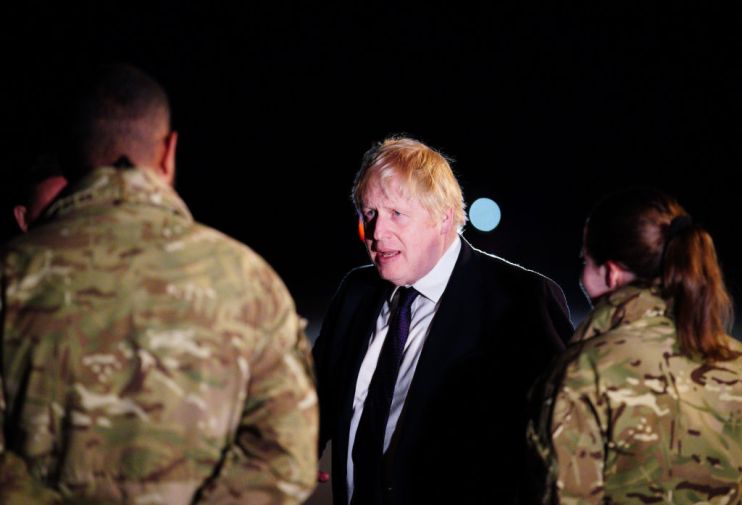
Boris Johnson Meets With Military Personnel At RAF Brize Norton
Boris Johnson has come under fire for comparing the UK vote on Brexit to those impacted by Russia’s invasion of Ukraine.

Germany, along with most of the rest of the EU, has finally woken up to the folly of relying on other countries – mainly the US but also the UK – to defend them.  

At the end of last month, Chancellor Olaf Schulz announced that €100bn will be put into a new defence procurement fund. For the first time in decades, defence spending will rise to over  2 per cent of German GDP.

The German move puts even more pressure on the British government to follow suit. If we are to retain our position as the premier military nation in Western Europe, defence spend needs to be nearly doubled to some 4 per cent of GDP. But all this pales in comparison with America. At an annual total of over $700bn, defence expenditure in the US  is more than the total spending on defence of the next ten highest spenders – including China – combined.

A striking feature of the American security budget is the vast amounts spent with private contractors. For example, around 10 per cent of total manufacturing output in the US is accounted for by military production.

The major defence suppliers are huge companies. Lockheed Martin employs 110,000 people. Raytheon Technology is even bigger, with a turnover of over $80bn and 243,000 employees.

Money is handed out not just to giant firms, but to companies of all sizes and individual contractors. The scope now extends far beyond the weapons manufacturing, with artificial intelligence, machine learning and cyber warfare services also now contracted out.

All of this comes with a risk. Economists have coined the phrase “regulatory capture” to describe situations in which regulatory bodies become dominated by the interests of the companies they are meant to regulate, rather than the wider public interest.

The symbiotic relationship between the public and private spheres in the American defence industry, and the employees who move readily between them, creates the potential for a similar phenomenon.

Read more

Badenoch: Cut benefits to fund £10bn defence spending package

Two people, a woman and a man, standing in the open hatches of a large olive-green military vehicle.

Sixty years ago, President Eisenhower recognised this in his farewell address. He warned that the arms industry was growing into a shadow government and urged that the actual government should be on guard against “the acquisition of unwarranted influence”.

He condensed all of this into the memorable phrase “the military-industrial complex”. But there has been a very marked upside to this complex.

The defence industry needs to innovate more than most other sectors. A failure to do so does not just mean a possible loss of market share to competitors. It puts the security of the nation in jeopardy.

The imperative to innovate plus the sheer size of the sector is a crucial reason why America has retained the technological leadership of the world.

Out of necessity, the military-industrial complex must carry out research in areas where failure is the most likely outcome. Indeed, even in areas where failure is almost certain.  

Almost all university research is based on tiny incremental change to existing knowledge on projects where the results are widely anticipated in advance. There are places trying to change this, such as Innovate UK, but even here a reasonable prospect of success is required. There is a role for this in the scientific process. But this is not how major breakthroughs are achieved.

In Europe and the UK, innovation lags badly behind the US. Ramped up defence spending could create our very own military-industrial complex, with all the benefits that come with it.

Read more

Burnham insists defence uplift ‘can’t come at expense’ of welfare

Andy Burnham, Mayor of Greater Manchester, speaking with Chancellor John Healey listening intently in the background.

Share this article

  • Facebook
  • X
  • LinkedIn
  • WhatsApp
  • Email

Similarly tagged content:

Sections

  • Opinion

Categories

  • Opinion

Trending Articles

  • Wetherspoon boss: ‘Not up to Burnham’ to choose who is on the high street 

  • Badger Beer maker Hall & Woodhouse doubles profit ahead of tie-up with James May

  • Four interest rate hikes loom despite surprise economic growth

  • Primark sales slip as owner dresses up retailer for demerger

  • As it happened: FTSE 100 rallies as economy beats forecasts; oil falls back

More from Morning Wire

  • Badenoch: Cut benefits to fund £10bn defence spending package

    Politics
    Two people, a woman and a man, standing in the open hatches of a large olive-green military vehicle.
  • Burnham insists defence uplift ‘can’t come at expense’ of welfare

    Economics
    Andy Burnham, Mayor of Greater Manchester, speaking with Chancellor John Healey listening intently in the background.
  • ‘Large tax hikes on the way’: How the global bond rout is boxing in Healey

    Economics
    John Healey smiling, holding two ice cream cones, standing in front of an ice cream van.
  • Treasury ‘tells Healey’ to consider tax on banks and oil

    Politics
    Chancellor John Healey smiling, wearing a navy suit, white shirt, and red tie.
  • Labour backbencher adds to criticism of stamp duty on shares

    Politics
    Callum Anderson, a smiling business professional in a navy suit and striped tie against a gray background.
  • Defence Tech Hub, Nordics’ Leading Dual-Use Deep-Tech Hub, Expands and Unites the Helsinki Region’s Defence Ecosystem

    Business Wire
  • The unhelpful nationalism of ‘Buy British’ in defence

    Opinion
    Andy Burnham in a suit, standing on a dock with the HMS Agamemnon submarine and BAE shipyard in the background.
  • Burnham refuses to rule out more borrowing and blames Tories for debt crisis

    Politics
    Andy Burnham, wearing a dark suit and glasses, speaks outdoors with trees in the background.
MorningWire

Independent European business, markets and political news for decision-makers.

Morning Briefing

Europe

  • Germany
  • France
  • EU Institutions
  • Europe

Business

  • Markets
  • Business
  • Economy
  • Regulation
  • Competition
  • Public Affairs

Editorial

  • Opinion
  • Editorial Policy
  • Corrections
  • Contact

Company

  • About Morning Wire
  • Privacy Policy
  • Terms of Use
  • Cookie Policy
© 2026 Morning Wire Ltd · Published by Morning Wire Media, Bahnhofstrasse 65, 8001 Zürich, Switzerland
Privacy · Terms · Cookies · Facebook