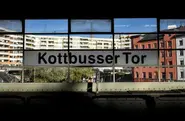
Berlin’s public transport operator, BVG, has launched a new pilot project, encouraging passengers to report cleanliness and maintenance issues at Kottbusser Tor station through WhatsApp.
The initiative is being tested exclusively at the Kreuzberg station, which BVG describes as an “innovation station” where new ideas for cleanliness, safety and customer service are trialled before a wider rollout.
By making it easier for passengers to report problems, the operator hopes to identify issues more quickly, speed up responses and improve the overall passenger experience.
How it works
Posters and stickers displayed around the station at Kottbusser Tor, often called 'Kotti' for short, contain a QR code that opens a WhatsApp chat. Passengers can also access the service directly via the number 030 25630100.
Users are guided through a reporting process and can submit observations ranging from litter and graffiti to vandalism and damaged facilities.
BVG chief executive Henrik Falk said the new channel is designed to make it as simple as possible for customers to alert the company to dirt, damage and other concerns.
The system can also be used to flag suspicious behaviour or situations that may require investigation.
But BVG stresses that the service is not an emergency hotline. In urgent situations, passengers should continue to use station emergency points or contact police via 110.
Why Kottbusser Tor?
Kottbusser Tor has become a testing ground for a range of new measures. Previous projects introduced there include cleaning patrols and smart camera detection technology, both of which have since become part of regular operations.
If the WhatsApp reporting channel proves effective, BVG says it could eventually be introduced at other stations.
Not everyone is convinced
News of the pilot has generated mixed reactions.
One commenter on broadcaster RBB’s website questioned whether the reporting system would actually lead to cleaner streets and stations. Pointing to experiences with Berlin’s Ordnungsamt Online platform, the commenter argued that reports are sometimes marked as “resolved” when they have merely been forwarded to another department, even though the underlying problem remains visible.
Others questioned whether residents should be expected to play an increasing role in identifying issues that public authorities are already responsible for addressing.
One commenter referenced BerlinPay, a separate pilot project launched earlier this year which rewards environmentally responsible behaviour, including participation in clean-up activities, with perks such as free drinks, discounted experiences and other incentives.
The focus on litter and public cleanliness comes as Berlin prepares for the state election on September 20th, with several parties highlighting the issue in their campaign messaging.
The Social Democrat Party (SPD) has unveiled slogans including “Playgrounds without syringes”, while Volt has adopted the tongue-in-cheek slogan Endlich eine Schmutz-Kampagne ("Finally a dirty campaign"), a play on words linking concerns about rubbish and street cleanliness with the idea of a political “dirty campaign”.