Hard numbers and gut feel: Lessons learned the hard way about the investor relationship

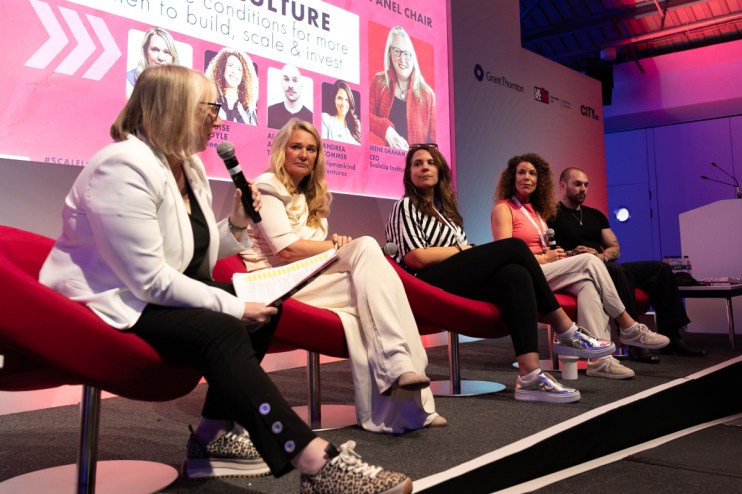
At SCALE SUMMIT on 22 April, Women Who Scale brought together a panel of female founders and investors for a frank discussion on capital, culture and the conditions needed to enable more women to build and scale.
The conversation went deep on what it actually feels like to raise money as a female founder. The near misses, the moments of being underestimated, and when to trust your instincts. Here are the key lessons, including what the investors backing women are really looking for.
The panel, chaired, by Irene Graham, CEO of The ScaleUp Institute, featured: Louise Doyle, co-founder and CEO of Needi, a corporate gifting concierge business now serving clients including Microsoft, Virgin and Spotify; Andrea Sommer, founder of Womankind Ventures, a global consultancy that works with female founders and the investors who back them; Albert Azis-Clauson, investor and founder of Tramlines; and Sam Smith, founder of The Super Scalers.
Read Sam’s fireside chat with Irene here.
Due diligence works both ways
Louise Doyle described a moment that nearly ended her company, Needi, before it had the chance to scale. Early in their fundraising journey, she and her co-founder Steph signed an exclusivity agreement with an investor without doing sufficient due diligence. “They made us sign a piece of paper that said we wouldn’t go to anyone else. And we nearly went under,” said Louise. But what followed was a lesson she’s carried ever since.
We took the positive. We went, do you know what, they’ve helped us understand what our value is, what we can raise, where we could go. And it made us really, really thoughtful about who our investors were afterwards. We had to find investors that shared that vision. And we kissed a lot of frogs.
For every investor Needi considers, Lou interviews six portfolio founders; three who have joined recently, three who have been with the investor for a long time. She doesn’t rely on the names the investor provides.
“I’ll take the recommendations, but I’m going to do my own digging, big time. I want to know how those people feel. What happened when things went wrong, what happened when they had a really tough time? What happened when they needed the follow on round. It’s really important to understand that.”
Founder Takeaway 1
Treat investor due diligence as seriously as investors treat theirs and think of it as a committed, long-term relationship. The time spent upfront finding out how an investor behaves under pressure is never wasted.
Transparency is not vulnerability
Louise was also advised, by multiple female VCs, not to disclose that she was pregnant with twins during her fundraising process. She was advised repeatedly that other investors would use it as a reason to back out.Against their advice, Louise was honest about her pregnancy anyway. “I just can’t hoodwink people that I’m then going to be in bed with for the next ten years, I was like, that’s not the relationship I want”, explained Louise.
If they are going to say no to me now they know I’ve got twins, they are not the people that I want to be with.
Louise’ experience connects directly to what Andrea sees as the single most important quality in any investor relationship: alignment.
“You will have disagreements. You’re not going to be aligned on everything. But ultimately, it’s your business that you need to run. So it’s about trying to bring them along on the journey.”
Founder Takeaway 2
If honesty about your circumstances causes an investor to hesitate, their hesitation sends a signal you should pay attention to.
Public markets will not be the right destination for every company, nor the immediate next step for many. But more founders are thinking earlier about the disciplines that public markets reward through the provision of long term capital and liquidity: clear and credible growth narratives, robust governance, and accountability. These are not simply IPO considerations – they are the foundations of strong, scalable businesses, whatever route a company ultimately takes.
What investors are actually looking for
At Womankind Ventures, Andrea works with female founders at every stage, and with the investors who back them. Her firm only invests in female founders. The single biggest thing she looks for in early stage companies isn’t revenue, team composition, or market size – it’s commercial rigour.
Andrea explained to the SCALE SUMMIT audience:
I want to see that the founder really understands their metrics. And even though some of the numbers may be based on assumptions that need to be validated, we want to see that the founder has thought through what those different levers are that can be pulled within the business
The logic is simple: if a founder hasn’t mapped the levers early, capital alone can’t accelerate growth later.
Louise’s experience of fundraising bears this out. The thing that made her pitch land with investors wasn’t the numbers themselves, but the story wrapped around them. “Half the battle is just getting across what your business does and where it’s going to go, in a way that somebody that’s never heard about your business can understand,” she said.
Founder takeaway 3
Know your numbers. But practice telling the story as well. Investors are comparing you to other companies solving the same problem, so you need to benchmark yourself against others in the same space, before they do.
The right people at the right stage
One of the most practical threads in the Capital Culture conversation at SCALE SUMMIT was around advisory boards: When to build them, who to put on them, and when to move people on.
Louise described the advisors who had made the biggest difference to Needi: not necessarily the most senior or best-connected people, but the most curious. “The ones that have really added value are the ones who can’t help themselves. They’ve messaged me at 2am because they’ve suddenly thought of something to do with Needi, and it sparked something.”
Albert Azis-Clauson, founder of Tramlines, pushed back on the idea of advisory boards altogether, preferring structured engagement over informal accumulation of advisors.
Everyone in this room can give good advice to somebody about something. If you listen to all of that good advice, you’ll be in an absolute mess.
His approach: create structured engagement plans with clear objectives and outputs instead.
Both agreed on one thing: as a business scales, the people around it need to be ready and willing to grow with it. If you don’t have the right people around you who can scale, replace them with people who can.
Founder takeaway 4
Review your advisory board as rigorously as your investor base. The people who were right for your last stage may not be right for your next one.
Sam Smith, founder of The SuperScalers, has spent 24 years raising money for growth companies. She offered the most direct warning.
Finding the wrong investor can create such a big problem for you that it’s imperative you spend the time finding the right one. It is better to probably have no investor than the wrong investor, and gut feel matters.
Andrea echoed it plainly: “They always say it’s harder to get rid of an investor than it is to get a divorce. And it is very true.”Albert’s closing thought cut to the simplest principle of all: “A pound of revenue is worth ten pounds of investment. Don’t take investment for its own sake.”
Albert’s closing thought cut to the simplest principle of all: “A pound of revenue is worth ten pounds of investment. Don’t take investment for its own sake.”
Founder takeaway 5
The right investor is one who shares your long-term vision, communicates in a way that makes you feel heard and understood, and who has a track record of sticking with founders under pressure. Don’t settle for less.