Skip to content
Tuesday 11 August 2026London --:--Frankfurt --:--Zurich --:--
NewslettersSearchEN · DE
MorningWire

European business, markets and politics

FTSE 100
10,844.19
-0.17%
DAX
26,391.42
+0.26%
CAC 40
8,714.94
-0.13%
STOXX 50
6,551.22
+0.24%
  • Europe
  • Markets
  • Business
  • Economy
  • Technology
  • Politics
  • Opinion
More
GermanyFranceBankingAIEnergyFintechPropertyCapital Markets
  • Germany
  • France
  • Europe
  • Markets
  • Business
  • Economy
  • Technology
  • Politics
  • Opinion
  • DE
Wednesday 24 July 2024 6:00 am  |  Updated:  Tuesday 23 July 2024 2:56 pm

How private equity lost its lustre


By: Elliot Gulliver-Needham

Add as a preferred source on Google
Private equity trusts are currently trading at a significant discount.

Private equity isn’t what it used to be.

The industry might be swelling to new heights, with literally trillions of pounds flowing into private equity houses, but returns in recent years have not reached the heights that investors might be used to.

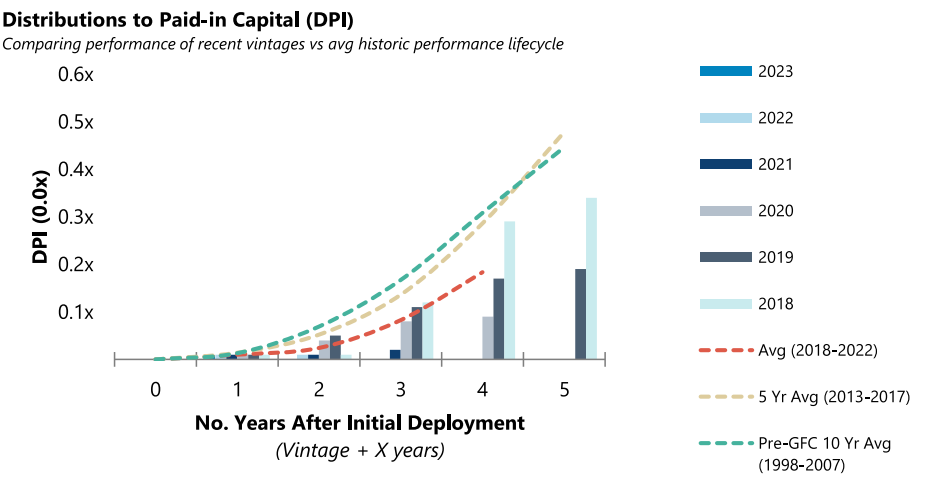
Private equity returns between 2018 to 2023 have been about a third lower than that of historical norms, new analysis from Wall Street giant Jefferies has found.

Using a comparison of private equity ‘vintages’, or the year when capital was first deployed in the fund, Jefferies analysts discovered that “distributions from recent vintages are significantly lagging historical averages”.

The analysts found this trend across all alternative asset managers, in sectors like real estate, infrastructure, and private credit, but it was “most acute” in private equity.

“This is likely the result of a higher-for-longer interest rate cycle that has weighed on value creation and kept bid-ask spreads wide, and in turn constrained monetisation activity,” the Jefferies analysts wrote.

With the IPO market floundering to a halt, it has been harder and harder for private equity houses to boost returns on their investment.

Dealmaking has also slowed, as funds increasingly sit on greater amounts of ‘dry powder’, or cash that hasn’t been deployed into investments.

Alternative assets, private credit

Across all alternative assets, private credit, which has seen disproportionate client demand over the last few years, has been most insulated from the drop-off, with payouts falling to around 85 per cent of historic norms.

The weaknesses in alternative assets have been noticeably mixed across recent years, as while funds that began deploying capital before the pandemic started off strong, they have struggled to match that performance since 2022 onwards.

Read more

FTSE 100 firm agrees £5.7bn takeover in latest private equity swoop

GettyImages 2211256637 showing a significant event or figure relevant to recent news updates in the business sector

In contrast, funds that began deploying capital in the last two years “are off to a weak start” across private equity, real estate, and infrastructure, Jefferies analysts found.

However, private credit performance is still doing better than most since the pandemic, with recent vintages “continuing to track above historic norms at this relatively early-stage”.

When analysing recent returns from private equity houses, Jefferies identified EQT as the strongest performer throughout Europe over the last ten years, followed by Apax and Intermediate Capital Group.

The analysts did stress that the historic average unrealised carrying values did indicate a potential “for distributions to normalise higher when the exit environment improves”.

“The potential improving realisation/capital market backdrop could still have a sizeable impact on the return profiles of various vintages,” they added.
It’s not just returns that are down. Across Europe, venture capital funding has fallen since the highs of 2021, from 32.3m euros in 2022, to 21.7m in 2023, to only 9.4m in the first half of 2024.

Deal activity is also severely depressed, falling by almost half in 2023 from 105m euros to just 60, and to only 28m in the first six months of this year.

The news comes after a recent paper that found private equity houses have been adjusting fund performance figures to smooth returns and increase their appeal to investors.

The paper, which was published in April, discovered that by shifting when returns were reported, funds were often avoiding having to report a loss.

The effect was especially large when a fund was raising money, but once a fund was closed for investment, the effect vanished.

Read more

Grant Thornton partners pocket £35m from private equity deal

Grant Thornton building exterior with illuminated logo and name against a dramatic pink and purple sky at dusk.

Share this article

  • Facebook
  • X
  • LinkedIn
  • WhatsApp
  • Email

Similarly tagged content:

Sections

  • News

Categories

  • Business

People & Organisations

  • Jefferies
  • Private credit
  • private equity

Related Topics

  • Private equity

Trending Articles

  • Five-star Mayfair hotel hit with HMRC winding-up petition

  • Nottingham Forest owner Marinakis sues Crystal Palace for defamation

  • Back to basics: Sainsbury’s gradual retreat from the British high street

  • Hargreaves Lansdown orders staff back to office

  • As it happened: Intel, Arm shares slide; Oil climbs higher

More from Morning Wire

  • FTSE 100 firm agrees £5.7bn takeover in latest private equity swoop

    Markets
    GettyImages 2211256637 showing a significant event or figure relevant to recent news updates in the business sector
  • Grant Thornton partners pocket £35m from private equity deal

    Prof Services
    Grant Thornton building exterior with illuminated logo and name against a dramatic pink and purple sky at dusk.
  • ‘We are going to run out’: Mitie marks eleventh mega takeover of 2026

    Markets
    The FTSE 100 enjoyed a 3-year record rally in the third quarter.
  • ‘You can blame us’: The firm that sparked accountancy private equity gold rush

    Accountancy
    On the hunt for lost savings
  • Mark Kleinman: Well runs dry for Thames Water creditors

    Business
    Mark Kleinman is Sky News' City Editor and writes a column for Morning Wire
  • Grant Thornton set for $5bn CBIZ buyout in landmark accountancy deal

    Accountancy
    Grant Thornton office building exterior at dusk with illuminated logo and windows, purple sky.
  • Clifford Chance partners pocket £2.3m as private markets drive growth

    Law
    Silhouetted person walks past a modern building with 10 Upper Bank Street visible on its glass facade at night.
  • Swiss Pension Funds Increase Commitments to Record Infrastructure Equity Fund to EUR 1.23 Billion

    Business Wire
MorningWire

Independent European business, markets and political news for decision-makers.

Morning Briefing

Europe

  • Germany
  • France
  • Europe
  • UK & Ireland

Business

  • Markets
  • Banking
  • Technology
  • Energy
  • Property
  • Fintech

Editorial

  • Opinion
  • Editorial Policy
  • Corrections
  • Contact

Company

  • About Morning Wire
  • Privacy Policy
  • Terms of Use
  • Cookie Policy
© 2026 Morning Wire Ltd · Published by Morning Wire Media, Bahnhofstrasse 65, 8001 Zürich, Switzerland
Privacy · Terms · Cookies · Facebook