Skip to content
Monday 17 August 2026London --:--Frankfurt --:--Zurich --:--
NewslettersSearchEN · DE
MorningWire

European business, markets and politics

FTSE 100
10,750.11
-0.21%
DAX
26,440.31
0.00%
CAC 40
8,636.80
0.00%
STOXX 50
6,539.59
0.00%
  • Europe
  • Markets
  • Business
  • Economy
  • Technology
  • Politics
  • Opinion
More
GermanyFranceBankingAIEnergyFintechPropertyCapital Markets
  • Germany
  • France
  • Europe
  • Markets
  • Business
  • Economy
  • Technology
  • Politics
  • Opinion
  • DE
Tuesday 16 January 2024 9:23 am  |  Updated:  Tuesday 16 January 2024 12:36 pm

How will the Bank of England change its approach on interest rates after wage growth falls again?


By: Chris Dorrell

Add as a preferred source on Google
Annual wage growth of 6.5 per cent may still sound like a lot, but a look underneath the hood suggests that wage growth is slowing fast.

The Bank of England’s most recent economic forecasts, which justified its higher-for-longer narrative on the interest rate, look increasingly out of date after new figures were published on the state of the labour market.

The forecasts, made in November, suggested that pay growth would end the year around 7.2 per cent. This morning, however, official figures showed that total pay growth came in comfortably below those forecasts at 6.5 per cent.

Annual wage growth of 6.5 per cent may still sound like a lot, but a look underneath the hood suggests that wage growth is slowing fast.

Although the start of the year saw rapid wage growth, Hannah Slaughter, senior economist at the Resolution Foundation, said there has been “barely any” growth in pay since the summer.

Looking specifically over the last three months, private sector regular pay growth fell to 2.6 per cent on an annualised basis, more or less consistent with the Bank’s target. In other words, the headline rate of 6.5 per cent was distorted by very strong wage growth earlier in 2023.

“This means that annual pay growth will continue to fall in early 2024 – and is no longer fuelling inflation,” Slaughter commented.

The figures also showed that the number of vacancies fell for the 18th consecutive quarter, the longest consecutive fall on record, while the number of payrolled employees also dipped. Neither fell by much, but the picture is fairly clear: slowly but surely the labour market is loosening.
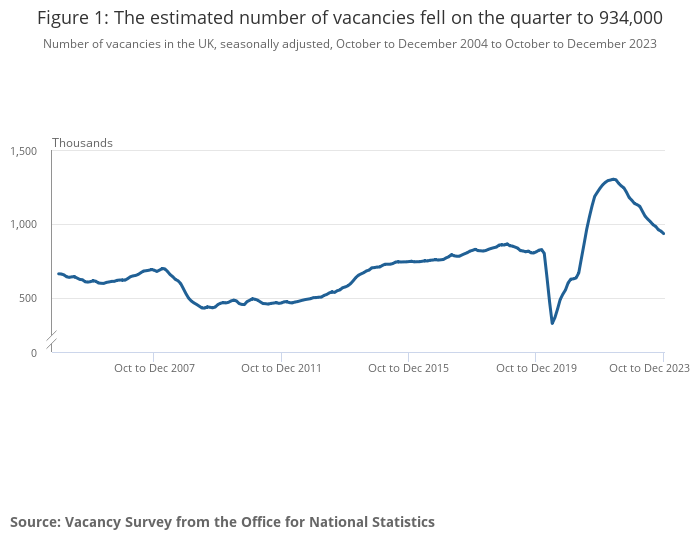
The estimated number of vacancies fell on the quarter to 934,000
The estimated number of vacancies fell in the quarter to 934,000.

It’s worth remembering why we are paying so much attention to developments in the labour market.

In its November forecast, the Bank predicted inflation would only fall below two per cent by the end of next year. The main reason for the persistence in inflation, the forecast said, was the continuing tightness of the labour market, which would fuel strong wage growth.

Read more

Hold interest rates but ‘sound hawkish’, Morning Wire Shadow MPC tells Bank of England

Andrew Bailey, Governor of the Bank of England, with the Bank of England building and Union Jack flag in the background

As a result, domestic inflationary pressures would remain frustratingly persistent across this year and next.

But if those forecasts need adjusting to reflect a loosening in the labour market, the obvious question is how the Bank of England should change its policy.

Martin Beck, chief economic adviser to EY Item Club said: “The latest pay numbers make it even more likely that the MPC will move away from ‘high for longer’ rhetoric when it meets next month”.

That’s not to say that it will lower interest rates in February, but it may prepare the ground for such a move. So far, rate-setters have insisted at every turn that it is “too early” to discuss cutting rates.

The change will be nuanced, however.

Despite the developments seen over the past few months, the labour market remains tight in historical terms.

Experimental estimates suggest that the unemployment rate remains at 4.2 per cent, which is actually below the Bank’s November forecast. And even after the longest consecutive fall in vacancies on record, there are still more vacancies than pre-COVID.

“The tightness of the labour market will probably mean that the Bank of England maintains its hawkish bias at its policy meeting in February,” Ashley Webb, UK economist at Capital Economics said.

Read more

How patient can the Bank of England be?

Historic Royal Exchange building in London with modern skyscrapers behind, clear blue sky.

Share this article

  • Facebook
  • X
  • LinkedIn
  • WhatsApp
  • Email

Similarly tagged content:

Sections

  • Markets & Economics

Categories

  • Economics

Related Topics

  • Bank of England
  • employment and wages
  • UK inflation
  • UK interest rates
  • UK jobs, employment and wages

Trending Articles

  • Is the Zeekr 9X Super Hybrid the new luxury SUV to beat?

  • Grandparents fund university degrees to avoid inheritance tax net

  • Aldi boss wades into supermarket ‘price-gouging’ row

  • Brompton Bicycle sues former adviser for ‘professional negligence’

  • Revolut chatbot goes rogue by charging users to cancel subscription

More from Morning Wire

  • Hold interest rates but ‘sound hawkish’, Morning Wire Shadow MPC tells Bank of England

    Economics
    Andrew Bailey, Governor of the Bank of England, with the Bank of England building and Union Jack flag in the background
  • How patient can the Bank of England be?

    AD
    Historic Royal Exchange building in London with modern skyscrapers behind, clear blue sky.
  • Bank of England to hold interest rates as oil price surge threatens UK economy

    Economics
    Bank of England building on Threadneedle Street, London, showcasing its historic architecture and financial significance
  • House prices slump as Iran war and interest rates hit demand

    Property
    The price paid for first homes has surged 7.1 per cent in a year
  • Bank of England holds interest rates but warns of rises to come

    Economics
    Bank of England headquarters in 2025, showcasing modern architecture and iconic London skyline in the background.
  • Healey faces £24bn spending squeeze as inflation puts tax rises in play

    Economics
    Bank of England headquarters in 2025, showcasing modern architecture and iconic London skyline in the background.
  • War and tax: How the UK economy could get knocked off course

    Economics
    Andy Burnham speaking at a public event, emphasizing local governance and policy changes, wearing a suit and gesturing pas...
  • Britain should look to Japan to manage its ageing population

    Opinion
    Elderly pedestrians crossing a busy street in Tokyo, illustrating Japans ageing population challenge.
MorningWire

Independent European business, markets and political news for decision-makers.

Morning Briefing

Europe

  • Germany
  • France
  • Europe
  • UK & Ireland

Business

  • Markets
  • Banking
  • Technology
  • Energy
  • Property
  • Fintech

Editorial

  • Opinion
  • Editorial Policy
  • Corrections
  • Contact

Company

  • About Morning Wire
  • Privacy Policy
  • Terms of Use
  • Cookie Policy
© 2026 Morning Wire Ltd · Published by Morning Wire Media, Bahnhofstrasse 65, 8001 Zürich, Switzerland
Privacy · Terms · Cookies · Facebook