Skip to content
Monday 10 August 2026London --:--Frankfurt --:--Zurich --:--
NewslettersSearchEN · DE
MorningWire

European business, markets and politics

FTSE 100
10,873.29
-0.26%
DAX
26,434.77
+0.44%
CAC 40
8,717.98
+0.03%
STOXX 50
6,550.67
+0.41%
  • Europe
  • Markets
  • Business
  • Economy
  • Technology
  • Politics
  • Opinion
More
GermanyFranceBankingAIEnergyFintechPropertyCapital Markets
  • Germany
  • France
  • Europe
  • Markets
  • Business
  • Economy
  • Technology
  • Politics
  • Opinion
  • DE
Thursday 28 May 2015 5:18 am

Humans will be at the mercy of US killer robots in a matter of years, scientist warns

By: Sarah Spickernell

Add as a preferred source on Google

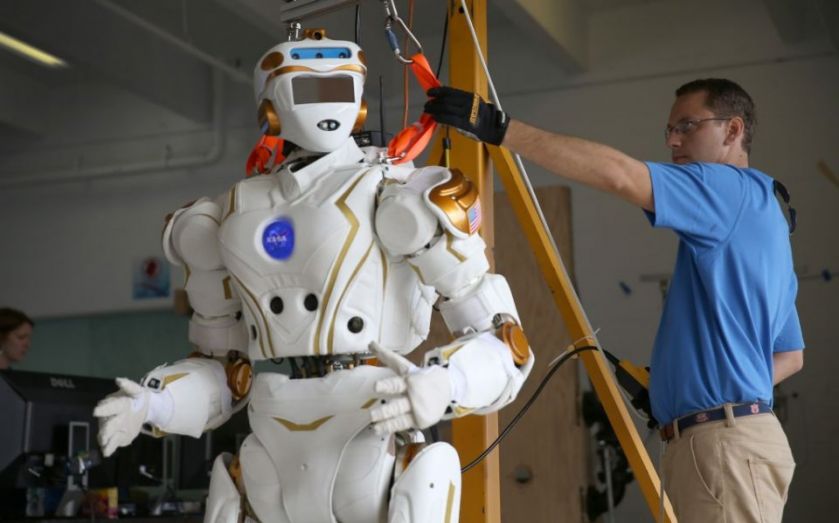
There's no escape – robots capable of killing people without human intervention are on their way, and we will be utterly defenceless against them. 

This is the warning issued by Stuart Russell, an Artificial Intelligence (AI) professor at the University of California, Berkley. He says the US military is currently developing robots called Lethal Autonomous Weapons Systems (LAWS), and these could be in full operation in just a few years. 
 
“The AI and robotics communities face an important ethical decision: whether to support or oppose the development of LAWS,” he writes in Nature. 
 
LAWS are considered to be the “third revolution” in warfare, even more dangerous than gunpowder and nuclear arms. There are clear benefits to using them – it means machines, rather than human beings, can be placed on the front line. But while some lives are saved by this method, many more will be put at serious risk.  
 
“Autonomous weapons systems select and engage targets without human intervention; they become lethal when those targets include humans,” Russell continues. 
 
At the moment, the US military is working on two LAWS projects. The first is the Fast Lightweight Autonomy (FLA), and this will involve programming tiny rotorcraft to move around unaided at high speed in urban areas and inside buildings.  The other,  Collaborative Operations in Denied Environment (CODE), will see teams of autonomous aerial vehicles carrying out “all steps of a strike mission – find, fix, track, target, engage, assess”. 
 
But it's not just the US that's working to develop these machines – the UK and Israel are also developing their own LAWS, and other countries may well be pursuing projects in secret. 

Protecting humans

The prospect of autonomous robots has attracted a lot of attention from world leaders. It was one of the topics discussed at Davos at the start of the year, and last month the UN held a conference in Geneva to discuss their future in combat.
 
Questions left to be answered include whether robots should be banned, and if not, the extent to which human control is necessary. Michael Møller, a top UN official, said the world has the opportunity to take “pre-emptive action” and ensure the “ultimate decision to end life remains firmly under human control”. 
 
So how, legally, could they be stopped? International humanitarian law, which governs attacks on humans in times of war, has no provisions for robot autonomy. But the UN has the potential to limit of ban these weapons under the Convention on Certain Conventional Weapons. 
 
If an international treaty is put in place within the next few years, as happened with blinding laser weapons 1995, we may have a lot less reason to worry about terrifying robots taking our lives.

Share this article

  • Facebook
  • X
  • LinkedIn
  • WhatsApp
  • Email

Similarly tagged content:

Sections

  • News

Categories

  • Tech

Related Topics

  • Artificial intelligence (AI) and robots

Trending Articles

  • Back to basics: Sainsbury’s gradual retreat from the British high street

  • Thames Water faces fresh threat to survival after pensions regulation breach

  • Hargreaves Lansdown orders staff back to office

  • FTSE 100 Live: Stocks drop as US-Iran peace stalls; Oil climbs higher

  • PwC’s Embankment HQ to get major makeover ahead of Canary Wharf move

More from Morning Wire

  • UMA Unveils Its Vision for the Next Generation of Humanoid Robots

    Business Wire
  • Exclusive: Top FTSE executive recruiter goes bust after AI platform launch

    Business
    Consultancy sector and AI
  • Vodafone pushes into legal tech market to co-develop AI platform

    Legal
    Vodafone Group has announced the appointment of Microsoft's Pilar López as its new chief financial officer.
  • Top investors managing $3tn to gain access to UK infrastructure projects via AI platform

    Investing
    INPP have invested in four new infrastructure firms in the first half of this year
  • The best weapon against AI slop is a good lunch

    Opinion
    Pub in Leadenhall Market, London
  • Apple sues Open AI accusing them of stealing ‘trade secrets’

    Tech
  • There’s a 45 per cent chance this op-ed was written by AI

    Opinion
    Vintage 1960s typing gloves, showcasing retro office fashion and ergonomic design for typewriter use
  • Let the machines do the grunt work, so that we can do the great work

    Opinion
    Advanced AI robots collaborating in a tech workspace, showcasing cutting-edge technology innovations in robotics
MorningWire

Independent European business, markets and political news for decision-makers.

Morning Briefing

Europe

  • Germany
  • France
  • Europe
  • UK & Ireland

Business

  • Markets
  • Banking
  • Technology
  • Energy
  • Property
  • Fintech

Editorial

  • Opinion
  • Editorial Policy
  • Corrections
  • Contact

Company

  • About Morning Wire
  • Privacy Policy
  • Terms of Use
  • Cookie Policy
© 2026 Morning Wire Ltd · Published by Morning Wire Media, Bahnhofstrasse 65, 8001 Zürich, Switzerland
Privacy · Terms · Cookies · Facebook