Hunt’s misguided fiscal rules risk holding back UK growth

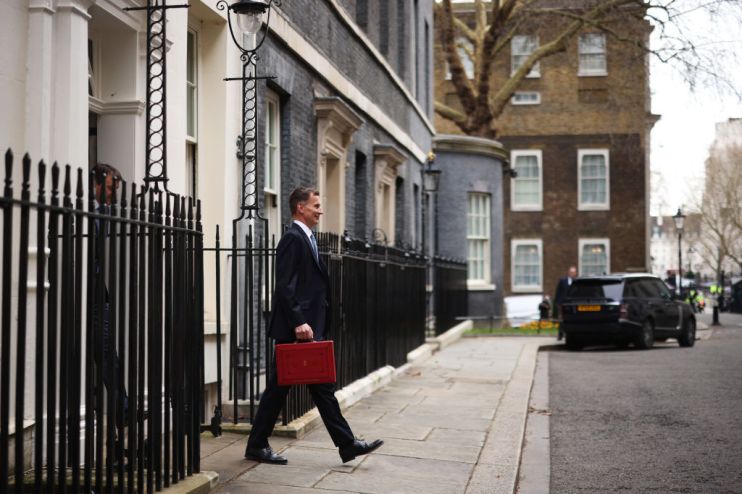
With the Spring Budget fast approaching, the Chancellor is engaging in a dizzying array of financial gymnastics to meet his fiscal rules.
The most important of Jeremy Hunt‘s current set of self-imposed fiscal rules, which restrict the government’s tax and spending policies, is that national debt must be forecast to fall as a share of GDP in the fifth year of the Office for Budget Responsibility‘s (OBR) projections.
Forecast is the key word in this rule, since debt never has to actually fall. In fact debt can be significantly higher across the forecasts so long as it is expected to be falling in the fifth year. Richard Hughes, chair of the OBR, described it as a “mañana” rule.
There’s another absurdity that has attracted a lot of attention in recent months: the government does not actually have any specific spending plans for after the next general election. We know that some departments will face deep cuts in real terms to ensure debt ends up falling, but there is no detail about where the axe will fall.
Now this is nothing new, but it’s hardly a good basis for policy. Olly Bartrum at the Institute for Government said the current set-up means the government can effectively meet its fiscal rules “just by saying that it will, without setting out how”.
And even then, Hunt is only just succeeding in meeting his target. In November, Hunt had headroom of £13bn, 0.4 per cent of GDP. This time around he may have less than £10bn depending on the scope of tax cuts announced on Wednesday, which is a rounding error when it comes to forecasting the performance of a £3.1trn economy over the next five years.
Indeed, over the first two months of 2024, changing interest rate expectations looked set to give the Chancellor a £10bn windfall before markets changed their mind and quickly took it all back again.
To summarise: The rule is forcing Hunt to set tax and spending decisions today on the basis of highly uncertain forecasts that involve future spending plans, which have been described as “worse than fiction”.
Despite the obvious absurdity of this set-up, fiscal rules should not be abandoned entirely.
Most economists agree that the rationale behind fiscal rules is sensible. In short, markets need to have confidence that the government can pay its debts and fiscal rules can provide this. There is some evidence to suggest that fiscal rules can help to reduce the cost of borrowing.
There is also no such thing as a perfect fiscal rule. The underlying principle can be both reasonable and vague. Making it more specific inevitably makes it susceptible to gaming, when a Chancellor meets the letter of the law but not the spirit.
The most important point is ensuring that the fiscal rules do not disincentivise policies that would actually improve the economy.
This is particularly the case when it comes to long-term investment in the UK, which already lags behind other advanced economies. The UK is starting to feel the effects, with NHS waiting lists at record levels, local councils going bust and huge backlogs in the justice system.
However, Hunt’s determination to stick to the letter of the rule will prevent meaningful action from being taken in any of these areas, as he has been forced to freeze capital investment in cash terms over the next five years to ensure the maths adds up.
Worse, Labour’s Rachel Reeves has already stressed her determination to stick to exactly the same set of fiscal rules. This helps explain why the opposition has watered down its own investment plans.
Previous fiscal rules have focused more on day-to-day spending, and not constrained important structural investment. This raises an important point: supposed fiscal prudence should not stand in the way of economic necessity.
Hunt should radically reform this debt rule if he really cares about getting the UK economy growing again.