Skip to content
Sunday 23 August 2026London --:--Frankfurt --:--Zurich --:--
NewslettersSearchEN · DE · FR
MorningWire

European business, markets and politics

FTSE 100
10,816.56
+0.64%
DAX
26,136.56
+0.59%
CAC 40
8,484.43
+0.37%
STOXX 50
6,462.22
+0.63%
  • Europe
  • Markets
  • Business
  • Economy
  • Regulation
  • Politics
  • Opinion
More
GermanyFranceEU InstitutionsCompetitionPublic AffairsBankingTechnologyEnergy
  • Germany
  • France
  • Europe
  • Markets
  • Business
  • Economy
  • Regulation
  • Politics
  • Opinion
  • DE
Monday 08 April 2024 11:00 am  |  Updated:  Monday 08 April 2024 11:36 am

IMF warns central banks should be wary of leaving interest rates on hold for too long


By: Chris Dorrell

Add as a preferred source on Google
In a chapter from its latest World Economic Outlook, the IMF noted that different economies have experienced different effects from higher interest rates.

Central banks, including the Bank of England, should be wary of leaving interest rates on hold for too long and risk putting households under unnecessary strain, the International Monetary Fund (IMF) warned today.

In a chapter from its latest World Economic Outlook, the IMF noted that different economies have experienced different effects from higher interest rates.

In general, global growth has performed much better than economists expected at the start of the tightening cycle. This reflects a number of factors in the housing market, including the supply of housing and the level of household debt.

However, the most important factor is the prevalence of fixed-rate mortgages.

“Monetary policy has greater effects on activity in countries where the share of fixed-rate mortgages is low,” the Washington-based institution said.

In the UK, the proportion of mortgagors who are on fixed-rate mortgages in the UK has risen from under 30 per cent in the early 2000s to around 85 per cent.
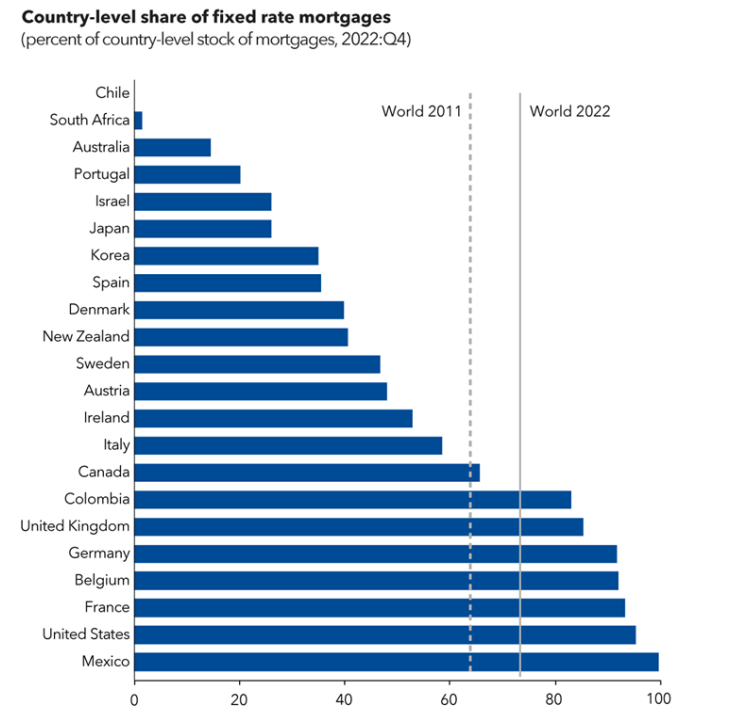
Source: IMF

The length of time people are deciding to fix their mortgages has also gotten longer, both of which help to explain why the drag from higher interest rates has been less pronounced than many economists feared.

But the IMF warned that there were still dangers for central banks. “Over-tightening, or leaving rates higher for longer, could nevertheless be a greater risk now,” it said.

“The longer time rates are kept high, the greater the likelihood that households will feel the pinch, even where they have so far been relatively sheltered”.

At the end of last year in the UK, around 45 per cent of fixed-rate mortgage deals agreed pre-2021 were yet to renew.

Although lower interest rates mean they will not face the same shock as those refinancing a year ago, they will still face a sizeable jump in their mortgage costs.

“Over time, and as rates on these mortgages reset, monetary policy transmission could suddenly become more effective and so depress consumption, especially where households are heavily indebted,” the IMF warned.

Read more

Grandparents fund university degrees to avoid inheritance tax net

GettyImages 452181854 showing a business conference with diverse professionals engaged in a panel discussion.

Share this article

  • Facebook
  • X
  • LinkedIn
  • WhatsApp
  • Email

Similarly tagged content:

Sections

  • Markets & Economics

Categories

  • Economics

People & Organisations

  • Bank of Engalnd
  • IMF

Related Topics

  • Bank of England
  • mortgage
  • mortgage rates
  • UK interest rates

Trending Articles

  • Can debt-ridden Morrisons become a Big Four supermarket again?

  • Ratcliffe’s Ineos saves Runcorn plant

  • Mike Ashley’s Frasers offers to pay personal shoppers in Harvey Nichols takeover

  • Amazon says it buys books in bulk to ‘improve products’

  • Burnham predicted to raise taxes for ‘fundamental’ cost of living support

More from Morning Wire

  • Grandparents fund university degrees to avoid inheritance tax net

    Personal Finance
    GettyImages 452181854 showing a business conference with diverse professionals engaged in a panel discussion.
  • Inflation leaps to 2.9 per cent in blow to Burnham 

    Economics
    Burnham cityscape showcasing modern architecture, bustling streets, and vibrant community life in a thriving urban setting
  • How patient can the Bank of England be?

    AD
    Historic Royal Exchange building in London with modern skyscrapers behind, clear blue sky.
  • Algoma Central Corporation Reports Financial Results for the 2026 Second Quarter

    Business Wire
  • Starling plans to ‘come out swinging’ in diversification bid

    Fintech
    Smiling woman, potentially Starling CEO, over city skyline with STARLING branding
  • The European fintech American dream is being called into question

    Fintech
    Wise logo with downward trending stock chart, highlighting fintechs share decline amid Belgium fraud investigation
  • Public sector makes wage growth higher than expected

    Economics
    London has defied national trends as job postings in the capital rose.
  • Metro Bank profit jumps as it bucks branch closure trend

    Banking
    Metro Bank logo on a blue sign above a modern building entrance with reflective windows
MorningWire

Independent European business, markets and political news for decision-makers.

Morning Briefing

Europe

  • Germany
  • France
  • EU Institutions
  • Europe

Business

  • Markets
  • Business
  • Economy
  • Regulation
  • Competition
  • Public Affairs

Editorial

  • Opinion
  • Editorial Policy
  • Corrections
  • Contact

Company

  • About Morning Wire
  • Privacy Policy
  • Terms of Use
  • Cookie Policy
© 2026 Morning Wire Ltd · Published by Morning Wire Media, Bahnhofstrasse 65, 8001 Zürich, Switzerland
Privacy · Terms · Cookies · Facebook